You open a trade on a major exchange with billions in daily volume. The order book looks deep. And yet, the price you get is worse than the one you clicked. This is slippage, and it happens even in highly liquid markets.
Understanding why requires looking beyond the headline volume numbers and into the actual structure of the order book.
Order book depth and liquidity are not the same thing, and treating them as if they are is one of the most expensive mistakes an active trader can make.
What is an order book?
An order book is a real-time list of all outstanding buy orders (bids) and sell orders (asks) for an asset at a given exchange. Each order is listed at a specific price and quantity. When a buyer's price matches a seller's price, the trade executes.
The order book is the live record of supply and demand at every price level. Reading it correctly tells you not just what price you can buy or sell at, but how much you can buy or sell at that price before the market moves against you.
What is order book depth?
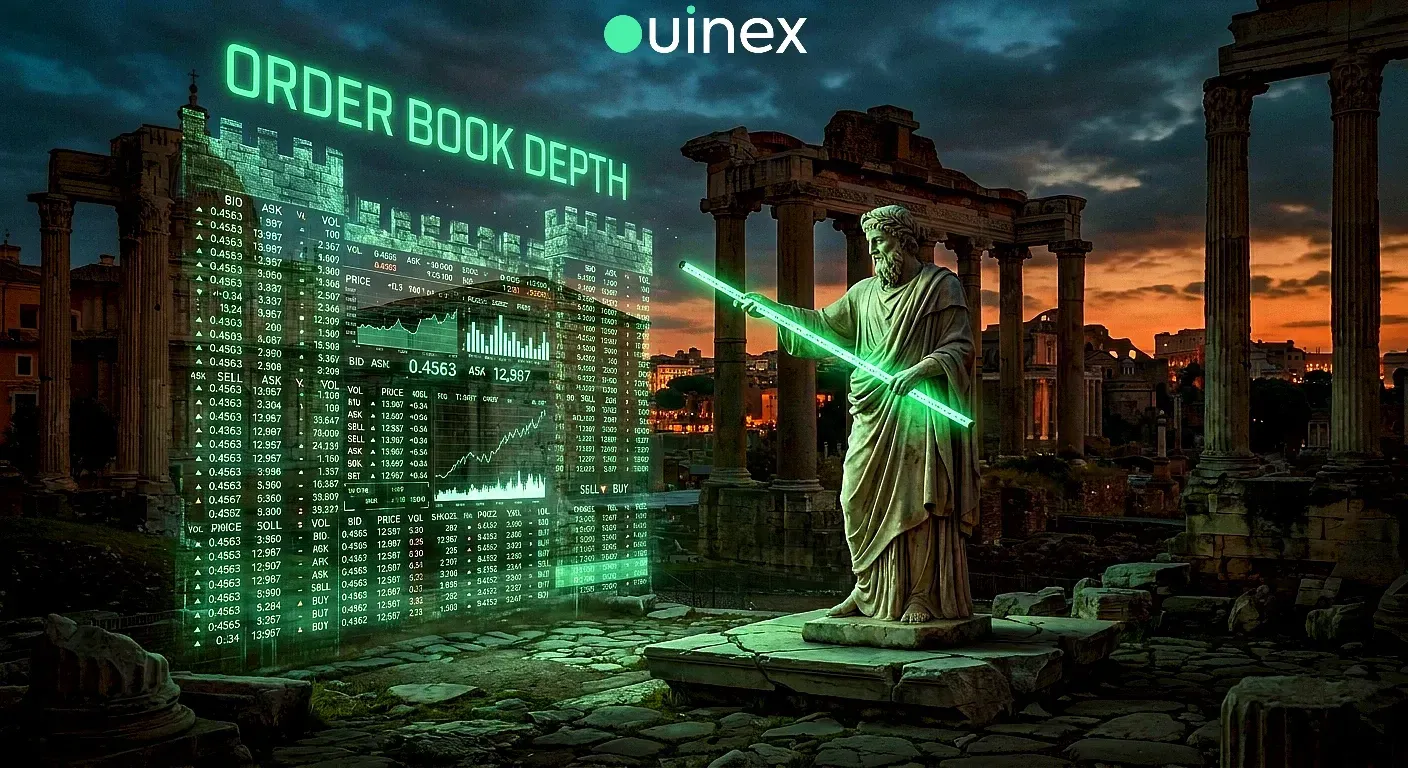
"Depth" refers to how many orders sit at each price level, and how far from the current price those orders extend. A deep order book has large volumes of buy and sell orders stacked across many price levels. A shallow order book has thin orders that run out quickly.
| Shallow order book | Deep order book |
Liquidity | Low / few orders at each level | High / many orders at each level
|
Slippage | High / large orders move price significantly | Lower / but NOT zero |
Spread | Wide bid-ask spread | Tighter bid-ask spread |
Large order impact | Severe / moves market quickly | Moderate / but still present |
Manipulation risk | Higher / easier to move price | Lower / but institutions still exploit it |
The CLOB structure directly determines what depth looks like in practice. On a CLOB, every bid and ask is visible at a specific price. The depth chart shows you the cumulative volume available at every level up and down from the current price.
What is slippage and why does it happen?
Slippage is the difference between the price you expected to pay when placing an order and the price you actually received when it was executed. It is not a fee, it is a structural cost of trading in markets where your order size exceeds the available liquidity at your target price.
When you place a market order to buy, your order fills against the existing sell orders in the book. If the order book only has 1 BTC available at $50,000, and you want to buy 5 BTC, your order will also consume the sell orders at $50,010, $50,025, $50,040, and so on, whatever it takes to fill the full quantity. Your average fill price ends up higher than the price you clicked.
The thinner the order book at each level, the more levels your order consumes, and the worse your average price becomes. This is slippage.
Why you're still getting slipped even on deep liquidity exchanges
key insight: A deep order book does not guarantee low slippage for retail traders. Institutional players with faster tools actively exploit the order book in ways that consistently disadvantage retail execution.
Here is what actually happens on most major exchanges:
- Quote stuffing
Institutions flood the order book with orders they never intend to fill, creating the appearance of depth. When a retail trader's order approaches, those orders are cancelled in microseconds, and the real liquidity is thinner than it appeared.
- Latency arbitrage
Co-located servers operating at nanosecond speeds can see your incoming order before it executes and adjust their quotes accordingly. By the time your order fills, the price has already moved.
- Spoofing
Large fake orders are placed on one side of the book to move price in the desired direction, then cancelled once the target is reached. The depth you saw when you decided to trade was not the depth that was there when you executed.
- Non-linear depth structure
Order book depth does not scale linearly with distance from the mid-price. Analysis shows a two-phase pattern: liquidity accelerates through the first 25 basis points, then progressively thins. Large orders cannot consume depth evenly, they pay a disproportionate cost as they go deeper.
The result: a $5 million market order on an exchange showing apparently deep liquidity can incur $25,000 or more in slippage. The depth was there on the screen. But it was not there when it mattered.
How liquidity depth affects perpetual pricing and arbitrage
Liquidity depth is not only relevant to spot trading. In perpetual futures markets, the bid-ask spread and order book depth directly affect the viability of strategies like funding rate arbitrage.
A funding rate arbitrage trade requires entering both a spot long and a perpetual short simultaneously. If either leg suffers significant slippage on entry, the spread cost can eat the entire funding rate being collected.
This is why professional arbitrageurs obsess over execution quality, not just the headline funding rate. A 0.015% per-period funding rate that looks attractive on paper disappears quickly if entry and exit slippage costs 0.05% per round trip.
How to trade with this knowledge
Understanding order book depth realistically changes how you approach trade execution:
- Use limit orders instead of market orders wherever possible: A limit order specifies the price you are willing to pay, preventing your order from consuming multiple levels of the book uncontrollably.
- Size positions to match available liquidity: If the top of the book has 2 BTC at your target price, a 10 BTC market order will not fill at that price. Adjust size or use algorithmic order splitting.
- Check order book depth before entry, not during: Depth charts can change in milliseconds. Build your view before committing, and account for the depth thinning out beyond the first few levels.
- Avoid market orders during high volatility: During news events or liquidation cascades, order book depth evaporates rapidly. The spread widens and slippage escalates. Limit orders with a price ceiling protect you.
When you need to trade with deep liquidity on derivatives, across crypto, commodities, and indices, the quality of execution depends on the transparency and real depth of the order book, not just its headline size. Platforms with genuine CLOB execution and visible order books give you the information needed to execute with confidence.
Other questions You Might Ask
What is order book depth in crypto?
Order book depth refers to the volume of buy and sell orders available at different price levels on an exchange. A deep order book means there are large quantities of orders stacked across many price levels, giving large trades more liquidity to fill against.
Why do I still get slippage on exchanges with deep liquidity?
Deep order books are regularly exploited by institutional traders using quote stuffing, latency arbitrage, and spoofing. These tactics create the appearance of depth that disappears before retail orders execute. Additionally, order book depth thins non-linearly, large orders face disproportionately worse pricing as they consume deeper levels.
What is slippage in crypto trading?
Slippage is the difference between the price you expected to trade at and the price you actually received. It occurs when your order size exceeds the available liquidity at your target price, forcing your order to fill at progressively worse price levels.
How do I reduce slippage when trading?
Use limit orders instead of market orders, size positions relative to available depth at the price level you want, avoid market orders during high volatility, and choose exchanges that provide transparent, real order book depth rather than displayed depth that evaporates on execution.
What is the difference between liquidity and order book depth?
Liquidity refers to how easily an asset can be bought or sold without significantly affecting its price. Order book depth is one measure of liquidity — specifically, how many orders are stacked at each price level. High reported depth does not always translate to high actual liquidity if those orders are fake or cancel before execution.
Trade with real depth
Access crypto and cross-asset derivatives with transparent and safe order book execution.
View real-time bid and ask depth on Ouinex before you commit to any trade.