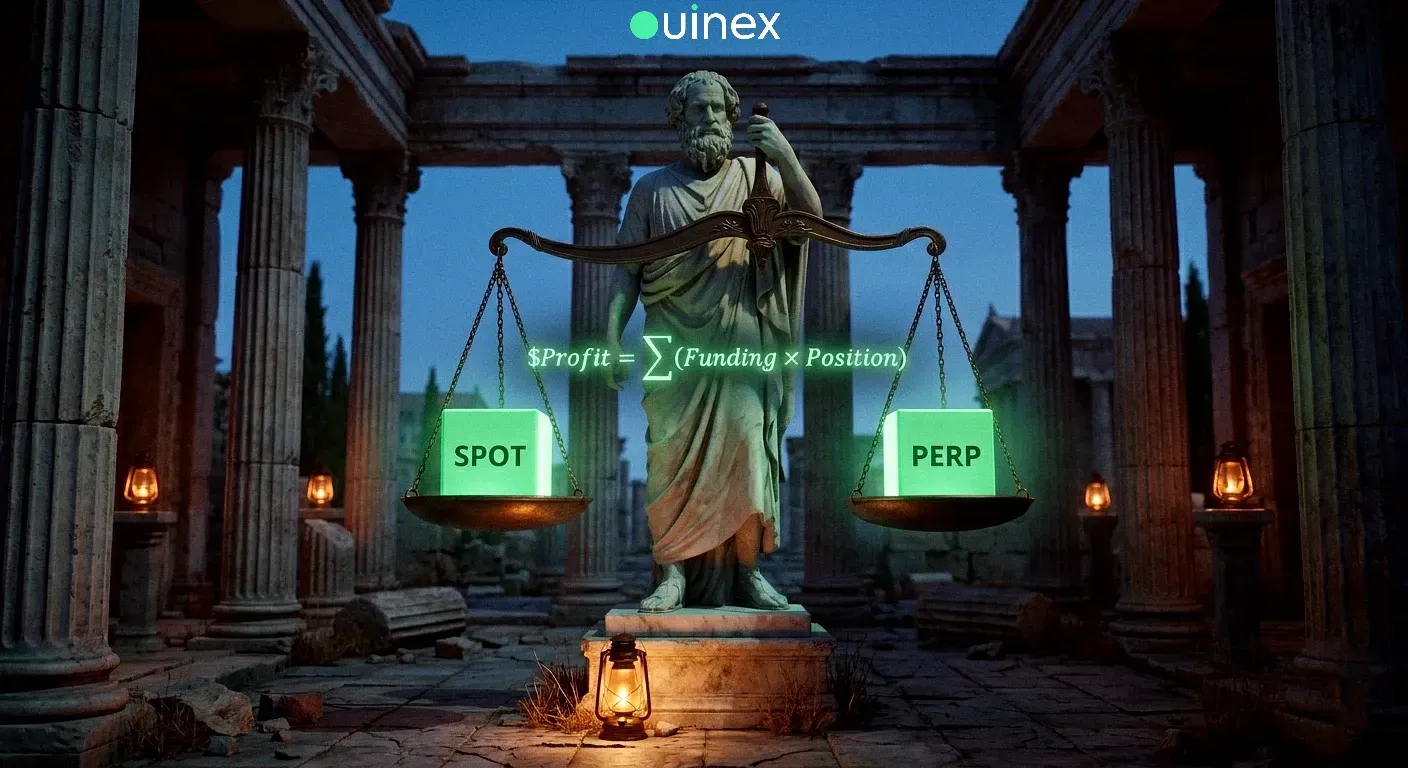
Funding rate arbitrage is a market-neutral strategy that lets traders collect recurring funding payments from perpetual swap markets without taking directional risk on price.
Instead of betting on whether Bitcoin goes up or down, you hold both a long spot position and a short perpetual position simultaneously, and collect the funding fee paid between the two sides every eight hours. When executed well, the strategy generates consistent returns regardless of market direction.
What is The funding rate?
A funding rate is a recurring cash transfer between long and short traders on a perpetual swap contract. Unlike traditional futures, perpetual contracts have no expiry date, so exchanges use the funding rate as a mechanism to keep the contract price anchored close to the underlying spot price.
When the funding rate is positive, long traders pay short traders. When it is negative, short traders pay long traders. The rate typically updates every eight hours and reflects the gap between the perpetual price and the spot price.
In practice, funding rates are positive the vast majority of the time, reflecting the persistent demand for leveraged long exposure in crypto markets. This consistent positive rate is exactly what funding rate arbitrage exploits.
How funding rate arbitrage works
The core mechanics of the strategy are straightforward:
Buy the asset on the spot market (long spot position).
- Simultaneously short the same asset on the perpetual contracts market.
- Hold both positions. Every eight hours, the funding payment from longs is paid to your short position.
- Your long spot position offsets any price movement; you are market neutral and do not need to predict direction.
- Close both positions when the funding rate drops or you have collected your target return.
At an average funding rate of 0.015% per eight-hour period, this compounds to approximately 19% annualised on the capital deployed. Higher funding rate environments can push this significantly higher.
Why execution quality and order book liquidity matter
Funding rate arbitrage is sensitive to execution. Even a small amount of slippage on entry or exit can erode the funding rate income you are trying to capture. This is why order book liquidity is one of the most important factors when choosing where to run the strategy.
In thin markets, the bid-ask spread alone can cost more than a single funding payment. When the spread on entry and exit combined exceeds the rate you are collecting, the trade is loss-making before fees are even counted.
Always calculate: (funding rate per period × number of periods) − (entry spread + exit spread + trading fees) to check whether the trade is viable.
Executing on a CLOB-based exchange matters here. A central limit order book aggregates real buy and sell orders at transparent prices, meaning the price you see is the price you get. Platforms with opaque order routing or market maker models often show tight displayed spreads that widen significantly on larger orders which is a direct threat to arbitrage profitability.
Risks that can reduce or eliminate your returns
Funding rate arbitrage is lower risk than directional trading, but it is not risk-free. The following are the most common ways the strategy underperforms:
- Funding rate flips negative: If the rate turns negative while you hold a short perp position, you become the payer rather than the receiver. Monitor rates continuously and exit if they fall toward zero.
- Execution slippage: As described above, entering or exiting on low-liquidity markets can cost more than the rate being collected. Use limit orders where possible.
- Exchange risk: Holding funds on a centralised exchange carries custodial risk. Size positions accordingly and do not concentrate more capital than you are comfortable holding on any single platform.
- Funding rate compression: As more capital deploys this strategy, rates tend to compress toward zero. Returns of 19% annualised assume average conditions, competitive environments can halve this.
- Correlation break; If the spot and perpetual prices diverge sharply (during exchange outages or extreme volatility), your hedge may not fully offset the position. This is rare but should be modelled in advance.
Cross-exchange vs single-exchange arbitrage
There are two main ways to structure the trade:
- Single-exchange (spot-perp):Buy spot and short the perpetual on the same platform. Simplest to manage, no cross-exchange transfer risk or withdrawal delays. Relies on the exchange offering both spot and perpetual markets for the same asset.
- Cross-exchange: Go long on one exchange and short the perpetual on another that offers a higher funding rate. Captures the rate differential between platforms but introduces transfer risk and requires careful margin management on both sides simultaneously.
For most traders starting with this strategy, the single-exchange approach is more practical. It requires less capital overhead for margin and eliminates transfer timing risks.
Other Question You Might Ask
What is funding rate arbitrage in crypto?
Funding rate arbitrage is a market-neutral strategy where you hold a long spot position and a short perpetual contract simultaneously, collecting the funding payments paid by long traders to shorts when the funding rate is positive.
How much can you earn with funding rate arbitrage?
At average funding rates of 0.015% per eight-hour period, the strategy returns approximately 19% annualised. During high-leverage market conditions (bull market peaks), rates can spike significantly higher but competition and capital deployment compress returns over time.
Is funding rate arbitrage risk-free?
No. While it is market-neutral against price direction, it carries risks from funding rate flips, execution slippage, exchange counterparty risk, and rate compression as more capital enters the strategy. Managing these risks is as important as identifying the opportunity.
What assets work best for funding rate arbitrage?
Bitcoin and Ethereum offer the most consistent liquidity across spot and perpetual markets, making them the most practical assets for the strategy. Higher-volatility altcoins sometimes carry higher funding rates but also higher slippage and liquidity risk.
How do I know when to exit the trade?
Exit when the funding rate drops toward zero or turns negative, when your target return has been achieved, or when spread and fee costs start approaching the funding income. Setting a minimum rate threshold before entering the position makes this decision easier to automate.

Related Articles.
The No-Nonsense Guide to Risk Management in Crypto, Perps, Staking, and TradFi

Digging for Gold: From California to Modern Day Markets, There’s Always a Way to Profit from Gold

News-Based Trading: Ride the Waves of Market Reactions