What Is Spoofing in Crypto? Definition, Examples, and How It Affects Retail Traders
Updated August 2026
On a hot road, a mirage is not an illusion in the traditional sense. The physics are honest, light really bends through layers of heated air, and the water-like sheen you see ahead is a genuine optical signal. What doesn't exist is the water. Spoofing works the same way.
The order in the book is real. The signal it sends is real. While the demand is not. By the time you've reacted to it, the order is gone, and the trader who placed it is selling into the move you just created.
This is not a rare edge case in crypto markets. It is a structural feature of how most exchanges are built and understanding it is the difference between trading the market and being traded by it.
This article covers what spoofing is, how it works step by step, how it compares to related tactics, and why the order book structure of most crypto exchanges makes it viable.
What Is Spoofing?
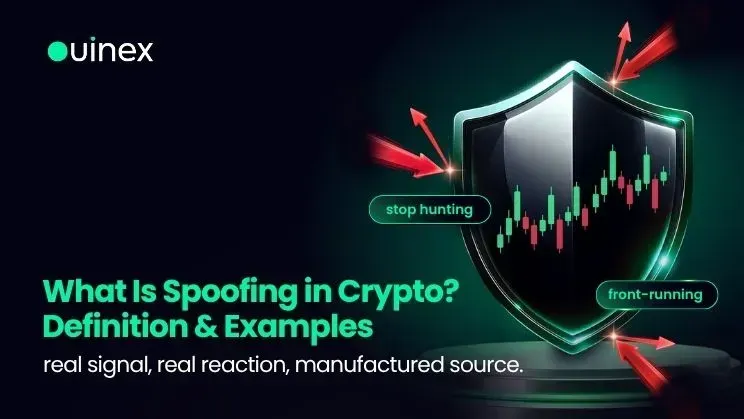
Spoofing: A form of market manipulation in which a trader places large buy or sell orders with no intention of executing them. The orders create a false impression of demand or supply, just like the mirage, move the market, and are cancelled before they fill.
Spoofing is explicitly illegal in regulated financial markets. In the United States, the Dodd-Frank Act prohibits it, and regulators including the CFTC and SEC have prosecuted spoofing cases in equities and futures markets. In crypto, enforcement is fragmented by jurisdiction. That is one of the primary reasons it remains prevalent.
The legal distinction hinges on intent. A trader who places an order and legitimately changes their mind is not spoofing. The defining characteristic is that the order was never meant to fill and was placed specifically to manufacture a price signal.
How the Mirage Gets Built: Spoofing Step by Step
Spoofing exploits a structural feature of how most crypto exchanges work: the order book is visible to everyone.
On exchanges using a Central Limit Order Book (CLOB), every open order is public. That transparency was designed to make markets fair. In practice, it gives sophisticated actors a manipulation surface that retail participants have no tools to defend against in real time.
Here is how the sequence unfolds:
- Place the mirage: A large trader places substantial buy orders just above the current market price. The order book now shows apparent demand at that level: your signal that buyers are waiting.
- Generate the forward pull: You see the large orders. You interpret them as institutional conviction: someone significant wants to buy here. Other algorithms make the same inference.
- You move first: You buy. Other retail traders buy. Algorithmic momentum strategies respond to the price signal. The price rises toward the spoofed orders.
- Strike the set: Just before the price reaches the level where the spoofed orders would execute, the original trader cancels them. The apparent demand evaporates.
- Collect the spread: The spoofer, who had already accumulated inventory or positioned short before placing the spoofed orders, sells into the move you created. The price drops back. You are holding an asset at an inflated price, and the correction comes from the same person who manufactured the signal.
The structure is simple. The speed is not. Institutional algorithms can place, monitor, and cancel orders in microseconds: faster than any human can react and faster than most enforcement mechanisms can respond.
A Concrete Example
BTC trades at $65,000. A large trader places buy orders totalling 200 BTC at $65,200, visible to every participant in the order book.
You see what appears to be institutional demand. You buy at $65,000–$65,100, pushing the price up. Other algorithmic traders respond to the momentum.
At $65,190, just before the spoofed orders would execute, the large trader cancels them. The demand was never real. The price drops back toward $65,000 or below.
The spoofer, short from the start or holding inventory accumulated before the fake demand appeared, profits from the move you funded. You absorb the loss.
This is the mirage in full: real signal, real reaction, manufactured source.
Why Crypto Exchanges Are Structurally Vulnerable
Two structural conditions make spoofing viable on crypto exchanges: order book visibility and enforcement gaps.
The Central Limit Order Book (CLOB) makes every open order visible to all participants. On traditional exchanges, this works because regulatory oversight is active and algorithmic speed advantages are bounded by rule. On most crypto exchanges, institutional-grade algorithms execute in microseconds and regulatory authority is fragmented across jurisdictions, often with no clear prohibition on manipulation at all.
The EU's MiCA regulation, phasing in through 2024–2025, introduces prohibitions on market manipulation including spoofing. In practice, enforcement in crypto remains inconsistent compared to regulated equity and futures markets.
A sophisticated trader can manufacture a signal, observe your reaction to it, and cancel the underlying order all before any enforcement mechanism can respond, and in many jurisdictions, without legal consequence.
Spoofing vs. Related Manipulation Tactics
Spoofing belongs to a family of order book manipulation techniques. Knowing the differences matters, because each pattern looks slightly different in the data and misidentifying one as another leads you to the wrong response.
Layering is a more sophisticated variant of spoofing. Where spoofing places a single large order to create a directional signal, layering places multiple orders at several price levels simultaneously, manufacturing the appearance of a deep, well-supported order book. The intent is identical: create a false impression of supply or demand, move the market, cancel before execution. The deception operates at a greater scale.
Wash trading involves a trader buying and selling the same asset to themselves, generating artificial volume without real counterparty participation. Where spoofing manipulates directional price signals, wash trading inflates apparent activity, making a thin market look liquid, or an obscure token look actively traded. The mechanism is different; the harm is the same: you make decisions based on manufactured data.
Stop hunting targets your stop-loss orders directly. Large traders move the price deliberately to the level where retail stops cluster: triggering them, collecting the resulting market orders, and reversing the move once the stops are flushed. Your risk management becomes the attack vector.
These three tactics frequently appear together. A spoofer may layer multiple levels to amplify a signal. A stop hunter may use wash trading to build apparent momentum before the flush. The order book is the battlefield, and its visibility is the vulnerability.
Frequently Asked Questions
Is spoofing illegal in crypto?
In traditional financial markets, yes, explicitly. The Commodity Exchange Act in the US prohibits it. In crypto, the legal picture varies by jurisdiction and by whether the asset is classified as a security or commodity. The EU's MiCA regulation introduces clearer prohibitions on market manipulation including spoofing. In practice, enforcement in crypto remains inconsistent compared to regulated markets.
How do you spot spoofing in real time?
It is difficult and that difficulty is by design. The tell is a large order appearing at a price level, a directional price move following it, and the order disappearing just before it would execute. Advanced traders use order book heatmaps and volume delta tools to track placement and cancellation patterns. But by the time the pattern is visible, the move has usually already happened. Detection tools help you understand what just occurred but they rarely prevent it.
What is the difference between spoofing and layering?
Layering is a more sophisticated variant of spoofing. Where spoofing places a single large order to create a price signal, layering places multiple orders at several price levels simultaneously, manufacturing the appearance of a thick, well-supported order book. The intent and outcome are the same, manufacture a false impression of demand or supply, move the market, cancel before execution, but layering operates at greater scale and creates a more convincing fiction.
Can spoofing happen on decentralised exchanges?
The mechanics depend on the exchange's architecture. DEXs using automated market makers (AMMs), like Uniswap, have no order book, so traditional spoofing does not apply. DEXs that use on-chain order books are theoretically susceptible, though the gas cost of placing and cancelling orders limits its economic viability compared to centralised exchanges.
Does spoofing happen on Ouinex?
No. Ouinex's no-CLOB execution model removes the structural condition that makes spoofing possible: order book visibility. On Ouinex, market makers cannot see the retail order book. They post bid and ask prices and compete against each other for order flow, but have no visibility into where retail orders cluster. The information asymmetry that spoofing exploits does not exist in this architecture.
How Ouinex's No-CLOB Model Closes the Attack Surface
Spoofing requires two conditions: the ability to see the order book, and the ability to cancel orders faster than enforcement can respond. Ouinex's no-CLOB architecture removes the first condition entirely.
On Ouinex's crypto perpetual futures and forex CFDs platforms, market makers post prices into a system where they cannot observe retail order flow. There is no shared visible order book to manipulate. Market makers compete on price: they cannot manufacture signals because the information they would need to do so does not exist in this environment.
This also means you are not exposed to slippage driven by manufactured volatility. The price moves you see reflect genuine supply and demand, not orchestrated order book activity. The full architecture explanation covers how this plays out across execution quality, slippage, and spreads.
The mirage only works where the light bends. Ouinex removes the heat.
CFDs are complex instruments and come with a high risk of losing money rapidly due to leverage. You should consider whether you understand how CFDs work and whether you can afford to take the high risk of losing your money.