SpaceX trades on Nasdaq now. That fact alone collapses years of speculation about how ordinary investors might one day get exposure to Elon Musk's rocket and satellite company. The question has changed. It is no longer can I invest in SpaceX. It is which route should I take.
There are two answers, and they serve different people. If you hold a US brokerage account, you can buy SPCX shares directly on Nasdaq. If you do not, or if you want leverage, the ability to go short, or exposure without committing the full share price, you can trade SPCX CFDs on Ouinex. This guide walks through both.
Two Ways to Invest in SpaceX Right Now
SPCX listed on Nasdaq on June 12, 2026, at $135 per share. As of this week it trades around $201, after touching an all-time high of $225.64 on June 16. The above information refers to the past performance of SPCX and is not a reliable indicator of its future performance. Two paths now lead to exposure on that price.
The first is share ownership. If you have a brokerage account with access to US equities, you can place an order for SPCX the same way you would for any Nasdaq-listed stock. You own the underlying shares. You can hold them indefinitely. You cannot easily profit if the price falls, and you cannot use leverage unless your broker separately offers margin.
The second is a contract for difference, a CFD. Trading SPCX as a CFD means taking a position on the price without owning the share itself. You can go long if you expect the price to rise, or short if you expect it to fall. You can apply leverage to the position. And you do not need a US brokerage account to do it, which matters for the large share of SpaceX's audience that lives outside the United States.
The rest of this guide focuses on that second route, starting with why it fits SPCX specifically before getting into the mechanics of opening a position.
Why Trade SPCX CFDs Instead of Shares
There is a case for skipping CFDs altogether. If you already hold a US brokerage account and plan to hold SPCX for years regardless of near-term volatility, buying the shares outright is simpler. You pay no overnight financing on a held position, and you carry no margin call risk. For a buy-and-forget allocation, share ownership is the cleaner instrument.
That case holds, right up until volatility itself becomes the opportunity. In its first four trading days, SPCX moved from $135 to $225.64, a gain of roughly 67%, before pulling back to around $201. Investments can go up and down. Past performance is not necessarily indicative of future performance. Few large-cap stocks move that much in years, let alone days. That kind of range is exactly the environment leveraged trading was built for, and exactly the environment that punishes anyone who only has one direction available to them.
Volatility this sharp cuts both ways, which raises the second reason CFDs fit SPCX better than shares: the short side. The bear case here is not theoretical. Ninety-six percent of shares remain locked with early investors and employees. SpaceX has never reported a public quarterly earnings result. Starship, the program much of the long-term valuation depends on, is currently grounded pending an FAA mishap investigation. The fuller bull and bear case for SPCX lays out both sides in detail. If you believe the valuation is ahead of the fundamentals, a CFD lets you act on that belief directly. A share purchase does not.
That conviction is only useful if you can act on it, which is where access becomes the third reason. CFDs do not require a US brokerage account, identity verification tied to US residency, or the settlement delays that come with cross-border share ownership. You open an account with Ouinex, fund it, and trade SPCX alongside the rest of Ouinex's stock CFDs.
Knowing why CFDs fit is only the first half of the decision. The second half is doing it without mishandling the position on day one, which starts with the mechanics.
How to Open an SPCX CFD Position on Ouinex
The mechanics take a few minutes.
1. Open and verify an Ouinex account. Standard identity verification, the same process as opening an account on any trading platform.
2. Deposit funds. Ouinex supports a range of deposit methods depending on your region.
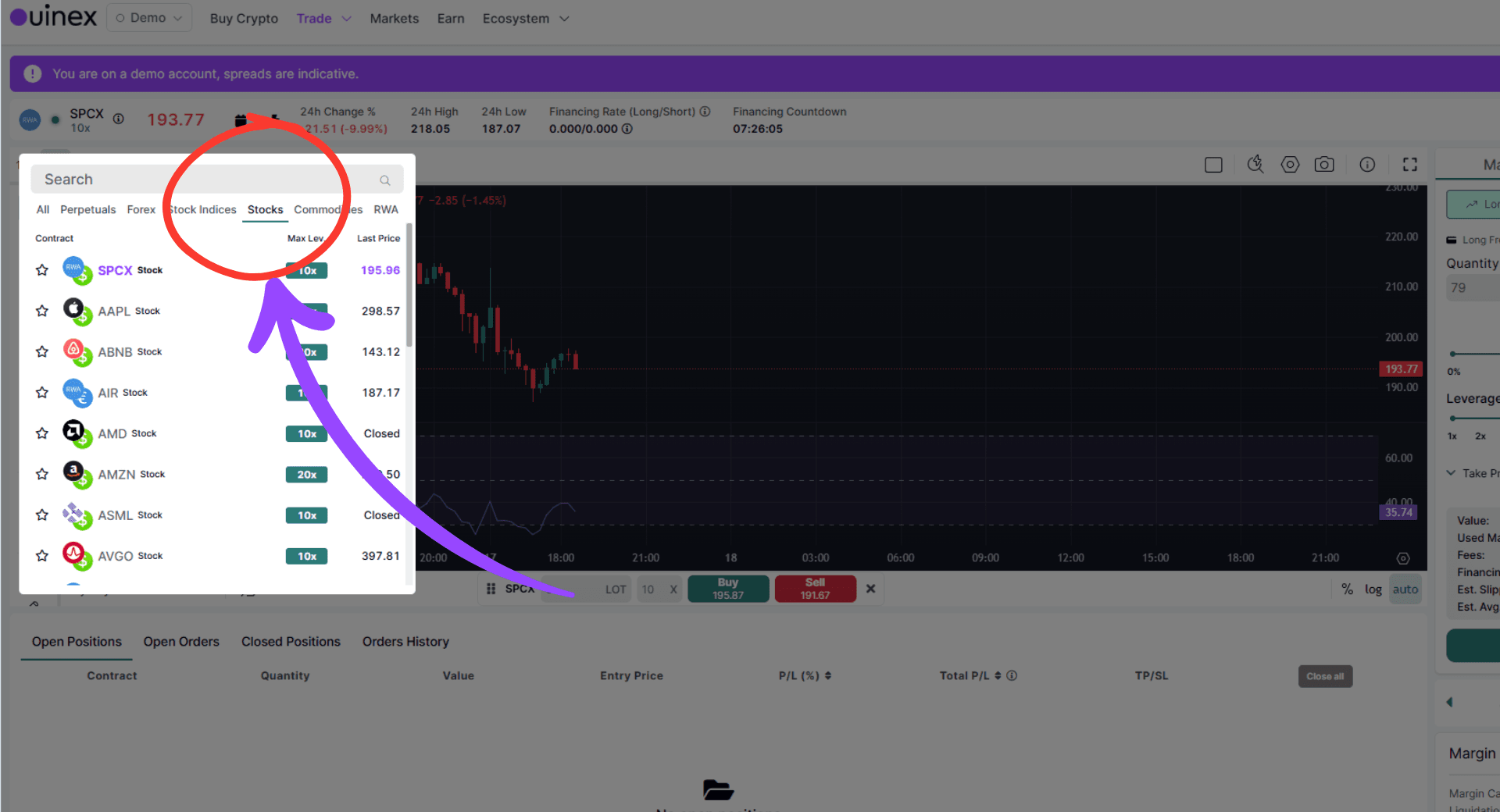
3. Search "SPCX" in the instruments list. It appears under stock CFDs.
4. Choose your direction. Long if you expect the price to rise, short if you expect it to fall.
5. Set your leverage. Lower leverage reduces both your exposure and your risk per dollar deposited.
6. Set a stop-loss, and a take-profit if you use one. Given the price ranges SPCX has shown in its first week, this step matters more here than on most instruments.
7. Confirm and place the trade.
That is the entire process. The decisions that matter happen in steps five and six, which is where most new SPCX traders get the position right or wrong.
Setting Leverage, Stop-Loss, and Position Size on SPCX
Leverage on a stock like SPCX behaves differently than leverage on a stable, established blue chip, because the underlying moves so much more.
What does that actually look like in dollar terms? At 5x leverage, $1,000 of margin controls a $5,000 position. A 10% move in SPCX...becomes a 50% move against your margin if it goes the wrong way. Well within its recent daily range, the same leverage that turns a good call into a strong return turns a bad one into a fast loss.
Stop-loss placement needs to account for that range, not fight it. SPCX has moved $20 to $30 in a single session more than once since listing. The above information refers to the past performance of SPCX and is not a reliable indicator of its future performance. A stop-loss set too close to your entry price will get triggered by ordinary noise, not by you being wrong about the direction. Give the position room to breathe, and size it smaller if that room makes you uncomfortable, rather than tightening the stop and hoping.
Position size should follow from this volatility, not ignore it. A position that would be a reasonable percentage of your account on a stable large-cap stock is an oversized bet on SPCX. Most traders working with newly listed, thinly floated stocks like this one keep individual position sizes meaningfully smaller than they would on an established name.
What Moves the SPCX Price
Sizing and stops only protect you from volatility you cannot predict. Knowing what tends to trigger that volatility narrows the unpredictability, at least somewhat.
A handful of catalysts will keep driving SPCX in either direction over the coming months: Starship launch outcomes, Starlink subscriber updates, the first public earnings report expected in late July 2026, progress on the Cursor acquisition, Elon Musk headlines that touch any part of his portfolio, and the lock-up expiry window beginning in December 2026, when the 96% of currently locked shares starts becoming sellable.
None of these are predictable on a fixed schedule, which is itself the point. A position you can size, leverage, and exit on your own terms handles that unpredictability better than a buy-and-forget share purchase.
FAQ
Can you buy SpaceX stock?
Yes. SpaceX trades on Nasdaq under the ticker SPCX since its IPO on June 12, 2026. You need a brokerage account with access to US equities to buy shares directly.
How do I buy SpaceX stock without a US broker?
You cannot buy the shares directly without one, but you can trade SPCX CFDs on Ouinex, which tracks the SPCX price without requiring a US brokerage account.
Can I short SPCX?
Yes, through a CFD position. Share ownership alone does not give you a way to profit from a price decline. A short CFD position does.
What leverage is available on SpaceX CFDs?
Leverage availability depends on your account type and region. Lower leverage reduces both your exposure and your risk per dollar of margin used.
When does the SPCX market open and close?
SPCX trades on Nasdaq during standard 9:30 a.m. to 4:00 p.m. Eastern Time, Monday through Friday.
Sources
1. SpaceX IPO Leaves Retail Investors With Too Few Shares and a Tough Hold-or-Sell Decision (CNBC)
2. SPCX Stock Price Quote (Morningstar)
3. SpaceX Stock's Biggest Test Isn't Its Post-IPO Drop, It's Coming in Late July (Yahoo Finance)
4. SpaceX IPO, Employee Lockup Release Dates (Darrow Wealth Management)
5. FAA Requires SpaceX-Led Mishap Investigation (Spaceflight Now)
6. SpaceX to Acquire Cursor for $60B in Stock (TechCrunch)
CFDs are leveraged products. Trading SpaceX (SPCX) CFDs carries significant risk of loss. The value of your position can move against you rapidly, particularly given SPCX's trading history since its June 2026 listing. You may lose the full amount you invest, and your investment does not benefit from any form of financial protection. Past performance of SPCX is not a reliable indicator of its future performance. This content is not financial advice.