Most coverage of SPCX focuses on buying. But SpaceX stock moves hard in both directions. A 5% free float, a volatile Starship launch cadence, and a lock-up expiry that will release roughly 95% of outstanding shares in late 2026 mean this is not a one-directional market. If you want to position for a fall, the tool is a CFD short. Here is exactly how to do it, and what to watch so you know when the trade makes sense. For the bear case scenarios and price levels that matter, read the SPCX price prediction breakdown for 2026 first.
Why Traders Short SPCX
Shorting is not pessimism. It is a read on asymmetric risk. SPCX has structural features that make short positions legitimate tools for active traders, not just bears.
The Lock-Up Expiry Is a Known Event
SpaceX IPO share lock-up begins expiring August 21, 2026 for employees, with a second wave on October 25, 2026 for institutional holders. When roughly 95% of shares become eligible for sale, supply pressure increases. This is a dated, predictable catalyst: short interest tends to build ahead of known unlock windows. Past performance is not indicative of future results.
Starship Is Binary
A successful Starship flight sends SPCX up. A public failure sends it down fast. With a 5% free float amplifying every move, a negative flight outcome can produce a 15-25% intraday drop. Traders who anticipate a failure before the market does can position short in advance. Past performance is not indicative of future results.
Starlink Revenue Miss
The bulk of SpaceX's valuation rests on Starlink subscriber growth and average revenue per user. Any figure that misses analyst consensus removes the foundation of the bull case and reprices the stock lower. Revenue data from SpaceX is disclosed selectively. Watch for investor communications and partner announcements.
AI Acquisition Premium Unwind
The Cursor acquisition in June 2026 added a speculative AI premium to SPCX. If integration timelines slip or revenue is delayed, that premium unwinds. A short thesis built on premium contraction is distinct from a short thesis built on fundamental deterioration.
How to Short SPCX Using a CFD
A CFD (contract for difference) lets you open a sell position on SPCX without borrowing the underlying share. You do not need a locate, you are not subject to short-sale restrictions, and there is no settlement lag. You agree on a price with the broker, and if SPCX falls, the difference is your profit. If it rises, the difference is your loss.
To open a short CFD position on SPCX on Ouinex:
1. Go to SPCX on the Ouinex stocks CFD platform.
2. Select Sell rather than Buy.
3. Set your position size in units or notional value.
4. Set a stop-loss. Non-negotiable when shorting (see risk section below).
5. Confirm the trade. Your short position is live.
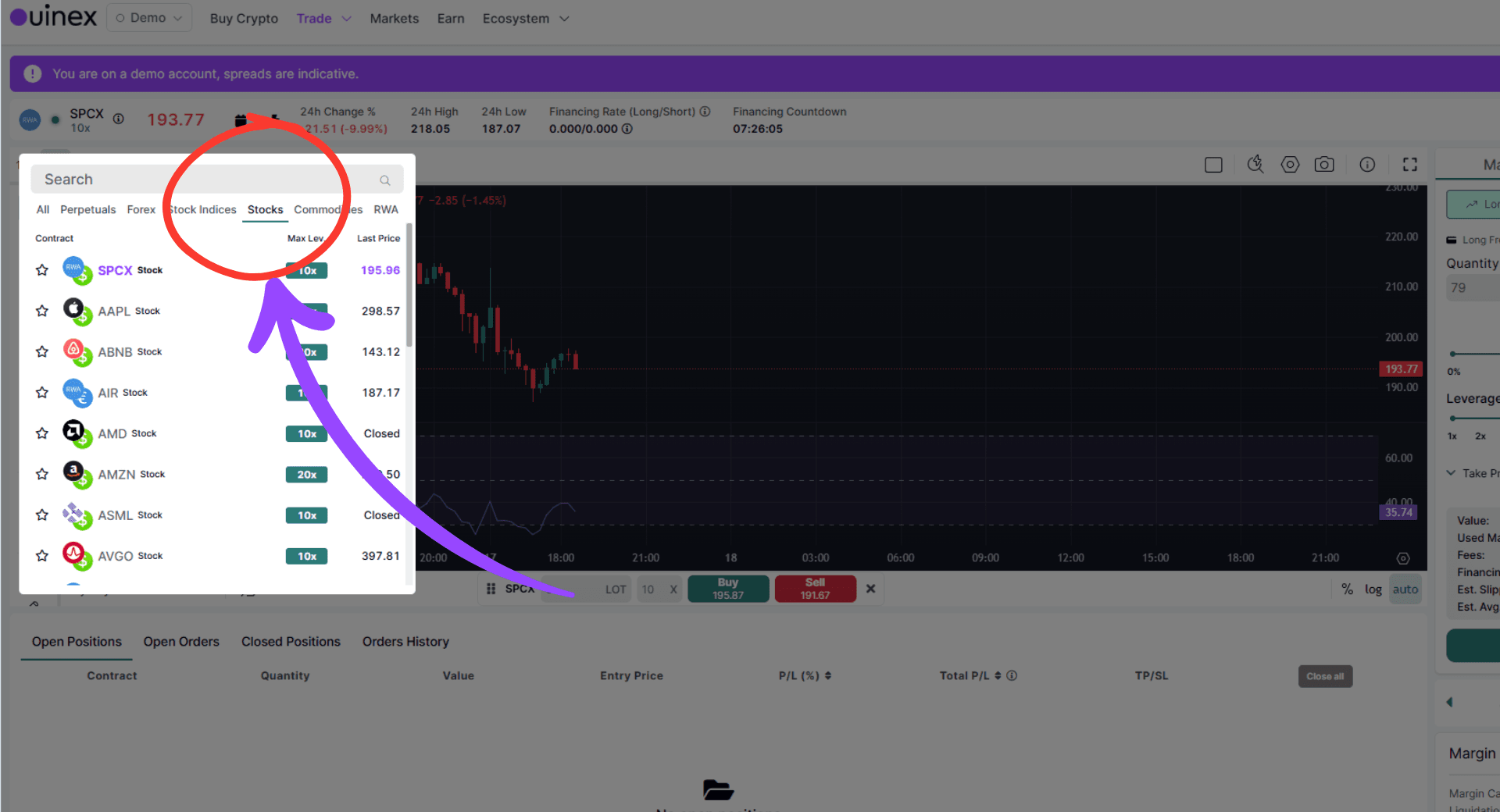
The position profits if SPCX falls below your entry price. It loses if SPCX rises above it. CFD positions on SPCX carry overnight financing charges for positions held beyond the trading day. Factor this into multi-day short trades.
CFD Short vs. Short Selling SPCX Shares
Shorting shares requires borrowing stock from a broker, paying a borrow fee, and returning the shares at closing. For a newly listed stock like SPCX with a tiny float, borrow rates can be prohibitively high, sometimes 50-100% annualised for heavily shorted small-float names.
A CFD short has no borrow requirement and no locate. The cost is the overnight financing rate. For most SPCX short trades held under a week, the CFD is the cheaper and more accessible instrument. For context on what SPCX is as a listed equity, read the breakdown of SPCX as a stock versus ETF ticker.
Risk Management When Shorting SPCX
Shorting carries theoretically unlimited upside risk. A long position can only fall to zero. A short position has no ceiling. If SPCX doubles after you go short, your loss equals your full position value. This is why stop-losses are non-negotiable, not optional.
Always Set a Stop-Loss
Define your maximum acceptable loss before you open the trade. A stop-loss at 5-10% above your entry is a reasonable starting point given SPCX's volatility. If the trade thesis is wrong, the stop closes you out before the loss compounds. Stop-losses do not guarantee execution at the exact level in fast-moving or gapped markets. Past performance is not indicative of future results.
Position Size for a Volatile Float
SPCX's 5% free float means intraday moves of 10-20% are not exceptional. Many active traders cap individual SPCX exposure at 1-3% of total portfolio value. This is not financial advice. Individual risk tolerance and account size vary.
CFD Short vs. Short Selling SPCX Shares
Shorting shares requires borrowing stock from a broker, paying a borrow fee, and returning the shares at closing. For a newly listed stock like SPCX with a tiny float, borrow rates can be prohibitively high, sometimes 50-100% annualised for heavily shorted small-float names.
A CFD short has no borrow requirement and no locate. The cost is the overnight financing rate. For most SPCX short trades held under a week, the CFD is the cheaper and more accessible instrument. For context on what SPCX is as a listed equity, read the breakdown of SPCX as a stock versus ETF ticker.
Risk Management When Shorting SPCX
Shorting carries theoretically unlimited upside risk. A long position can only fall to zero. A short position has no ceiling. If SPCX doubles after you go short, your loss equals your full position value. This is why stop-losses are non-negotiable, not optional.
Always Set a Stop-Loss
Define your maximum acceptable loss before you open the trade. A stop-loss at 5-10% above your entry is a reasonable starting point given SPCX's volatility. If the trade thesis is wrong, the stop closes you out before the loss compounds. Stop-losses do not guarantee execution at the exact level in fast-moving or gapped markets. Past performance is not indicative of future results.
Position Size for a Volatile Float
SPCX's 5% free float means intraday moves of 10-20% are not exceptional. Many active traders cap individual SPCX exposure at 1-3% of total portfolio value. This is not financial advice. Individual risk tolerance and account size vary.
Catalyst Timing
The highest-risk periods to hold a short are immediately before and after Starship launch dates. A successful test produces a fast gap up that can trigger stop-losses before manual intervention is possible. Check the SpaceX stock price catalysts guide for the full list of events that move SPCX. Past performance is not indicative of future results.
Frequently Asked Questions
Can I short SPCX?
Yes. The most accessible method is a CFD short position. Platforms like Ouinex allow you to open a sell position on SPCX without borrowing shares. CFDs are complex instruments and carry a high risk of losing money rapidly due to leverage. Past performance is not indicative of future results.
What happens if I short SPCX and it goes up?
Your position loses money. A short position has no ceiling on losses. If SPCX continues to rise, your loss grows with it. A stop-loss is the primary mechanism to cap this risk, though execution is not guaranteed at the exact stop level in fast-moving markets.
When is the best time to short SPCX?
There is no guaranteed best time. Past price patterns are not indicative of future results. Traders typically build short theses around dated catalysts: lock-up expiry windows (August 21 and October 25, 2026), Starship launch outcomes, and Starlink revenue reporting. These are events with defined timelines, not predictions.
Is shorting SPCX available outside the US?
SPCX shares listed on Nasdaq are subject to US brokerage access restrictions. CFD positions on SPCX are offered by platforms operating outside the US, including Ouinex, and are accessible to traders in eligible markets without requiring a Nasdaq account.
CFDs are complex instruments and carry a high risk of losing money rapidly due to leverage. The value of your investment can go down as well as up, and you may lose more than your initial deposit. Past performance is not indicative of future results. This content is for informational purposes only and does not constitute financial advice. You should consider whether you understand how CFDs work and whether you can afford to take the high risk of losing your money.
Sources
1. SpaceX IPO Prospectus (S-1): SEC EDGAR
2. SpaceX Lock-Up Expiry Schedule: SEC Filing 424B4
3. Short Selling: Definition, Pros, Cons, and Examples. Investopedia
4. Contract for Differences (CFD) Overview and Examples. Investopedia
5. Stock Borrow Rates Explained. Investopedia