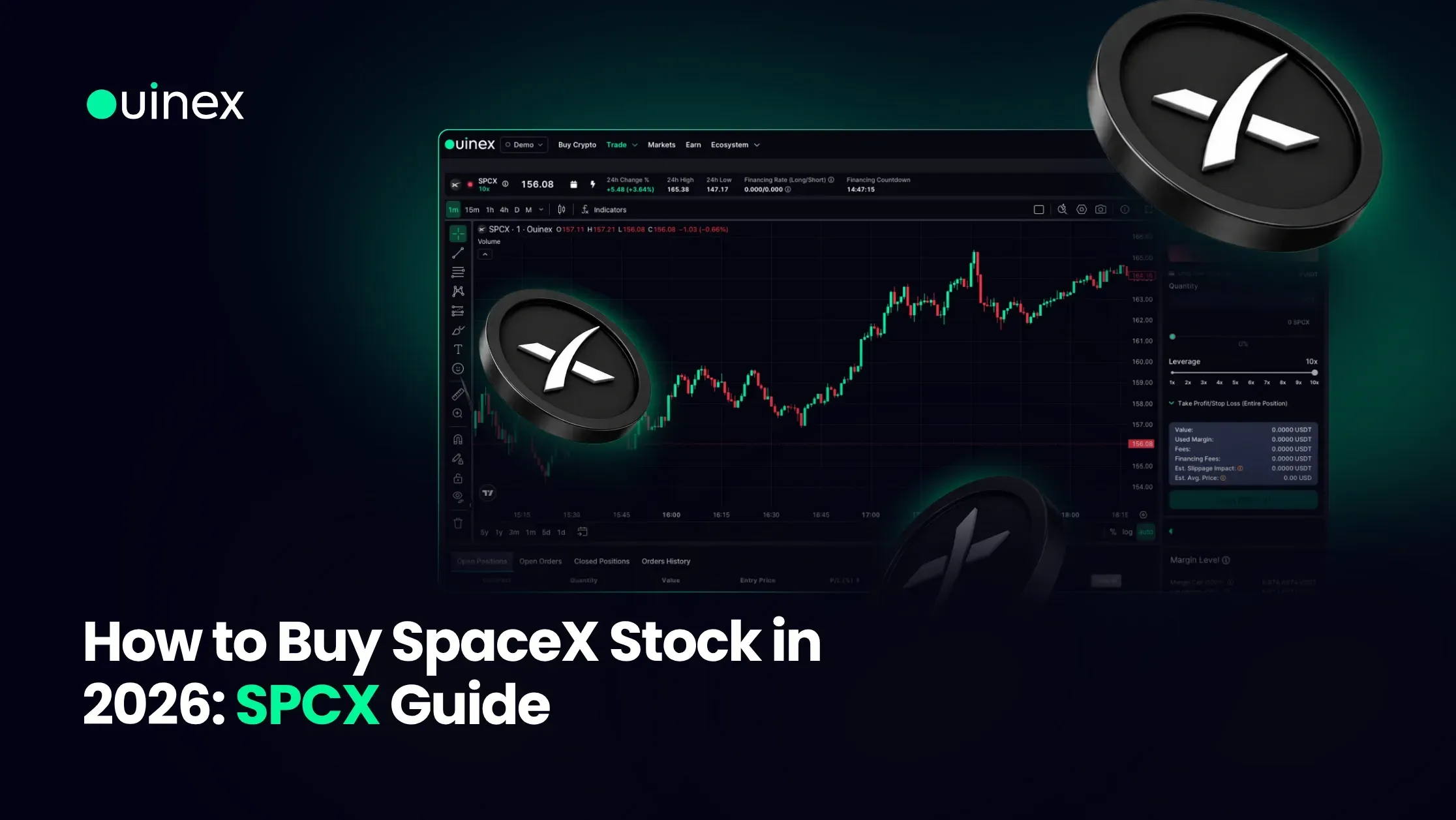
SpaceX listed on Nasdaq on June 12, 2026. SPCX opened at $150 per share. By the time most retail investors outside the United States finished reading the news, the IPO allocation window had already closed. That is not a complaint. It is a structural reality: your ability to buy SpaceX stock depends less on whether you want it and more on where you are and what you can access. There are three routes to SPCX exposure. They are not equal. If you have already decided you want to trade SPCX as a CFD, the full SpaceX CFD trading guide covers the mechanics step by step. For everyone else, here is how each option actually works.
Option 1: Buy SPCX Directly on a US Brokerage
SPCX trades on Nasdaq. If you hold an account with a US brokerage such as Fidelity, Charles Schwab, or Interactive Brokers, you can buy SpaceX stock at market price like any other listed equity.
The constraint for most non-US investors: standard US retail brokerages require a Social Security Number or ITIN for account opening. Without US residency or tax identification, direct equity access is restricted. Some international brokers offer US market access to non-resident clients, but the availability, verification requirements, and funding methods vary significantly by country.
If you do gain access, there is one structural factor to understand before placing your first order: SPCX has a free float of approximately 5% of total shares outstanding. The remainder is held by Elon Musk, pre-IPO institutional investors, and employees subject to lock-up agreements. Low float means thinner markets, wider bid-ask spreads, and amplified price moves in both directions. Past price moves are not indicative of future results.
Option 2: Get SpaceX Exposure Through ETFs or Funds
As of mid-2026, there is no pure-play SpaceX ETF. SPCX is SpaceX's direct equity ticker, not a fund. If you are searching for a fund under the SPCX symbol, that ticker previously belonged to a space-focused ETF that changed its symbol when SpaceX listed.
Some innovation-focused ETFs hold exposure to space and technology companies. None provides concentrated single-stock SpaceX exposure. Fund-based exposure means diluted returns, management fees, and price movements driven by the broader basket rather than by SPCX-specific catalysts such as Starship launches or acquisition announcements.
Before the IPO, vehicles such as Destiny Tech100 (DXYZ) allowed retail investors to access pre-IPO SpaceX shares indirectly. That route closed when SPCX listed on June 12. DXYZ's post-IPO SpaceX allocation depends on its own portfolio decisions and does not constitute a direct SPCX bet.
Option 3: Trade SPCX CFDs (Most Accessible Route for Non-US Investors)
A contract for difference (CFD) lets you speculate on SpaceX stock price movements without owning the underlying share. You open a long position if you expect SPCX to rise, or a short position if you expect it to fall. Your profit or loss is the difference between your entry and exit price, multiplied by your position size.
CFDs are available to non-US investors globally and require no US brokerage account or Social Security Number. For most traders outside the United States, CFDs are the most practical route to SPCX exposure. You can react to catalysts in real time, trade both sides of the market, and size your position without the settlement constraints of direct equity ownership.
The tradeoff is ownership: with a CFD you are speculating on price, not holding shares. You cannot vote in shareholder meetings or receive dividends as equity income. CFDs are a trading instrument, not a long-term equity investment vehicle. CFDs are complex instruments and come with a high risk of losing money rapidly due to leverage. Past price moves are not indicative of future results. To open a position on SPCX, trade SPCX CFDs on Ouinex.
Which Option Is Right for You?
If you are a US resident with a domestic brokerage account, Option 1 is available. You can buy and hold actual SPCX equity. Expect wider spreads than you would see on a large-cap stock due to the low free float.
If you are outside the United States, Option 3 is the most accessible route for active traders. No US tax identification required, available through globally licensed platforms, and executable in both directions. The full CFD mechanics are covered in the guide linked in the introduction.
Option 2 is the weakest choice for anyone seeking SpaceX-specific exposure. ETF and fund products dilute the position and introduce costs unrelated to SPCX performance. The only scenario where fund exposure makes sense is passive long-term technology portfolio allocation with no active trading intent.
Key Facts to Know Before You Buy SpaceX Stock
IPO price: $135 per share. First-day open: $150. Ticker: SPCX on Nasdaq. IPO date: June 12, 2026. For the valuation framework underpinning the $135 offering price, read the SpaceX valuation breakdown for 2026.
Lock-up schedule: SpaceX insiders and pre-IPO investors face staggered lock-up expiries with tranches beginning August 21, 2026 and continuing through October 25. Each tranche is a potential selling pressure event as locked-up holders gain the legal ability to sell. The current 5% float will expand materially if significant insider selling follows those dates. Past price moves are not indicative of future results.
Key catalysts that have moved and will continue to move SPCX: Starship test flight results, Starlink satellite deployment milestones, US Department of Defense contract announcements, and corporate acquisition news. The Cursor acquisition in June 2026 drove SPCX to an intraday all-time high of $225.64 before the stock established a floor near $191. Past price moves are not indicative of future results.
Pre-IPO access is no longer available. The SPCX offering closed June 12, 2026. If you are looking for how to invest in SpaceX before it went public, that window has passed. The only way to participate now is in the open market or through CFD instruments described above.
Frequently Asked Questions
Can you buy SpaceX stock?
Yes. SpaceX listed on Nasdaq on June 12, 2026 under the ticker SPCX. US retail investors can buy SPCX directly through any brokerage with Nasdaq access. Non-US investors have restricted direct equity access but can speculate on SPCX price movements through CFDs, which are available globally without a US brokerage account. Past price moves are not indicative of future results.
Is there a SpaceX ETF?
No. As of mid-2026, there is no pure-play SpaceX ETF. SPCX is SpaceX's direct equity ticker on Nasdaq. Before the IPO, the SPCX ticker was used by a different space-focused fund, which changed its symbol when SpaceX listed. Some innovation and space ETFs hold indirect exposure to SpaceX, but none provides concentrated single-stock exposure.
How much does SpaceX stock cost?
SPCX listed at an IPO price of $135 per share and opened at $150 on June 12, 2026. The stock has since traded across a wide range, with the Cursor acquisition in June 2026 driving an intraday all-time high of $225.64 and a subsequent floor near $191. For current SPCX price data, check a financial data provider such as Bloomberg or Nasdaq.com. Past price moves are not indicative of future results.
How to invest in SpaceX as a non-US investor?
Non-US investors have two main options: some international brokers offer US market access for non-resident clients, subject to local regulations and documentation requirements. Alternatively, non-US investors can trade SPCX CFDs, which are globally accessible and do not require a US brokerage account or Social Security Number. CFDs are complex instruments and carry a high risk of losing money rapidly due to leverage. Past price moves are not indicative of future results.
Risk Disclaimer
Trading CFDs on SPCX involves significant risk and may not be suitable for all investors. The value of CFDs can fall as well as rise. You may lose more than your initial investment. Past performance is not indicative of future results. This article is for informational purposes only and does not constitute financial advice or a recommendation to buy or sell any financial instrument. CFDs are complex instruments and come with a high risk of losing money rapidly due to leverage. Ensure you fully understand the risks before trading and seek independent financial advice if necessary.
Sources
1. SpaceX Updates -- spacex.com
2. SPCX Stock Data -- Nasdaq.com
3. SpaceX IPO Coverage -- Payload Space