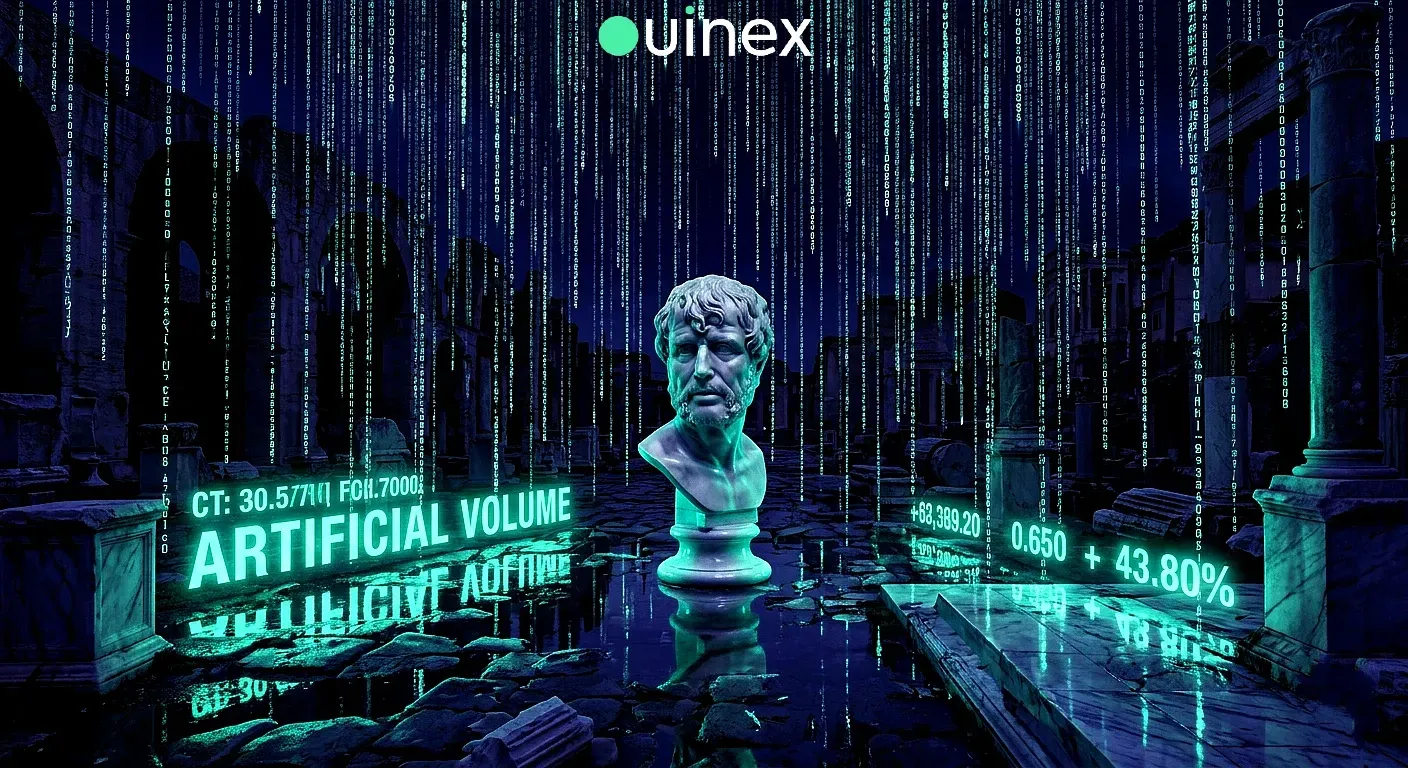
Wash trading is one of the most widespread forms of market manipulation in crypto. It occurs when a trader, or more often, an automated bot, buys and sells the same asset between accounts they control, generating volume without any real change in ownership. The result is an artificially inflated activity figure that misleads other traders, attracts listings, and distorts price discovery.
Understanding what wash trading looks like, which markets are most affected, and how to choose platforms where it is structurally difficult to execute is essential for anyone making trading decisions based on volume data.
What is wash trading?
Wash trading is the practice of buying and selling the same asset simultaneously, or in rapid sequence, between accounts controlled by the same party.
Since the buyer and seller are the same entity, no real transfer of ownership takes place but the transaction appears in the market's volume data as if it were genuine activity.
In traditional financial markets, wash trading is illegal. In crypto markets which remain largely unregulated in most jurisdictions, it is widespread across centralised exchanges and, increasingly, on-chain in NFT and DeFi markets.
The motive is straightforward: high volume makes an asset or exchange appear more liquid and active than it is, attracting genuine traders and investment that would otherwise not appear.
How wash trading works in practice
The mechanics depend on the platform and the goal:
Exchange-level wash trading: The exchange itself, or market makers operating with the exchange's knowledge, run bots that generate buy and sell orders between internal accounts. This inflates the exchange's reported volume rankings, which in turn attracts new traders and listings.
- Token-level wash trading
Token projects buy and sell their own token between controlled wallets to simulate interest, push the token onto trending lists, or meet volume thresholds required for exchange listings.
- NFT wash trading
The same NFT is sold between wallets controlled by the same person, inflating its apparent sale price and sale history to mislead potential buyers about its market value.
- Bot-driven high-frequency wash trading
Algorithms place thousands of buy and sell orders per second between controlled accounts. The pattern can be hard to detect in real time but leaves statistical traces in the trade data.
Why wash trading matters to you as a trader
If you make any trading decision based on volume data, wash trading directly undermines the quality of that information.
- Volume as a trend signal: A spike in volume is often interpreted as confirmation of a price move. If that volume is fake, the signal is false.
- Liquidity assessment: High volume suggests tight spreads and easy execution. An exchange with 95% fake volume will have far less real liquidity than its numbers suggest, meaning your trades will face higher slippage than expected.
- Market cap rankings: Exchange rankings by volume drive traffic, listings, and credibility. Wash trading corrupts these rankings entirely.
- Price discovery: When volume is artificial, price movements that appear to have genuine momentum behind them may be manufactured which leaves traders on the wrong side of a reversal.
How to identify wash trading
Several detection methods have been developed by researchers and professional traders:
- Trade size clustering: Legitimate markets produce varied trade sizes. Wash trading bots tend to produce repetitive, algorithmically regular trade sizes that cluster at specific values.
- Volume-to-wallet-size ratio: On-chain data allows analysts to compare an exchange's reported volume against the size of wallets they control. A major discrepancy between reported volume and actual assets held is a strong indicator.
- Volume with no price movemet: Genuine volume tends to move prices. Consistently high volume on an asset with minimal price change is a red flag for circular trading.
- Round-the-clock uniform volume: Real markets have peaks and troughs tied to trading sessions and news events. Perfectly uniform 24-hour volume with no natural variation is a statistical anomaly.
- Third-party verification: Platforms like Kaiko, CCData, and CoinGecko publish adjusted volume figures that attempt to strip out suspected wash trading. Comparing adjusted versus reported volume across exchanges is a practical first screen.
How to protect yourself from wash trading
There is no perfect defence against wash trading, but you can significantly reduce your exposure by making better choices about where and how you trade:
- Use adjusted volume data: Filter by adjusted volume rather than raw reported volume when evaluating markets or exchanges. Adjusted figures strip out suspected wash trades from the ranking.
- Choose a central limit order book exchange: On a CLOB, all orders are aggregated and matched transparently at publicly visible prices. Every trade requires a genuine counterparty on the opposite side. This structure makes the circular trading that powers most wash trading schemes structurally harder to execute and easier to detect.
- Cross-reference volume with order book depth: An exchange with genuinely high volume will have a deep order book with meaningful bids and asks at multiple price levels. An exchange relying on wash trading will often show high reported volume alongside a thin, shallow order book.
- Use automated risk controls: Platforms that offer kill switches and automated position management tools give you the ability to exit quickly if you find yourself in a market that is behaving in a manipulated or unpredictable way.
Also be aware of related manipulation tactics like stop hunting which are frequently used alongside wash trading to amplify the impact of manufactured price moves. Understanding both tactics together gives you a more complete picture of how markets are manipulated.
The safest approach is to trade on a transparent platform that operates on a CLOB model where all volume is real and verifiable. That way you can verify if there is manipulation.
Or trade on Ouinex’s no-CLOB execution model which ensures that retail traders are separated from market makers and other institutional traders. Institutions can’t affect the liquidity of the exchange negatively.
This means that institutional traders offer up bids and ask prices and Ouinex selects the best offers and feeds them to the retail traders.
In short, the institutions trade against each other to offer the best prices. In addition, institutions cannot see inside the order book, and retail traders cannot view preset orders from institutions.
Related Question You Might Ask
What is wash trading in crypto?
Wash trading is when a trader buys and sells the same asset between accounts they control, generating artificial volume without any real change in ownership. It is used to make an exchange or token appear more active and liquid than it actually is.
Is wash trading illegal in crypto?
In most traditional financial markets, wash trading is illegal. In crypto, regulatory coverage varies significantly by jurisdiction. In the US, the CFTC has taken action against crypto wash trading, but enforcement remains limited globally. Most unregulated exchanges operate in jurisdictions where it goes unpunished.
How much of the crypto trading volume is fake?
Studies suggest significant portions of reported volume are artificial. A Bitwise Management report estimated that 95% of reported Bitcoin trading volume on unregulated exchanges is fake. The US National Bureau of Economic Research attributed 70% of trades on unregulated crypto exchanges to wash trading.
How can I tell if an exchange is wash trading?
Look for: reported volume that far exceeds the size of the exchange's on-chain wallets, suspiciously uniform 24/7 volume with no natural peaks or troughs, high volume alongside a thin order book, and a large gap between raw reported volume and adjusted volume figures from third-party providers like Kaiko or CoinGecko.
Does wash trading affect price?
Yes, indirectly. While wash trades cancel each other out financially, they distort the volume signals that other traders use to make decisions. This can create false impressions of momentum, attract genuine buyers or sellers based on misleading data, and enable token projects or exchanges to achieve rankings and listings they would not otherwise qualify for.
Trade where every volume number is real.
Ouinex operates on a CLOB model. every order is matched against a genuine counterparty at a publicly visible price. No artificial volume. No hidden manipulation.