Please note: This article does not constitute investment advice. Laws governing crypto, derivatives, and other forms of trading and investments—as well as taxation—vary by region and are subject to change. You are responsible for complying with the laws in your jurisdiction. Ouinex’s services and offers, including those mentioned in this article—if any—may vary by location and are subject to change. All investments carry risk.
Multi-asset trading refers to the ability to trade multiple types of financial instruments, such as cryptocurrencies, commodities, stocks, indices, and foreign exchange (Forex), within a single platform and account. And, on a platform like Ouinex, it further allows you to use your crypto as collateral for TradFi derivatives (no need to first convert to fiat, which in some jurisdictions is a taxable event).
This, in turn, allows traders to immediately act on different opportunities without first having to transfer funds between accounts.
Key Takeaways
- Unified Access: Trade diverse asset classes (crypto, commodities, stocks, indices, and Forex) from a single, integrated platform
- Smarter Diversification: Build a balanced portfolio without the hassle of managing multiple accounts and wallets
- Capital Velocity: Move capital instantly between markets, enhancing speed, agility, and response time
- Tax-Efficient Collateral: Using crypto as collateral can improve capital efficiency and, importantly, may reduce unnecessary conversion-related taxable events
- Market Adaptability: Access to multiple assets allows traders to align with prevailing trends across all market cycles: bull, bear, or sideways
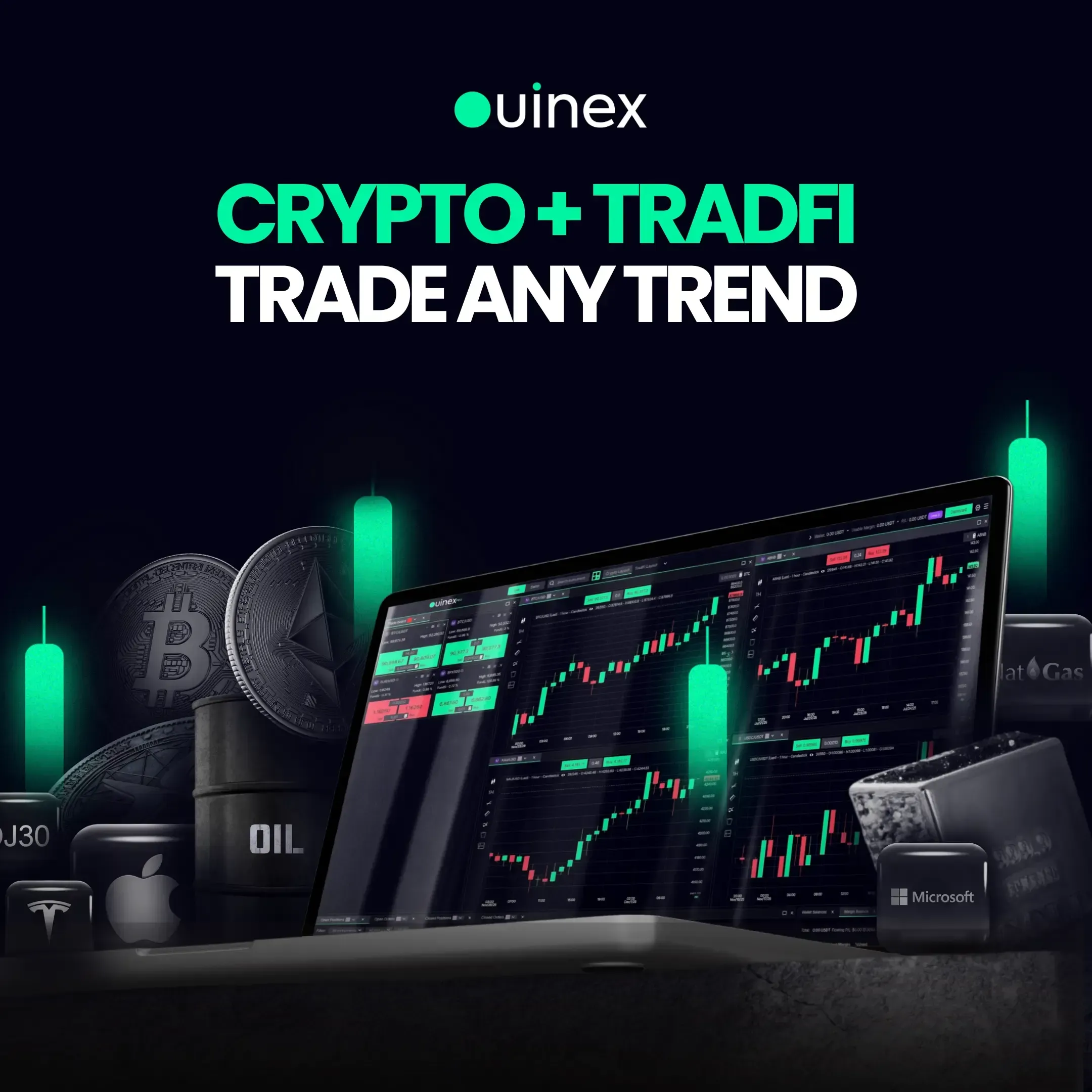
- Ouinex offers spot crypto, crypto perps, and TradFi derivatives (Forex, stocks, stock indices, and commodities) on the same platform
What Is Multi-Asset Trading and Why Does It Matter?
Traditionally, traders were forced to split their activity across multiple platforms: one for crypto, another for stocks, another for derivatives. This fragmentation creates friction, slows execution, and makes portfolio management unnecessarily complex.
Modern multi-asset platforms aim to solve this problem by bringing different markets under one roof, giving traders more flexibility, faster access, and better capital efficiency.
Ouinex offers multi-asset trading across spot crypto, crypto perpetuals, and traditional finance (TradFi) derivatives. More importantly, it allows crypto to be used as collateral for TradFi derivatives, removing the need to convert to fiat before accessing certain markets. This can prevent unnecessary taxable events in some jurisdictions.
This article explores why multi-asset trading matters, how it improves decision-making, and the real-world advantages it offers to active and long-term traders alike.
Diversification Without Complexity
Diversification is one of the core principles of risk management, but it often becomes difficult in practice. Managing exposure across different asset classes usually requires multiple platforms, different margin requirements, and disconnected reporting.
Multi-asset trading simplifies diversification by making it operationally easier.
Instead of being overexposed to a single market, such as crypto, you can spread risk across assets that behave differently under the same macro conditions.
For example:
- Crypto may react strongly to liquidity conditions
- Commodities like gold may perform better during periods of uncertainty
- Forex and indices may reflect broader macroeconomic trends
Having access to these markets at the same time allows traders to balance volatility rather than amplify it.
Speed and Agility in Changing Markets
Markets don’t send warning emails. Conditions can change in the time it takes to process a simple cross-platform transfer. A platform that limits you to one asset class fundamentally limits your response options.
With a unified multi-asset platform:
- Capital Velocity*: Funds can be redeployed instantly from a crypto position to a commodity position, or vice versa.
- Instant Hedging**: A sudden drop in crypto doesn’t require exiting; you can instantly hedge the position by taking a short on a related index derivative.
- Opportunity Capture: Traders can immediately follow opportunity instead of waiting for cumbersome transfers, KYC checks on a new platform, or slow fiat settlements.
Having one wallet and one execution environment transforms your ability to react to breaking news, macro events, or dramatic sentiment shifts without any operational drag. In fast-moving markets, speed isn’t just an advantage, it is the ultimate form of risk management.
And with Ouinex, you have in-app news and can react instantly to that, as well.
*Capital velocity refers to how quickly capital can be put to work, shifted between opportunities, and reused to generate returns without unnecessary delays or friction.
**Hedging is a strategy used to reduce potential losses by taking a position that can offset risk if the market moves against your original trade. For example, in uncertain times gold tends to do well, so while you keep HODLing BTC, you also go long on gold. Or you can short BTC while HODLing it, to help tie you over.
Trading Across Market Cycles
Different assets perform differently depending on market conditions. Multi-asset access allows traders to adapt rather than sit on the sidelines.
- In a crypto bull market* traders may focus on spot and perps.
- During a crypto bear market** attention may shift toward indices, Forex, or commodities.
- In broad risk-off environments, assets like gold, or short positions via derivatives (such as shorting the coin your HODLing), can provide alternative strategies.
Instead of being locked into one narrative, traders can align with prevailing trends and maintain productivity across any cycle.
*A bull market refers to a period when prices are generally rising and investor confidence is strong, often driven by optimism and increased buying.
**A bear market refers to a period when prices are generally falling and market sentiment is pessimistic, often marked by widespread selling and reduced confidence.
Capital Efficiency and Opportunity Cost
Keeping capital idle is often an overlooked cost.
Multi-asset platforms allow traders to:
- Keep funds active without unnecessary conversion
- Use existing holdings more efficiently
- Shift between active trading and passive strategies
For example, when markets become too volatile—or when time is limited—capital doesn’t need to sit unused.
Using Crypto as Collateral for TradFi Derivatives
One of the more practical advantages of multi-asset trading is collateral flexibility.
On many platforms, trading traditional markets requires fiat. That often means converting crypto into fiat currency, which is a process that can trigger taxable events in certain jurisdictions and introduce delays.
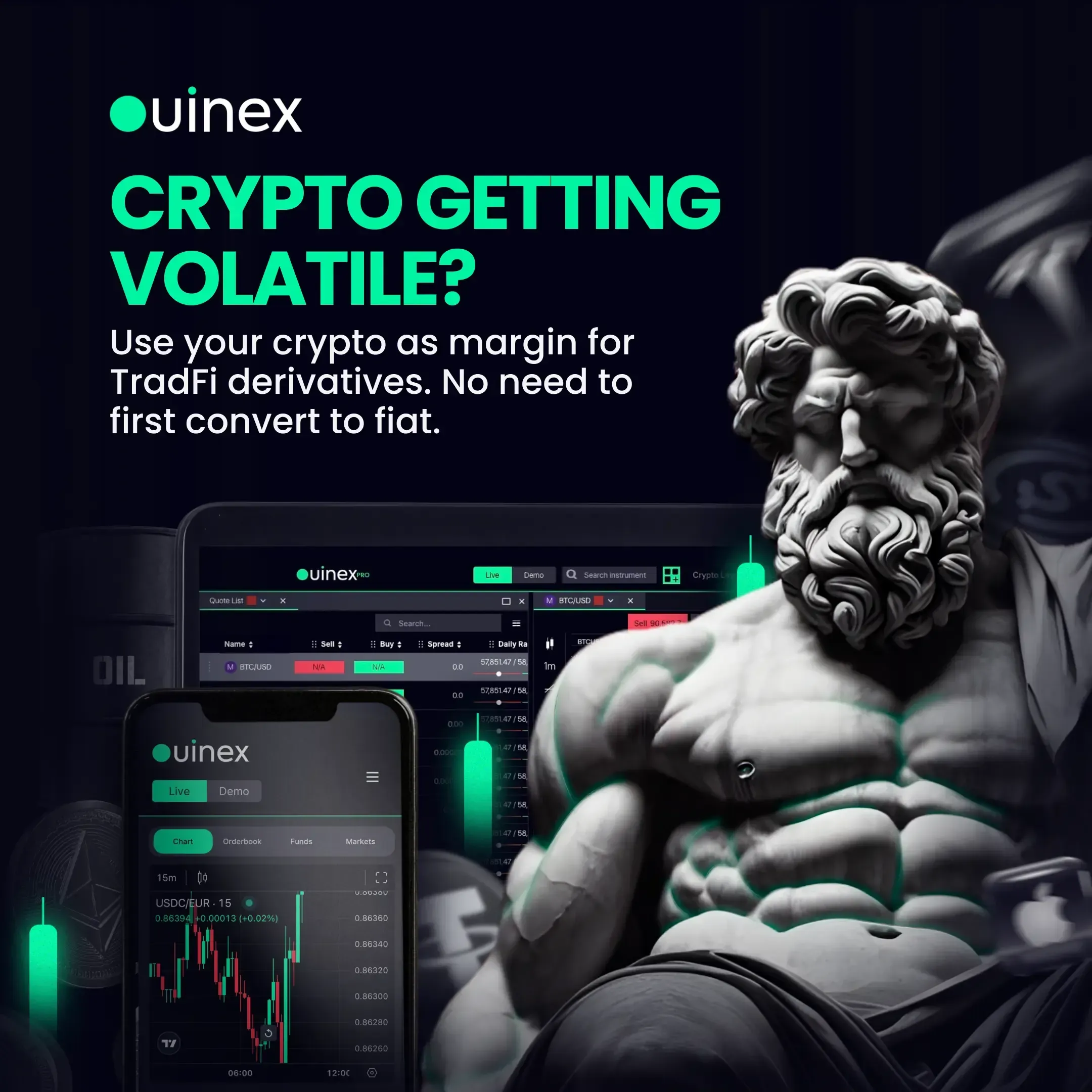
Ouinex allows traders to use crypto as collateral when trading TradFi derivatives. In practical terms, this means you can gain exposure to assets like gold, stock indices, or equities such as Tesla without first selling your crypto holdings.
Let’s take a closer look.
The Problem with Conversion
In a typical trading scenario, if a trader holds Bitcoin (BTC) and wants to open a leveraged position on the S&P 500 futures (a TradFi derivative), they are usually forced to sell a portion of their BTC for fiat currency to fund the traditional margin account.
The critical issue here is that the act of selling crypto for fiat (or even swapping one crypto for another) is legally considered a disposal of an asset in many jurisdictions. If the BTC has appreciated, this disposal triggers a Capital Gains Tax (CGT) or Income Tax event on the realized profit. Simply to fund a new trade, the investor is forced to realize a profit and pre-pay potential tax liability, immediately shrinking their available capital and hitting capital efficiency.
The Collateral Advantage: No Realization Event
Multi-asset platforms that allow crypto to be used as collateral circumvent this costly process.
When you use your existing BTC as collateral to margin a TradFi derivatives trade, the crypto asset is pledged, not sold or converted.
- Pledging Is Not a Disposal: Pledging an asset as security for a margin requirement typically does not constitute a “sale or exchange” for tax purposes. Therefore, the simple act of posting the crypto as collateral does not trigger a taxable realization event.
- Maintaining Exposure: The trader retains ownership and long-term exposure to the underlying crypto asset. The trader benefits from the performance of their crypto while actively trading in other markets.
- Maximum Capital Deployment: The full, current value of the crypto can be leveraged without the drag of selling and paying taxes on realized gains. This significantly enhances capital velocity and deployment efficiency.
For sophisticated traders, the ability to post, but not dispose of, their primary asset allows them to maintain a structurally optimal tax position while actively trading across markets. It separates the long-term asset holding strategy from the short-term trading strategy, making multi-asset platforms a tool for superior financial engineering.
Passive Opportunities Within a Multi-Asset Framework
Sitting on capital you don’t use costs in the form of lost opportunities.
A full-suite platform provides important safety valves and alternative uses for capital.
Ouinex, for example, offers passive options such as its EARN program, which provides attractive APY on stablecoin holdings. This allows traders to:
- Temporarily Step Back: Deploy capital into a stable, yielding instrument when markets are too volatile or directionless.
- Earn Yield on Unused Funds: Generate returns on capital that is awaiting a new trading opportunity.
- Maintain Liquidity: Keep funds readily available for immediate re-entry into active trading when market conditions improve.
These features don’t just complement active multi-asset trading; they complete the capital management picture, ensuring capital always has a productive role.
What Multi-Asset Trading on Ouinex Really Means
Multi-asset trading on Ouinex allows users to trade:
- Spot cryptocurrencies
- Crypto perpetual futures
- TradFi derivatives, including commodities, stocks, stock indices, and forex
All from a single platform, dashboard, and wallet. Plus, you have access to Launchpad for new tokens, EARN for passive investment, and SocialFi (where your social actions are rewarded with crypto).
This unified structure removes the need to transfer funds between platforms or juggle multiple accounts. Instead, traders can manage risk, exposure, and strategy from one place.
Summary: Why Multi-Asset Trading Matters
Multi-asset trading isn't about the stress of trading everything at once, but about the power of having unconstrained options.
By consolidating multiple markets into one sharp platform, traders gain:
- Greater, simpler diversification
- Faster execution and agility
- Improved capital efficiency (and potentially tax efficiency)
- Better adaptability across all market cycles
Whether markets are ripping bullishly, grinding bearishly, or sitting sideways in an uncertain range, multi-asset trading provides the most comprehensive toolkit available to respond strategically rather than react emotionally.
Sign up and start enjoying the benefits of multi-asset trading on Ouinex!
FAQs
Is multi-asset trading only for experienced traders?
No. While advanced traders benefit from flexibility, beginners may find a single platform easier to manage than multiple disconnected accounts. Plus, multi-asset trading is crucial for a balanced portfolio which, in turn, is crucial for risk management. You can read more about risk management here.
Does multi-asset trading reduce risk?
It doesn’t remove risk, but it can help distribute and manage it through diversification. You can read more about risk management here.
Can crypto-only traders benefit from TradFi access?
Yes. TradFi derivatives offer exposure to different economic drivers, which can help balance crypto-specific volatility. Such as going long on gold in times of volatile markets, as, traditionally, it’s the go-to asset for volatile times (it tends to thrive in times of volatility, though of course there is no guarantee that it will).
Not only that, you have access to crypto perps on Ouinex, so if you’re HODLing BTC or ETH and either coin takes a hit, you can hedge by going short on the asset you’re HODLing.
Do I need to trade all asset classes to benefit from multi-asset trading?
No. Multi-asset trading is about access and optionality, not obligation. Traders can focus on a single market, such as crypto, and still benefit from the ability to hedge, diversify, or pivot when conditions change. Even if you rarely trade TradFi derivatives, having them available means you are not forced into inactivity or reactive decisions during unfavorable market cycles.
Does multi-asset trading increase complexity?
It can seem that way conceptually, but in practice it often reduces complexity. Managing multiple platforms, wallets, and margin systems creates more friction and room for error than managing multiple assets from a single dashboard. A unified platform centralizes execution, risk management, and reporting, making it easier to understand overall exposure rather than fragmenting it across disconnected systems. Plus, if you don’t want to diversify, you don’t have to. You can stick to the assets you’re comfortable trading.