Nasdaq vs S&P 500: Understanding Their Correlation and What It Means for Traders
Updated August 2025
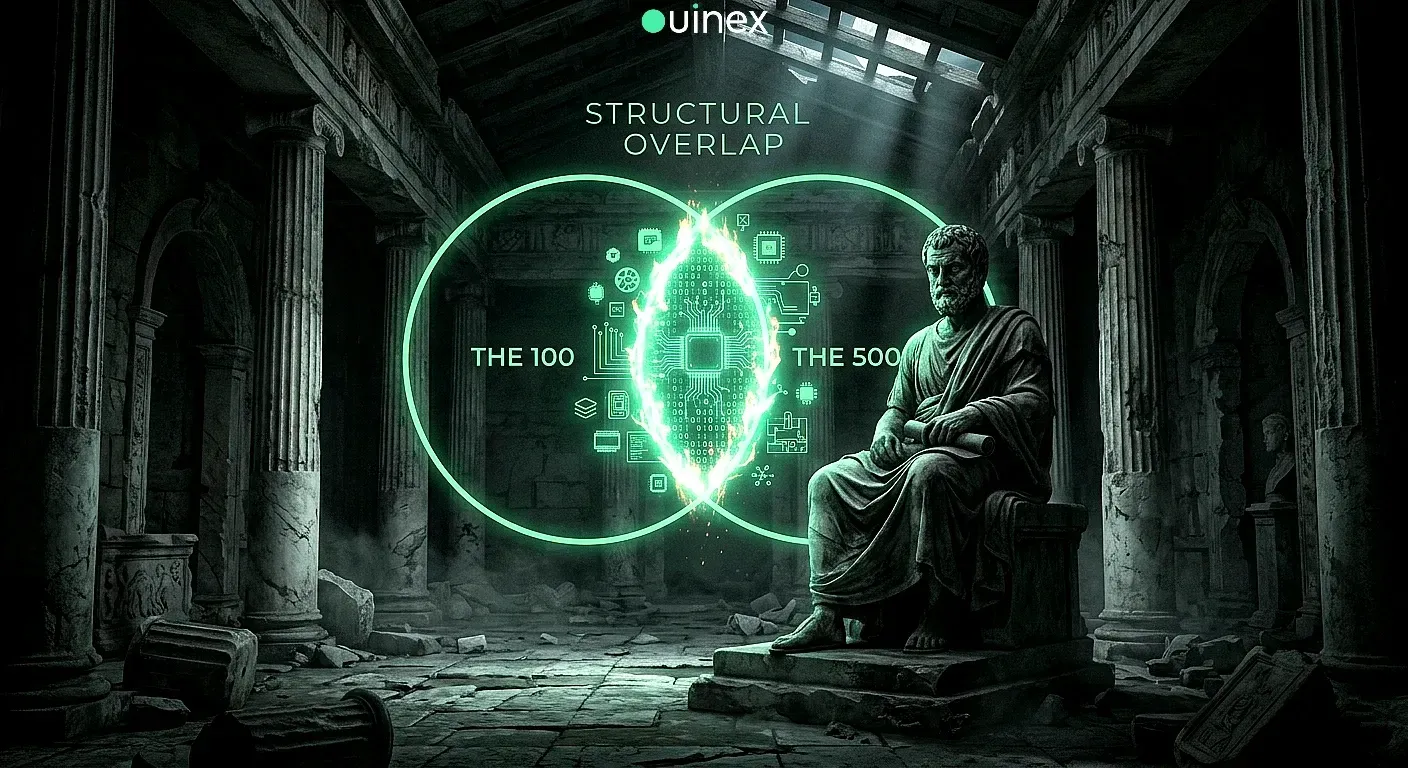
When global markets sell off, the Nasdaq and S&P 500 tend to fall together. When sentiment turns bullish, they climb in tandem. To a casual observer this makes them look like the same index wearing different names, but they're not. Their correlation is real and persistent, yet their underlying composition, risk profile, and behavour in certain market environments diverge in ways that matter a great deal if you're trading either one.
This article breaks down why these two indices track each other so closely, where they diverge, and what that correlation means for traders looking to take a position on either or both.
What Each Index Represents
The S&P 500 tracks 500 of the largest publicly listed US companies across all major sectors, technology, healthcare, financials, energy, consumer goods, and more. It's the broadest single snapshot of the US large-cap equity market and the benchmark most professional fund managers are measured against.
The Nasdaq-100 tracks 100 of the largest non-financial companies listed on the Nasdaq exchange. Because the Nasdaq exchange historically attracted tech companies, the index is heavily weighted toward technology and growth: software, semiconductors, e-commerce, and biotech dominate it. As of recent years, the top five holdings of the Nasdaq-100 account for roughly 40% of the entire index.
The key difference, in one sentence: the S&P 500 is broad and diversified, while the Nasdaq-100 is concentrated and tech-heavy.
The Correlation Between Nasdaq and S&P 500: The Numbers
Since the early 2000s, the rolling 1-year correlation between the Nasdaq-100 and S&P 500 has typically ranged between 0.70 and 0.95. That's a remarkably tight relationship. In practical terms it means that on most trading days, if one index moves up 1%, the other is likely to move up somewhere between 0.7% and 0.95%.
This correlation has strengthened since 2020 for a clear structural reason: tech giants like Apple, Microsoft, Amazon, Alphabet, and Meta have grown to represent an enormous share of the S&P 500 as well. The S&P 500 is no longer purely a diversified index. It has become partially a proxy for the same mega-cap tech
companies that dominate the Nasdaq. When those stocks move, both indices move.
Metric | Nasdaq | S&P 500 |
Number of components | 100 | 500 |
Sector focus | Tech & growth heavy (~55% tech) | Broad / diversified (28% tech) |
Financials included? | No | Yes |
Volatility (beta) | Higher | Lower more stable baseline |
Typical correlation (2020–present) | 0.85–0.95 | 1.0 (benchmark itself) |
Best used for | Tech/growth exposure, momentum trades | Broad market exposure, macro hedges |
When the Correlation Breaks Down
High correlation is the norm, but there are specific market environments where the Nasdaq and S&P 500 diverge noticeably and those divergences often present the most interesting trading opportunities.
- Rate hike cycles:
When interest rates rise sharply, growth stocks (which dominate the Nasdaq) reprice faster and harder than value stocks. The Nasdaq tends to underperform the S&P 500 during aggressive tightening cycles, as investors rotate from high-multiple tech to financials and energy. - Tech earnings divergence:
A single quarter of weak results from two or three mega-cap tech companies can drag the Nasdaq well below the broader S&P 500 performance, even if the rest of the market is holding up. - Risk-off macro events:
In a broad market sell-off driven by recession fears or systemic risk (2008, March 2020), both indices fall together, often with the Nasdaq falling more due to its higher beta. - Sector rotation:
When capital rotates into financials, industrials, or energy, the S&P 500 benefits while the Nasdaq lags, widening the spread between the two.
Understanding which regime you're in helps you decide whether to trade them together (as a correlated pair) or against each other (as a spread or rotation trade).
How Traders Use the Nasdaq / S&P 500 Correlation
For active traders, the Nasdaq-S&P 500 relationship is useful in three main ways:
- Confirmation:
If both indices are moving in the same direction with similar strength, the move has broad market backing. If one is leading and the other lagging, you may be seeing a rotation rather than a genuine directional move.
- Divergence signals:
A sustained period where the Nasdaq diverges from the S&P 500 often signals that something structural is happening in tech specifically, not just the broad market.
- Risk sizing:
Because the Nasdaq amplifies moves relative to the S&P 500, traders who want to express a bullish US equity view with more leverage often prefer Nasdaq exposure; those wanting more stability prefer the S&P 500.
Trading Nasdaq and S&P 500 via Futures: What You Need to Know
Most retail traders access these indices through ETFs (QQQ for Nasdaq-100, SPY or VOO for S&P 500) or through CFD/futures products. The futures market, specifically perpetual futures on crypto-native exchanges, offers a few structural advantages: no expiry dates, 24/7 trading, and access without a traditional brokerage account.
One thing to understand when trading perpetual futures on index products is the cost of holding a position overnight. These costs are expressed through futures funding rates and periodic payments between long and short holders that keep the perpetual price anchored to the underlying index.
When the market is heavily biased long (bullish sentiment), longs pay shorts. When shorts dominate, the dynamic reverses. Managing this cost is part of active position management on any perpetual futures platform.
Acting on the Correlation: Trade Both Indices on Ouinex
The Nasdaq and S&P 500 will likely remain highly correlated as long as mega-cap tech continues to dominate both indices. But the spread between them, which widens during rate cycles, rotation trades, and tech earnings seasons, contains real alpha for traders who know what to look for.
If you're looking to act on this correlation, you can trade Nasdaq and S&P 500 futures directly on Ouinex without a traditional brokerage account. Both instruments are available as perpetuals on our CLOB-based derivatives platform with full order book transparency, real-time depth data, and no hidden routing.