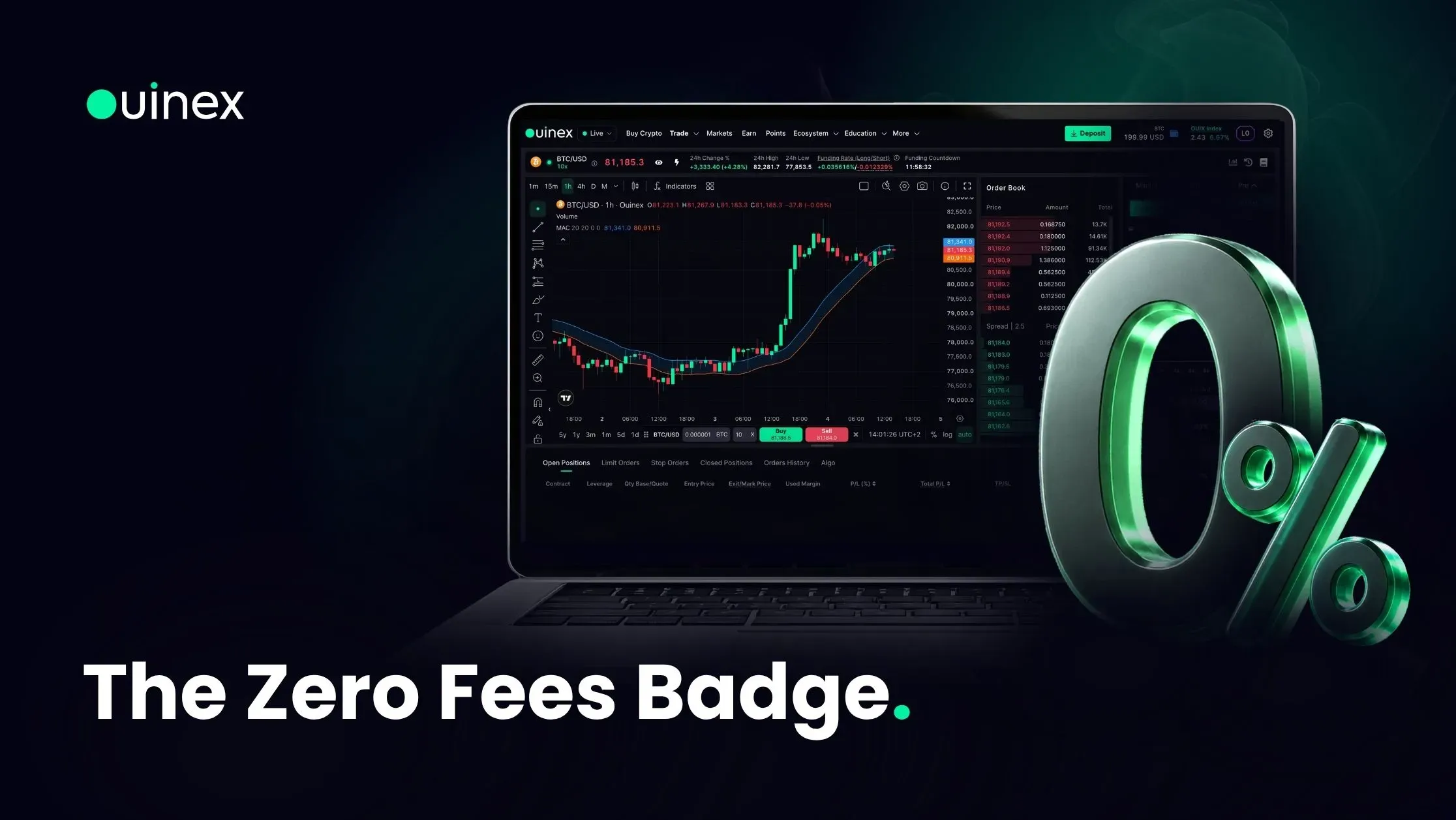
It appears on forex, stock indices and commodities. On those instruments you pay the spread and nothing else. There is no commission layer on top.
It does not appear on crypto or on stocks, and that is deliberate. Those markets carry a commission, and a badge that appeared everywhere would tell you nothing.
What "zero commission" actually means
You are paying the spread. That is not a hidden cost, but it is a real one, and a zero-commission market is not a free market.
The spread is the gap between the price you can buy at and the price you can sell at. Every instrument has one, on every platform. Cross it and you have paid it.
Commission is a separate charge applied on top of the spread, usually as a percentage of the notional value of the trade. It is a second cost layer, and it is the one the badge is telling you is absent.
So the honest description is this: on a badged instrument there is one cost rather than two. That is a genuine advantage, particularly for anyone trading frequently, a commission charged per trade compounds against a strategy in a way a spread you were paying anyway does not. It is not the same as trading for nothing, and anyone telling you otherwise is selling.
If the spread mechanism is unfamiliar, what spreads are and why exchanges hide them is the place to start, and the glossary entry on spread has the short version.
Where the badge appears, precisely
Market | Badge | What you pay |
|---|---|---|
Forex | 0 Fees | Spread only |
Stock indices | 0 Fees | Spread only |
Commodities | 0 Fees | Spread only |
Crypto perpetuals | No badge | Commission applies |
Stock derivatives | No badge | Commission applies |
Spot crypto | No badge | Commission applies |
The current rates for the markets that do carry a commission are on the fees page, along with the OUIXPower calculator.
Why it matters that these markets in particular
Forex, indices and commodities are the markets where commission has historically been least visible and most persistent. They are also the markets where a crypto-native trader is least likely to know what the normal cost structure is.
Being able to trade EUR/USD, the S&P 500 or gold without a commission layer, collateralised with crypto, from the same account as your perpetuals, is the specific thing Ouinex is for. The badge makes that concrete at the point where it matters, the moment you are choosing an instrument, rather than leaving it on a fees page you would have to go and read.
All of these are traded as CFDs: you are taking exposure to the price of the underlying, not buying the underlying itself. You do not own the index, the barrel or the currency.
How to use it
Use it as a filter, not as a reason. A zero-commission instrument is cheaper to trade than an equivalent one that carries commission, but the cost of a trade is only ever the smallest input into whether the trade was a good idea.
Where it genuinely changes the calculation is on frequency. A strategy that turns over many times a day accumulates commission faster than it accumulates anything else, and removing that layer changes which strategies are viable. A position held for three weeks is affected barely at all, because the cost that matters there is funding, not commission.
Match the badge to how often you trade, and it tells you something useful.
The bottom line
The badge means one thing: no commission on this instrument, spread only. It appears on forex, stock indices and commodities. It does not appear on crypto or stocks, because those carry a commission, and the badge is more useful for being accurate than it would be for being everywhere. The complete structure, including the markets that do carry a commission, is on the fees page.