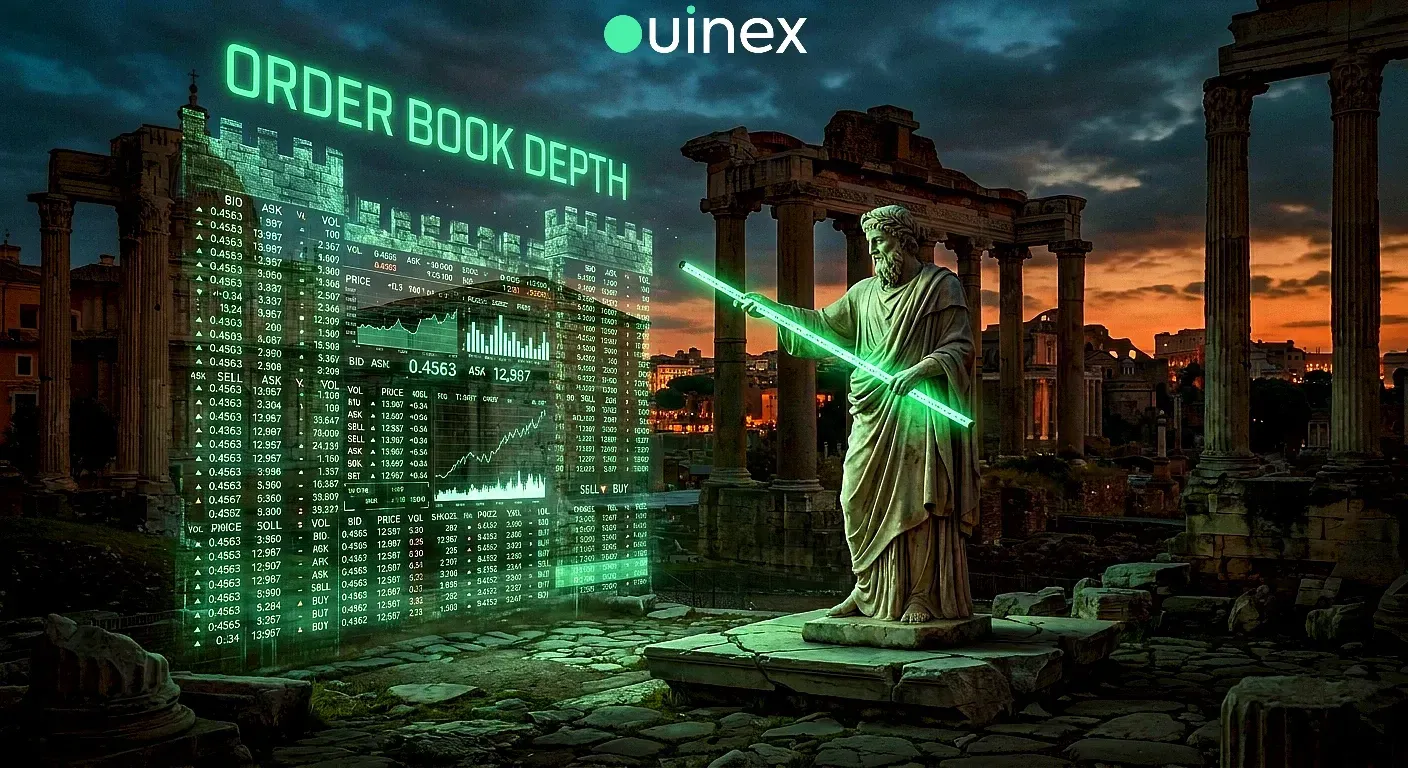
Papering the house is a century-old theater trick: give away free tickets, fill the seats, and let a half-empty show look sold out to everyone walking past the marquee.
The audience isn't there because the show is good. It's there because someone decided the room needed to look busier than it actually was. Wash trading does the same thing to a market instead of a theater, except the audience isn't real people who simply didn't pay.
It's the trader's own money, buying and selling itself, so an order book looks like a sold-out show instead of the empty room it actually is. If you've ever sized a trade off a volume chart, this is the mechanism you were trusting without knowing it.
What Is Wash Trading?
Wash trading is buying and selling the same asset: often with yourself or a colluding party: to fake trading volume and make an asset look more liquid or in-demand than it actually is. No ownership changes hands in any way that matters: the same person, or two parties working together, is on both sides of the trade. What moves is the volume number on a chart, not any real transfer of risk. You're not looking at demand when you read that number.
Wash Trading vs. Wash Sale: Don't Confuse the Two
Don't confuse this with a wash sale, an unrelated tax rule about repurchasing a security you just sold at a loss. A wash sale happens when an investor sells a security at a loss and buys a substantially identical one back within 30 days. Tax authorities disallow the loss deduction because the investor's actual market position never really changed. It's a rule about tax timing, and it applies to ordinary investors doing completely legal things with their own portfolios.
Wash trading is a different animal: the deliberate fabrication of trading activity that never should have existed, designed to deceive other market participants about supply, demand, or liquidity. Both terms describe a trade that cancels itself out from the trader's own perspective, but one is a tax accounting rule and the other is market fraud. If you searched for one and landed on the other, the wash sale rule sits with the IRS; everything from here on is about the manipulation.
How Wash Trading Works
volume attracts more volume
There are two structural versions of the same trick. In the self-trade version, one party places a matching buy and sell order for the same asset at nearly the same time and price, trading with themselves. Reported volume rises even though their net position hasn't changed at all, minus whatever fees the exchange charged.
In the colluding-party version, two or more accounts coordinate to trade back and forth, passing the same asset between each other repeatedly. It's harder for a naive volume count to catch, since the trades look like independent activity, until you notice the same handful of wallets appearing on both sides at suspiciously convenient prices, with none of the price discovery genuine competition produces.
Either version produces the same output: a chart that looks busier and more liquid than the real supply and demand underneath it. If you read volume as a signal of genuine interest instead of checking who's actually generating it, this is exactly how you get pulled in.
The motive is almost always the same: volume attracts more volume, whether it's a token signaling liquidity for a listing, an exchange padding its rankings, or a promoter making a thin market look worth entering. The fabricated number is doing marketing work the real market hasn't earned yet.
Is Every Matched Trade Wash Trading?
Here's the fair objection. Market makers place offsetting orders constantly as part of legitimate two-sided quoting, and a firm hedging one desk's position against another internally can generate trades that look, from the outside, exactly like a self-trade. If matched buy-and-sell activity alone were the crime, ordinary market-making would be illegal too.
It isn't, and the reason is intent, not mechanics. Wash trading statutes in the US and equivalent rules elsewhere require that the trade be entered into with the intent to create a false or misleading appearance of trading activity, not simply that the trade happens to net out. A market maker quoting both sides of a book to earn the spread has a genuine economic motive independent of the reported volume; a wash trader's only motive is the volume number itself. Regulators and exchanges draw that line by looking at intent, account relationships, and whether the trades served any purpose beyond appearance, not by flagging every matched order as fraud.
Wash Trading in Crypto: What the Research Actually Shows
That distinction between mechanics and intent is exactly what the two most rigorous studies of crypto wash trading were built to detect. The NBER working paper Crypto Wash Trading, by Cong, Li, Tang, and Yang, tested statistical patterns genuine trading reliably produces, such as first-digit distributions and order-size rounding.
Unregulated exchanges deviate from those patterns constantly; regulated exchanges mostly don't. Their estimate: wash trading accounts for more than 70% of reported volume on unregulated exchanges, worth trillions of dollars a year, large enough to distort rankings and temporarily move prices.
A separate peer-reviewed study, Wash Trading at Cryptocurrency Exchanges, reaches a parallel conclusion using different methods: weak regulation leaves crypto markets exposed, and wash trading is one of the most common tools exchanges and traders use to inflate the appearance of liquidity that isn't there. Between the two, the pattern holds regardless of which detection method researchers use.
The scale shows up in individual asset studies too. A Bitwise analysis submitted directly to the SEC found that roughly 95% of the Bitcoin trading volume reported by CoinMarketCap at the time didn't reflect real trades. Of the 81 exchanges Bitwise examined, only 10 showed volume patterns consistent with genuine trading, meaning most of the headline number for crypto's most-watched asset was fabricated.
This is a reason to be specific about where you trade it. A number claiming an asset is liquid is only useful if the volume behind it is real, and on the exchanges these studies examined, most of it wasn't.
Is Wash Trading Illegal?
Yes, wash trading is illegal in every major jurisdiction that regulates trading, and the law is built to punish exactly the intent described above. In the US it has been prohibited since the Commodity Exchange Act of 1936, and it's separately prosecuted as securities fraud under the Securities Exchange Act of 1934 when securities are involved. The prohibition doesn't hinge on whether anyone lost money; the offense is the fabrication itself, because it deceives every participant reading that volume as a genuine signal.
Enforcement in traditional markets shows what this looks like once intent is established. In 2019, the CFTC ordered Eagle Market Makers to pay a $350,000 penalty for wash sales, an Illinois firm sanctioned for wash sales on the Chicago Board of Trade and Chicago Mercantile Exchange, alongside a separate $150,000 CME fine for the same conduct. Nobody needed to prove a specific victim lost money; the violation was the fabricated activity itself, exactly as the statute defines it.
Crypto sits in a greyer enforcement zone only because jurisdiction over a given token is sometimes unsettled, not because the conduct is treated differently once a regulator asserts authority. Where a token is a security, or outright fraud can be shown, the same prohibitions apply. The lag isn't leniency; it's regulators catching up to a market structure that didn't exist when the statutes were written.
How to Spot Wash-Traded Volume Before You Trust It
None of these signs is proof alone, but together they're the pattern regulators describe in nearly every enforcement action on record:
- Volume that doesn't move price. A genuinely high-volume market shows real price discovery; heavy volume against a flat, static price is the single strongest tell.
- Concentrated counterparties. A small number of wallets or accounts trading back and forth repeatedly, rather than volume spread across many independent participants.
- Round-number and rhythmic trade sizes. Genuine order flow is messy; identical or evenly-spaced trade sizes at regular intervals suggest a script, not organic demand.
- Volume that vanishes off a single exchange. If an asset's liquidity collapses the moment one venue's numbers are excluded, that venue was likely doing the heavy lifting artificially.
- No matching depth in the order book. High reported volume against a thin, easily-moved order book is a mismatch worth investigating before you size a position around it.
Ouinex's own execution model is built around exactly this problem. Instead of running a traditional central limit order book, where any participant could in principle place matching buy and sell orders against each other, Ouinex uses a no-CLOB execution model: retail orders fill against competing market-maker quotes, and market makers can only make prices, not take them, with no visibility into the retail order book.
There's no shared book left for a trader, or a colluding pair of them, to wash-trade against. That's the model behind trading crypto perpetuals on Ouinex, and it's a mechanical answer.
How This Connects to Broader Market Manipulation
Wash trading rarely operates alone. It's the volume-faking half of a toolkit that also includes pump-and-dump schemes, which need fabricated trading volume to look organic, and spoofing, which fakes order-book depth instead of completed trades. Our guide to market manipulation covers the full picture: spoofing, layering, stop hunting, and marking the close, and shows how these tactics compound when used together rather than in isolation.
FAQ: Wash Trading Questions Answered
Is wash trading illegal?
Yes. It's been prohibited in the US since the Commodity Exchange Act of 1936 and is separately prosecuted as securities fraud under the Securities Exchange Act of 1934 when securities are involved. Crypto falls under the same prohibitions once a token is classified as a security or when fraud can be shown directly.
Is wash trading the same as a wash sale?
No. A wash sale is a tax rule about repurchasing a substantially identical security within 30 days of selling it at a loss, and it applies to ordinary, legal investing activity. Wash trading is the deliberate fabrication of trading volume to deceive the market, and it's illegal everywhere trading is regulated.
Is wash trading bad?
Yes. It deceives every market participant reading trading volume as a signal of real supply and demand, distorts prices temporarily, and can inflate an exchange's apparent ranking or liquidity relative to venues that aren't manipulating their numbers. Research on crypto exchanges has found wash trading responsible for the majority of reported volume on some unregulated platforms.
Conclusion
A packed theater and a wash-traded chart rely on the same illusion: activity that looks like demand but isn't backed by anyone who wants to be there. The seats are still empty; someone just paid so you couldn't tell from the outside. Trade where volume and depth are independently verifiable, treat a suspiciously smooth volume pattern as a red flag rather than reassurance, and remember a number on a screen is only informative if you know where it came from.
Sources
NBER Working Paper 30783, "Crypto Wash Trading" — Cong, Li, Tang, and Yang
ScienceDirect, "Wash Trading at Cryptocurrency Exchanges"
U.S. Commodity Futures Trading Commission — Commodity Exchange Act & Regulations
U.S. Commodity Futures Trading Commission — CFTC Orders Commodity Trading Firm to Pay Penalty for Wash Sales and Improve its Internal Controls (Eagle Market Makers, 2019)
U.S. Securities and Exchange Commission — Comment File Memorandum Referencing Bitwise Bitcoin Trading Volume Analysis, File No. SR-NYSEArca-2019-01
Virtual assets may lose their value in full or in part and are subject to extreme volatility. You may lose the full amount you invest, and your investment does not benefit from any form of financial protection. CFDs and other derivatives carry a high level of risk to your capital and can result in losses that exceed your initial deposit. Ensure you understand the risks involved and, if in doubt, seek independent advice.