If you've ever felt the odds were stacked against you on crypto exchanges, that instinct is structurally correct. Most platforms run an execution model that gives large financial institutions built-in advantages over retail traders. Ouinex was designed to close that gap with a no-CLOB execution model built from the ground up around the retail trader.
Five Key Takeaways
- The Central Limit Order Book (CLOB) is an execution model used by major exchanges including NASDAQ. In theory, it is fair: it matches buy and sell orders in sequence, and the order book is visible to all participants.
- On crypto exchanges, retail traders are matched against large financial institutions with minimal regulatory oversight. In that context, CLOB transparency becomes a liability: institutions can read the order book and act on it faster than any retail participant.
- Because institutional algorithms execute faster, retail traders rarely receive the price they clicked to execute at. They receive the next available price, slightly worse than expected. This is called negative slippage.
- Order book visibility enables manipulation tactics including spoofing, stop hunting, and layering. These are structurally possible on any CLOB platform with insufficient enforcement.
- Ouinex's no-CLOB execution model separates retail traders from market makers. Institutions can make prices but cannot take them, and cannot see inside the retail order book. In that way, they compete against each other to offer the best prices, which Ouinex feeds to retail traders.
How the CLOB Works Against Retail Traders
If you've been trading crypto and felt something was off, this section explains the mechanics behind that feeling.
Crypto exchanges use the same execution model as NYSE and other major exchanges: the Central Limit Order Book (CLOB). In theory, the CLOB is a fair system. It matches buy and sell orders in sequence, and because the order book is open to all participants, it's transparent. If anyone manipulates it, regulators intervene.
The problem on crypto exchanges is enforcement. Unlike traditional financial markets, crypto operates with limited regulatory oversight in most jurisdictions. Manipulation tactics like spoofing and stop hunting exist in an enforcement grey zone. And the exchanges depend on large institutions for liquidity, which creates a conflict of interest in policing them.
This is by default an execution model that is structurally fair in a regulated environment becomes structurally biased in an unregulated one.
Speed: Why You Rarely Get the Price You Clicked
You see an order in the order book, enter a price, and click to execute. But by the time your order reaches the matching engine, a financial institution's algorithm has already taken that price.
The price you receive is the next best available price and indeed worse than what you targeted. This is negative slippage, and it happens on nearly every trade on CLOB-based platforms. It is not a technical glitch. It is a structural consequence of matching retail and institutional orders in the same book.
Spoofing: Manufactured Price Signals
Imagine you see a cluster of large buy orders appearing in the order book just above the current market price. Other retail traders see the same thing. Anticipating the price rise, everyone buys. The price moves up and just before those large orders should execute, they disappear.
The price reverses. The institutions that placed those orders never intended to buy. They placed them to manufacture a signal, waited for retail traders to push the price up, then cancelled and sold into the move they created.
This tactic is called spoofing. It is explicitly illegal on traditional exchanges. On crypto exchanges, enforcement is inconsistent at best.
Related tactics such as layering or wash trading, follow the same logic. The visibility of the order book becomes a tool for manufacturing false signals that retail traders are not equipped to distinguish from real demand.
Why Limit Orders Sometimes Don't Execute
Limit orders are set to execute automatically when the market reaches a specific price. The assumption is simple: if the price hits your target, the order fires.
In practice on CLOB-based platforms, institutional algorithms sweep available liquidity before retail orders are processed. If enough liquidity is consumed, your limit order may not execute at all, even if the market briefly touched your price. The exchange ran out of counterparties at that level before your order reached the front of the queue.
Spreads
The spread is the difference between the bid and ask price: you buy at one price and can only immediately sell at a slightly lower one. The difference is distributed between the exchange and the market makers who provide liquidity.
Spreads are a legitimate cost of trading. The issue is visibility: on most exchanges, you need to dig into your analytics to understand what a trade cost you in spread. Ouinex surfaces this in real time, while you're placing the trade.
Stop Hunting: Engineering a Price Dip
Because the CLOB is visible to all participants, market makers can identify where clusters of stop-loss orders are concentrated. This creates a predictable vulnerability.
Say the market is at $45,100 and trending upward, but a large cluster of stop-loss orders sits at $45,000. An institution holding significant inventory sells into the market. The price drops to $45,000, triggering the stop-loss cluster. The cascade of sell orders pushes the price further, to $44,900. The institution buys back at the dip. The market rebounds.
The institution sold at $45,100, bought at $44,900, and pocketed the spread. The retail traders who were stopped out at $45,000 now face a higher price if they want back in.
Stop hunting is particularly prevalent in derivatives trading, where the exchange is often the market maker. That structure, the exchange profits when traders lose, is the one Ouinex was explicitly built to eliminate.
"On most platforms, market makers can see the order book and position against retail traders. On ours, it stays hidden from them." — Samuel Rondot, Head of Trading at Ouinex — BeInCrypto
The Ouinex No-CLOB Execution Model
The structural problems described above, slippage, spoofing, stop hunting, all share a root cause: market makers and retail traders are matched in the same visible order book.
Remove that shared visibility and the manipulation mechanics collapse.
That is the architecture Ouinex built. On the crypto perpetual futures platform and across forex CFDs, market makers can see the current market price and post bid and ask prices. They cannot see inside the retail order book. Ergo, They cannot execute against retail orders directly.
What they can do is compete against each other to offer the best prices. Ouinex selects the best bid and ask from the pool and routes them to retail traders. The institution that offers the most competitive price gets the order. This creates an incentive structure that works in the retail trader's favour, not against it.
The practical consequences for the trader:
- No stop hunting (market makers cannot see where stop-loss clusters are)
- No spoofing impact (manufactured order book signals don't exist in a hidden book)
- Improved slippage conditions
Ouinex can even deliver positive slippage when a better price becomes available between order placement and execution. Slippage is displayed in real time during the trade, and traders can set a maximum negative slippage tolerance.
Client assets are held separately from operational funds under Ouinex's safety of assets framework, an additional structural protection that CLOB-based exchanges with commingled custody do not offer.
[ Fish in a tank with sharks, that's what retail traders are on most exchanges. Ouinex is designed to be something different. ] — Forbes, May 2026
Forbes described Ouinex as a "centralized Hyperliquid", a shorthand for the combination of institutional-grade execution infrastructure with retail-first incentive design. The full architecture overview is available on the platform for traders who want the detailed technical breakdown.
Other Differentiators
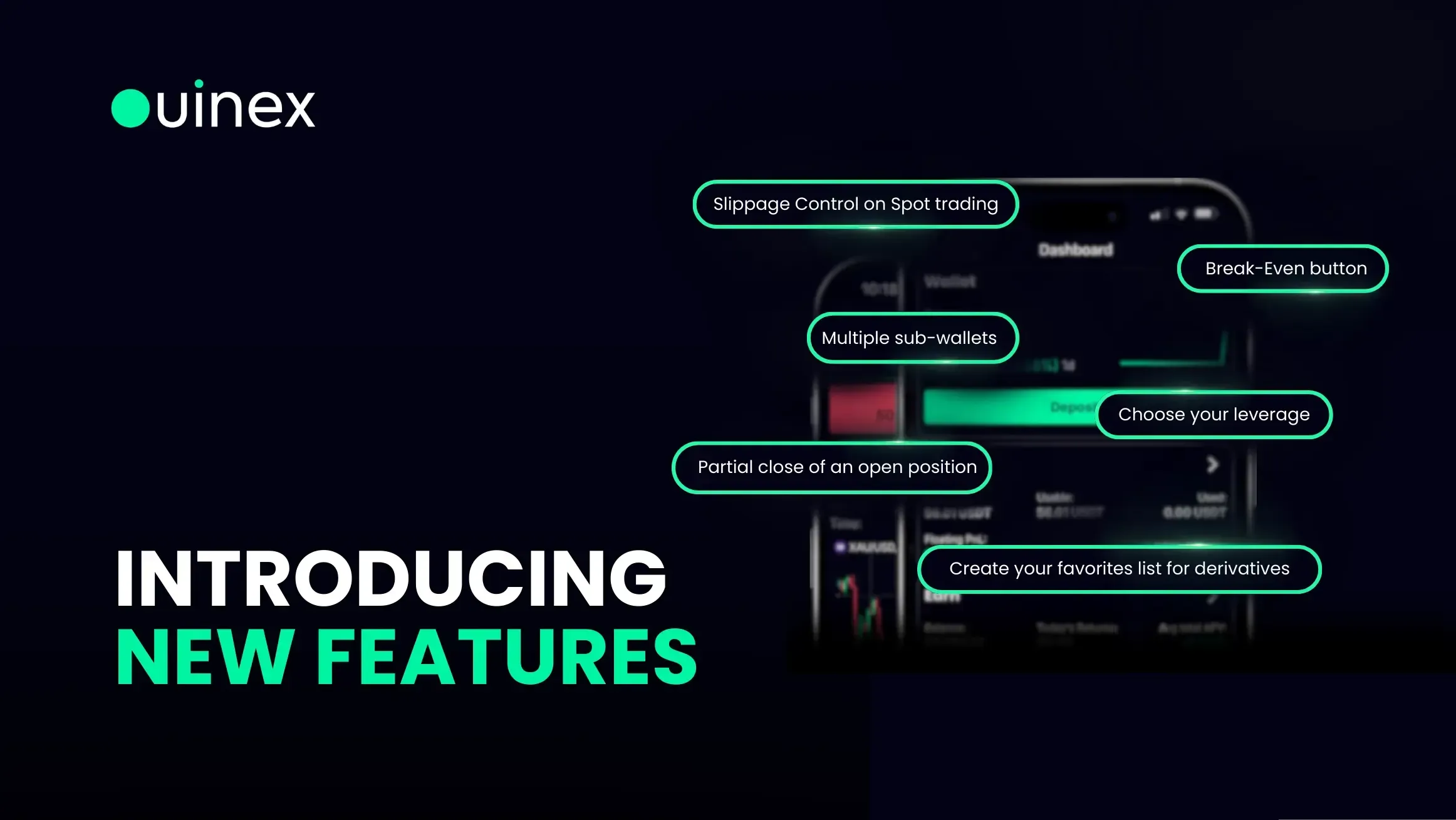
The no-CLOB model is the core structural distinction, but Ouinex adds several other features designed around the retail trader: visible spreads in real time, slippage control with user-defined tolerance, and multi-asset access to crypto perpetuals, forex, commodities, indices, and equities, all from a single regulated account.
The OUIXIndex and OUIXPower system ties trading activity to fee reductions and staking yield on $OUIX, the platform's native token, though that mechanics is covered in more detail in the ecosystem documentation.
The Sum Up
The CLOB (Central Limit Order Book) is the execution model used by major exchanges. It matches buy and sell orders fairly when all participants have comparable speed and regulatory oversight applies equally to all.
On crypto exchanges, those conditions don't hold. Retail traders are matched against institutional-speed algorithms in a shared visible order book, under light enforcement.
The result is structural disadvantage: worse execution prices, limit orders that don't fire, and order book manipulation that retail traders have no mechanism to detect or avoid.
Ouinex built a no-CLOB execution model that separates market makers from retail traders entirely. Institutions make prices; they don't take them. The retail order book is hidden from them. They compete against each other to provide the best bid and ask, and Ouinex routes the best prices to retail traders.
The goal is a platform where the exchange's business model and the retail trader's trading outcomes point in the same direction. The full architecture breakdown covers how that plays out in practice.
CFDs are complex instruments and come with a high risk of losing money rapidly due to leverage. You should consider whether you understand how CFDs work and whether you can afford to take the high risk of losing your money.