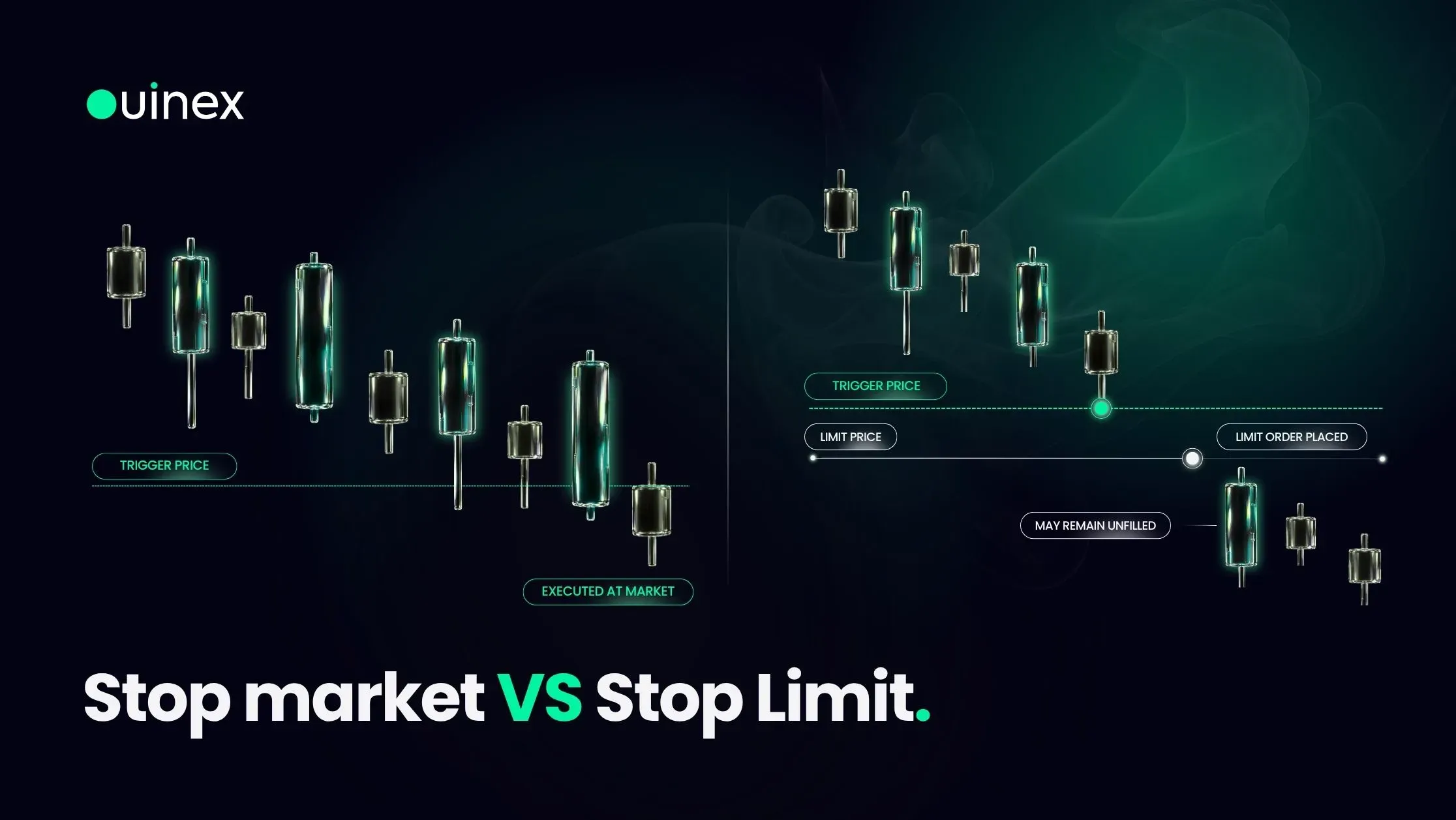
The difference between the two is what happens after the trigger fires, and it is not a detail. One prioritises getting out. The other prioritises the price you get out at. You cannot have both, and choosing the wrong one is how traders end up either filled 40 points away from their stop or not filled at all in the exact move they were protecting against. Both order types are available on Ouinex derivatives.
Watch the walkthrough: How to Use Stop Market and Stop Limit Orders on Ouinex
How a trigger order works
Every trigger order has a Trigger Price. Until the market reaches it, the order is dormant: it does not rest in the order book and does nothing at all. It only becomes a live order at the moment your trigger fires.
When the market touches your trigger, the order activates. What it becomes at that moment is the entire distinction:
- A stop market order becomes a market order.
- A stop limit order becomes a limit order, at a second price you specify.
Everything that follows comes from those two sentences.
Stop market: certainty of execution
A stop market order fires immediately at the trigger and takes whatever the market offers.
What you get: you are out. In almost all conditions the order fills within moments of the trigger, and the position is closed.
What you pay: you do not control the fill price. In a fast market, the price can move meaningfully between the trigger and the fill. In a gap, a weekend forex reopen, a session break in commodities, a hard crypto wick, there may be no trading at all between your trigger and a price some distance below it, and you will be filled at the first price where trading resumes.
That last point is the one worth internalising, because it is the reason the word "guaranteed" does not belong anywhere near this order type. A stop market order is very likely to fill, and very unlikely to fill at exactly your trigger. Those are two different properties and traders routinely confuse them.
The control you do have: Ouinex shows the estimated slippage on every order before you place it, and lets you set the maximum negative slippage you will accept. That does not make a fast-market fill land on your trigger, but it does let you decide in advance how far from it you are willing to be filled.
Use it when: being out of the position matters more than the price. That is most stop-loss situations, and it is why market is usually the correct setting on the stop side of an OCO order.
Stop limit: control of price
A stop limit order has two prices. The Trigger Price activates it. The Order Price is the limit it then places.
What you get: a floor. You will never be filled worse than your order price, full stop.
What you pay: you may not be filled at all. If the market blows through your order price before your limit can be matched, the order rests unfilled and your position stays open, in a market that has just moved hard against you.
This is a real and common outcome, not a theoretical edge case. It is also the specific scenario a stop loss exists to handle, which is why a stop limit used as a stop loss can fail precisely when you need it most.
Use it when: the exact price matters more than certainty. Entering a position on a breakout, where paying too much destroys the setup. Exiting into a target where you would rather stay in than sell cheap. Any situation where "no fill" is an acceptable outcome.
Side by side
Stop market | Stop limit | |
|---|---|---|
Prices to set | Trigger only | Trigger + Order Price |
After the trigger | Becomes a market order | Becomes a limit order |
Fill certainty | High | Not assured |
Price certainty | None | Absolute, never worse than your limit |
Main risk | Filled far from the trigger in a fast market | Not filled at all |
Natural use | Stop losses, urgent exits | Breakout entries, price-sensitive exits |
The honest summary: stop market can cost you price, stop limit can cost you the exit. Decide which of those you can live with on this particular trade, and the choice makes itself.
The setting that traps people
A stop limit order with the trigger price and the order price set to the same number is the most common configuration and the most fragile one. It works in calm markets and fails in exactly the conditions that produce the trigger.
If you are using a stop limit as a protective stop, which is already a debatable choice, the order price needs meaningful room beyond the trigger. Trigger at 100 and order price at 99.5 gives the limit half a point of market movement to work with. Trigger at 100 and order price at 100 gives it none.
This is also worth knowing: Ouinex rejects orders priced too far from, or too close to, the current market. Both limits are set per instrument, and an order placed around 30% away from the market price will not go through. If a stop limit is rejected on price, that is the safety control working, not a fault.
Placing one on Ouinex
Both sit in the order type menu at the top of the trade form, next to Market and Limit.
Stop market: choose Long or Short, enter your quantity, set the Trigger Price, adjust your leverage, optionally add take profit and stop loss levels, and confirm.
Stop limit: the same, with one extra field, the Trigger Price that activates the order, and the Order Price that controls the fill.
Both accept TP and SL at the point of entry, which is worth using. An entry order that arrives with its exits already defined is one fewer thing to remember in the minutes after a trigger fires.
FAQ
What is the difference between a stop market and a stop limit order? Both activate when the market reaches your trigger price. A stop market order then becomes a market order and fills at the next available price, prioritising execution. A stop limit order becomes a limit order at a second price you set, prioritising price control but accepting that it may not fill.
Which is better for a stop loss? Stop market, in most cases. A stop loss exists to close the position, and a stop limit can fail to fill during the fast move it was meant to protect against, leaving you in a losing position with no protection. Use a stop limit as a stop loss only when you would genuinely rather stay in the trade than exit below a specific price.
Can a stop market order fill at a worse price than the trigger? Yes, and it regularly does. The trigger activates the order; the market sets the fill. In a fast move or across a gap, the first available price can sit well beyond the trigger. The order type controls when you exit, not at what price. You can cap how far from your trigger you are prepared to be filled by setting a maximum negative slippage on the order.
Why did my stop limit order not fill? Because the market moved past your order price before a match was available. The trigger fired and the limit order was placed, but nothing traded at or better than your limit. This is the inherent risk of a stop limit and the reason it is a poor choice for urgent exits.
Are stop orders visible to other traders? A trigger order does not rest in the order book, so there is nothing to see until it fires. Separately, Ouinex runs a no-CLOB execution model: traders can see the order book and see each other's resting orders, but market makers cannot read it, which removes the structural advantage that makes stop hunting possible on a conventional central limit order book.
The bottom line
The choice between stop market and stop limit is a choice about which risk you would rather carry. If the worse outcome is being stuck in a losing position, use stop market and accept that the fill may not be pretty. If the worse outcome is transacting at a bad price, use stop limit and accept that you may not transact at all. Set the order price with real room beyond the trigger if you use a stop limit, and add your exits at the point of entry rather than after. Both order types are live now on Ouinex, alongside the full set of order types and everything else that shipped in 4.35.