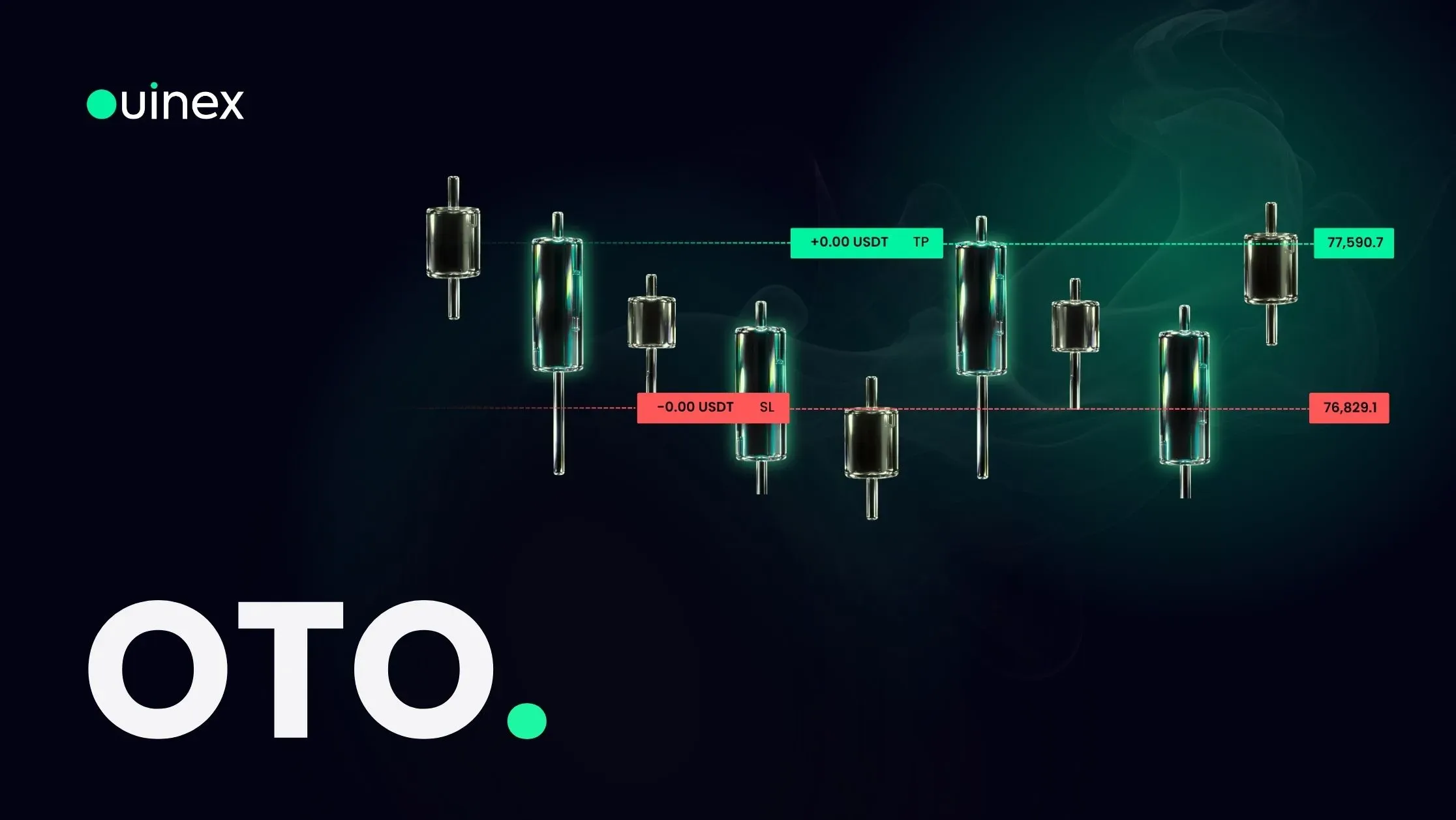
That window is usually short and occasionally catastrophic. A limit order fills at 03:00 while you are asleep, the market moves 4% against the position before you wake up, and the stop you always intended to place has never existed. OTO is now available on Ouinex derivatives, and it means the stop exists before the position does.
Watch the walkthrough: How to Use OTO Orders on Ouinex
How an OTO order works
An OTO ticket has two halves.
The primary order is your entry. You choose whether it is a Market or a Limit order, enter your quantity and set your leverage. This is the order that puts you in the position.
The secondary order is dormant until the primary fills. You choose an Exit Type, TP to take profit, or SL to protect the position, then its order type, quantity and price.
Until the primary fills, the secondary is not submitted. It is held with the ticket, so there is nothing live that could be triggered against a position you do not yet have. The moment the primary is filled, the secondary goes to the market for you.
The sequence is the point. A conditional order that only appears when there is a position to attach it to cannot fire against an empty account, which is the failure mode that makes manually pre-placed exits dangerous.
Why this matters more with a limit entry
With a market entry, you are watching. The fill is immediate, you are at the screen, and placing a stop is a matter of seconds. OTO saves you a few clicks.
With a limit entry it is a different feature entirely. A limit order sits and waits, for minutes, for a session, sometimes overnight. You do not know when it will fill, which means you cannot be present when it does. There are only two honest choices: sit at the screen until it triggers, or accept that the position will exist unprotected for however long it takes you to notice.
OTO gives you a third. The stop is defined at the same moment as the entry, attached to it, and submitted automatically. You decided your risk when you were calm and looking at the chart, rather than when you were half-awake and looking at a number that had already gone against you.
This is also why OTO pairs naturally with a stop limit or stop market entry: any entry that fires on a trigger rather than on your click has the same problem, and the same solution.
OTO, OCO, and the multi-level configuration
Ouinex 4.35 shipped three ways to attach exits to a trade. They are not competing versions of one feature.
What it links | When the second part exists | |
|---|---|---|
OTO | An entry to one exit | Created when the entry fills |
Two exits to each other | Both live from the start; the first to fill cancels the other | |
A position to up to five targets and five stops | Attached to the position, with per-level quantities |
Read the middle column and the choice makes itself. OTO is about sequence, this, then that. OCO is about exclusivity, this or that, never both. The multi-level configuration is about partial exits, some here, some there.
If what you want is an entry that automatically arrives with both a target and a stop, the cleanest route on Ouinex is a standard entry with the advanced TP/SL configuration attached, rather than an OTO with a single exit leg.
Setting up an OTO order on Ouinex
OTO is in the order type menu at the top of the trade form.
- Choose Long or Short.
- Set your Primary Order: order type (Market or Limit), quantity, leverage. This is your entry.
- Set your Secondary Order: Exit Type (TP or SL), order type, quantity and price.
- Confirm.
The order appears in the Algo tab at the bottom of the screen, where you can open the details or cancel it at any time.
One thing to check before confirming: the secondary quantity. If it is smaller than the primary, the secondary is a partial exit and the remainder of the position will be left uncovered when it fills. That is a legitimate way to trade and it is how you scale out, but it should be a choice rather than a typo. If the intention is to cover the whole position, the two quantities should match.
What OTO does not do
It does not validate your stop level. A secondary SL placed too close to the entry will be taken out by ordinary noise, and OTO will place it faithfully.
It does not protect against the gap between your trigger and your fill. If the secondary is an SL set to fire at market, it triggers at your level and fills at the next available price, which in a fast market can be some distance away.
And if you cancel the entry before it fills, you no longer have an OTO working. If you re-enter manually later, you are re-entering without a stop unless you build a new one.
FAQ
What does OTO mean in trading? One-Triggers-the-Other. It is a conditional order pair in which a primary order acts as the entry and a secondary order, a take profit or a stop loss, is submitted automatically only once the primary has filled.
What is the difference between OTO and OCO? OTO is sequential: one order creates another. OCO is exclusive: two orders exist together and the first to fill cancels the second. OTO answers "what happens after I get in"; OCO answers "which of these two exits happens".
Does the secondary order exist before the entry fills? No. It is held with the ticket and submitted only at the moment the primary is filled, so it cannot be triggered against a position you do not yet have.
Can the secondary order be both a take profit and a stop loss? The OTO ticket takes one secondary exit, TP or SL. For an entry that arrives with both a target and a stop, use a standard entry with the advanced TP/SL configuration, which supports up to five of each.
Can I cancel an OTO order? Yes. Like every algorithmic order it appears in the Algo tab at the bottom of the screen, where you can view the details or cancel it at any time.
The bottom line
OTO is worth using any time your entry is not a market order you are watching fill. Define the exit in the same ticket as the entry, match the quantities unless a partial exit is deliberate, and check the Algo tab to confirm the pair is live. The order type does not decide where your stop belongs, that is still the hardest and most important part of the trade, but it does make sure the decision you made while thinking clearly is the one that actually reaches the market. OTO is available now alongside the rest of the algorithmic order types on Ouinex derivatives.