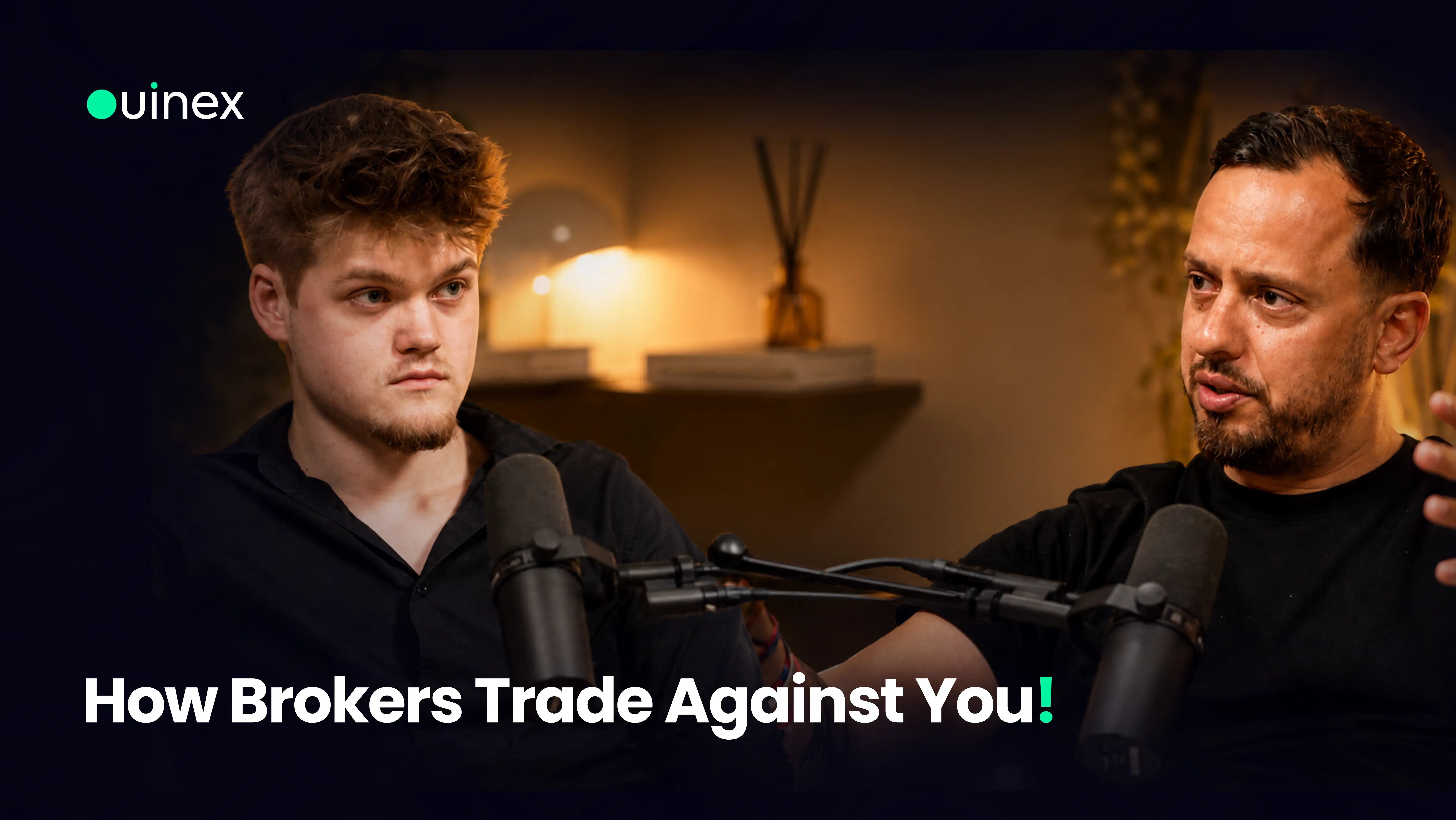
How Brokers Trade Against You: Inside Ouinex CEO Ilies Larbi's Interview
Updated June 2026
Every trade you place looks identical from where you sit: a price, a button, a confirmation. What happens in the seconds after you click is where the real story lives, and it is also where most retail traders first learn how brokers trade against you without ever being told. That is the premise Ivan Patriki put to Ilies Larbi, founder of the trading platform Ouinex, in a June 2026 episode of the podcast On the Margin. Larbi spent fifteen years at FXCM before leaving to found Ouinex in 2022, and for over ninety minutes he walked through what happens backstage when an order leaves a retail trader's screen: who sees it, who trades against it, and who profits when it goes wrong.
Think of it as a stage play. The audience watches a clean, simple performance. Behind the curtain, the cast and the people holding the ropes are doing something considerably less simple, and not all of them are working in the audience's interest. Larbi's argument is that most of crypto's trading infrastructure was copied from a stage design meant for professionals, then opened to everyone else without changing the choreography.
How Brokers Trade Against You Behind the Scenes
According to Larbi, the central limit order book, the standard matching engine behind most exchanges, was designed for institutions trading against other institutions. In that setting, both sides have execution servers, infrastructure, and speed. It is an even match. The problem, he says, is that crypto exchanges opened that same order book to retail traders running mobile apps from a coffee shop, without giving them any of the institutional tooling that makes the system fair in the first place.
That asymmetry shows up in a specific, mechanical way. Market makers who provide liquidity on an exchange are often also permitted to see and trade against the full retail order book. Place a limit order priced away from the market, and a market maker can spot it and trade directly against it before the price ever gets there.
Larbi also says it is standard practice, not a secret, for some platforms to give certain market makers privileged access to order flow data in exchange for a cut of the revenue. None of this requires fraud. It only requires asymmetric information, and a system that was never built to hide that asymmetry from the side that does not have it.
This is where the conversation moves from market structure to business model, because the order book is not the only place the imbalance shows up.
The Business Model Behind a Losing Trade
Larbi draws a hard line between two ways a broker can be structured. An A-book broker passes every client order out to the market and earns money from the spread or a commission, regardless of whether the client wins or loses. A B-book broker takes the other side of the trade internally, meaning the client's loss is the broker's direct profit.
Larbi is not arguing that internalising trades is automatically dishonest; matching a buy order against a sell order is a normal market function. The problem is the conflict of interest it creates. A B-book broker has a direct financial incentive to see its clients lose, and Ilyes Larbi says that incentive shapes which clients get onboarded in the first place: smaller, more heavily leveraged accounts are, in his telling, the ones this model actively chases, because undercapitalised traders are statistically the most likely to blow up fast.
He frames this as an industry-wide pattern rather than a one-platform accusation, and the data backs the general shape of his claim: ESMA found that 74 to 89% of retail CFD accounts across the EU lose money, with average per-client losses ranging from EUR 1,600 to EUR 29,000. A small share of clients generates most of an A-book broker's commission revenue, while B-book operators profit most from the inverse: high-churn accounts that lose quickly. Either model can be run honestly. The incentive structure is what decides whether it usually is.
The Wall Ouinex Says It Built
Ouinex's answer, per Larbi, is structural rather than promised. Market makers cannot open trading accounts directly on the platform. Instead, they connect through a prime broker relationship, stream continuous bid and ask quotes into an aggregation engine, and the engine selects the best available price for the retail client, without exposing the retail order book back to the institutions supplying liquidity. Larbi calls this a wall between the two sides and says he is not aware of another crypto exchange running the same setup, while acknowledging he has not audited every exchange in existence.
The revenue model follows the same logic. On Ouinex's traditional-markets instruments (forex, indices, commodities, and stocks), the platform charges no commission and earns only the spread built into the aggregated price. On crypto, it charges a small commission because that is how the underlying liquidity providers price their service.
Larbi also points to an internal comparison he ran against Hyperliquid's published fee schedule, where he says Ouinex's spreads were meaningfully tighter and the order book several times deeper. Worth stating plainly: that is a self-run comparison, not an independently audited one, and the linked fee schedule is there so readers can check the underlying numbers themselves rather than take the comparison on faith.
The OUIX Token
Ouinex is launching a token, OUIX, with a total supply of 200 million. Half of that supply was pre-sold directly to roughly two thousand members of Ouinex's existing trading community, with no venture capital involved, and Larbi frames the absence of VC money as the core difference between OUIX and the token launches he says drain retail money on a regular basis.
He lays out, in detail, how a typical rug pull works (a founder builds hype around a product that barely exists, then dumps their holdings and disappears) and how a VC-driven pump and dump differs (funds buy unlocked or lightly vested allocations specifically because they expect retail demand to show up at listing, then exit within weeks).
Presale buyer tokens for Ouix are locked for three years and unlocked gradually over twenty-four months, which he says removes most of the sell pressure a new listing would otherwise face.
That is a reason to treat OUIX the way Larbi tells his own audience to treat everything else: verify what can be verified, and recognise where the only thing standing between a good outcome and a bad one is somebody's word.
Signal Seller Who Is Selling You Out
Larbi's clearest, least self-serving advice in the whole conversation concerns a different kind of operator: the signal seller. His test is simple. If a trading signal genuinely worked, the person selling it would trade it themselves rather than license it out for a few hundred dollars a month. A real edge, priced honestly, would have to cost something closer to six figures a month to make economic sense for the seller to give it up at all. Anything cheaper than that is, by his logic, a marketing product wearing a trading product's clothes. He also describes a pattern he says he has seen directly: influencers paid through broker affiliate programmes that reward them specifically when their followers lose money, which means the influencer's incentive runs in the opposite direction from the audience's.
CFD and crypto derivatives trading carries a real risk of capital loss, regardless of which side of the order book a platform is built to protect. Before choosing where to trade, the structural question, who can see your order, who profits from your loss, and who is on the other side of your trade, is worth asking before the personal one. Understanding how brokers trade against you starts with that question. |