Before airlines trust a pilot with passengers, they put them in a simulator calibrated to reproduce the same instrument readings, the same responses, and the same failure scenarios as a real aircraft.
The simulation builds decision-making under pressure, in an environment where mistakes cost nothing but time.
A demo trading account works on the same logic. The price data is real. The order execution mirrors live conditions. The only thing absent is consequence and that absence is precisely what makes it useful.
What Is a Demo Trading Account?
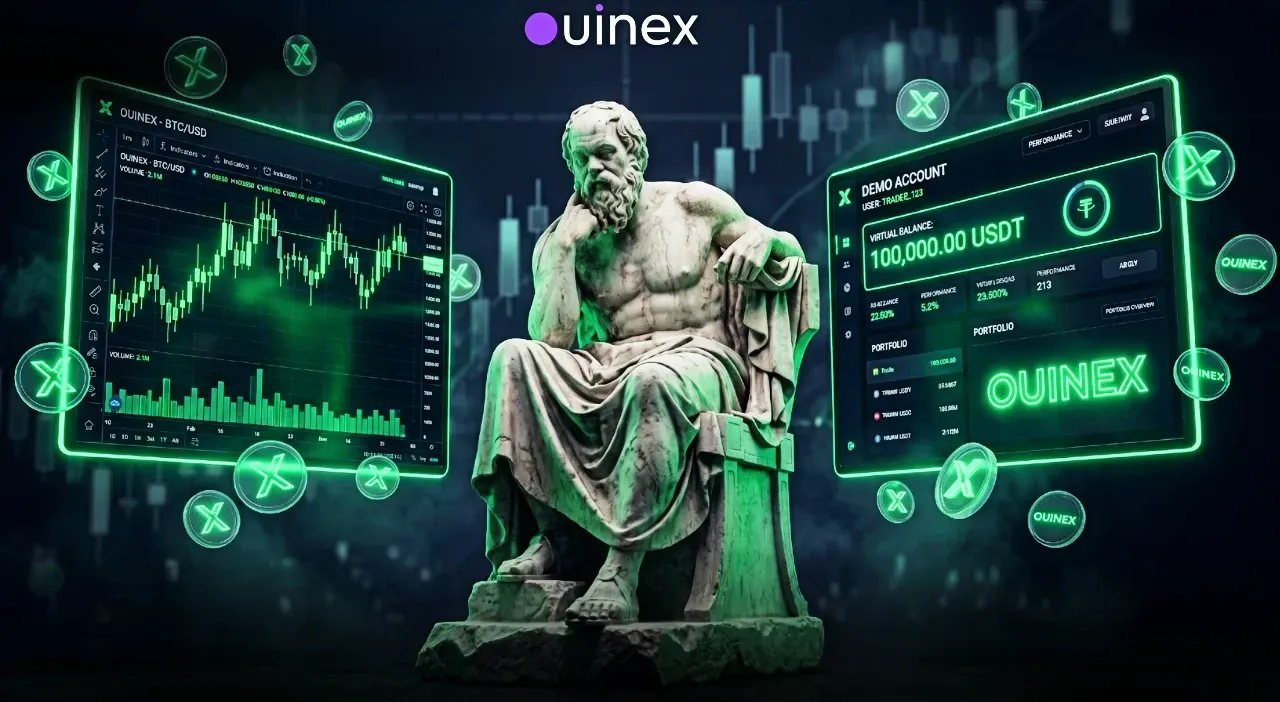
A demo trading account is a practice environment provided by a trading platform that lets you trade using virtual funds against real market data. Prices update in real time. Orders execute at live market prices. Every instrument available in the live account is available in the demo.
The only difference is that the money is not real.
The virtual balance, typically set between $10,000 and $100,000, can be reset at any point. Blow the account through poor trades, reload it and try again. Build it to double its starting value, and you have learned something worth knowing before real capital enters the picture.
For a beginner, a demo trading account is the closest thing to a consequence-free learning environment that markets offer. That is not a small thing. Most financially meaningful skills require real stakes to develop. On Ouinex you can learn to trade on a demo account and earn crypto along the way, and that’s what differentiates Ouinex demo account from the rest of the trading Platform. Every action you take is rewarded.
you cannot learn to manage a business on a spreadsheet alone. Trading is one of the few disciplines where the simulation is close enough to reality that it actually builds transferable skill. Its because the inputs are identical. The only variable missing is your own emotional response to real money moving.
How a Demo Trading Account Works
The mechanics are worth understanding precisely, because they directly determine how useful the demo period will be.
The data is live
Prices update from the same feeds that power the live trading environment. If EUR/USD drops 40 pips while you hold a long position on a demo, your account reflects that move with the same precision a live account would. There is no artificial smoothing, no delayed feed, and no simplified price model.
Orders execute as they would on a live account
Market orders, limit orders, stop-losses, take-profits, all function as designed. You encounter slippage during volatile periods. You see how quickly a market order fills when liquidity is thin. You experience what happens when a stop-loss triggers at a price slightly worse than the level you set. These are not abstract concepts after you have experienced them in a live market environment, even on demo.
The platform is identical to the live version
This is the element that matters most. A demo account is not a simplified interface you will later need to unlearn. The charting tools, the risk management features, the order types, the position sizing mechanics: you are using the same system that handles real money. The learning you accumulate on demo transfers directly.
Who Should Use a Demo Trading Account?
The short answer is everyone.
Experienced traders use demo accounts when they move into a new instrument or asset class. A trader who has been profitably trading forex CFDs for three years does not improvise when moving into commodities CFDs, they run the new market on demo first to understand its volatility profile, its spread behaviour, and its liquidity conditions during different sessions.
For beginners specifically, a demo account solves a problem that no amount of reading resolves: the gap between knowing how trading works theoretically and actually doing it under live market conditions. You can work through every course available on technical analysis and still hesitate at the moment of placing your first order. A demo account is where that hesitation gets trained out of you at zero cost.
The honest counterargument is worth stating: because no real money is at risk, some traders develop habits on demo that collapse under live conditions. Ignoring a stop-loss, holding a losing position far past where discipline should have closed it, doubling a position to recover a loss: these errors surface when real capital is involved, not before. A demo account can produce a misleading sense of readiness.
The answer is not to skip but to trade it with the same rules and the same discipline you would bring to a live account. That requires intention. Most traders who waste their demo period treat it as a game. The ones who benefit treat it as a rehearsal.
What Can You Trade on a Demo Trading Account?
A well-designed demo account provides access to the same instruments available in the live environment. On Ouinex, that means you can practise across forex CFDs, currency pairs including majors, minors, and exotics, stock CFDs, commodity CFDs including gold and oil, and crypto perpetual futures across Bitcoin, Ethereum, and other digital assets.
The practical advantage of practising across markets on the same platform is context. Different markets behave differently. Gold has its own volatility patterns. Crypto perpetuals carry higher vol than forex majors. Commodity CFDs respond to supply data in ways equity-based instruments do not. Spending time across these markets on demo before committing capital to any of them is pure preparation.
CFD trading involves significant risk of capital loss. Losses can exceed your initial deposit. Trading with leverage means both gains and losses are magnified. Not all traders profit from CFD trading. Past performance in a demo account does not indicate future results in a live account.
Demo Account vs Paper Trading: Is There a Difference?
Paper trading and demo trading describe the same core concept, practicing with virtual rather than real money, but the implementation is different enough to matter.
Paper trading in its original form meant manually recording hypothetical trades in a notebook or spreadsheet: writing down an intended entry price, tracking the outcome against real prices, and calculating a theoretical profit or loss. The obvious problem is self-reporting bias. A trader doing this honestly gets useful data. A trader who retroactively adjusts their theoretical entry price to be more favourable gets nothing useful at all.
A demo account removes the self-reporting layer entirely. The platform executes your orders in real time at actual market prices, with the same latency and the same execution mechanics as a live account. The trade log is objective. You cannot improve your entry price in hindsight. If you held a position through a drawdown and it recovered, the account records that you held through a drawdown and recovered, not that you made a clean, timely exit.
For practical purposes: if a platform offers a demo account, there is no reason to use manual paper trading instead.
How to Open a Demo Trading Account
The process is designed to be fast. No deposit is required. On most platforms, no ID verification is needed to access a demo account. The steps are straightforward:
- Navigate to the demo account registration page on the platform.
- Enter a name and email address.
- Confirm the email if prompted
- Select your starting virtual balance and the markets you want to explore.
- Start trading immediately.
The entire process takes two to five minutes. There is no financial commitment at this stage, you are simply entering an environment where the cost of learning is zero. And on Ouinex, you earn while you learn.
How Long Should You Stay on a Demo Account?
This is the question most beginners do not ask early enough. The default assumption is that a demo is something to rush through, a waiting room before the real experience begins. That framing produces traders who go live underprepared and lose capital they could have protected.
There is no correct number of days. The signal that you are ready to consider a live account is not time-based; it is condition-based. You are ready when your strategy produces consistent results across at least 30 trades under the same rules. You are ready when you close losing trades at your predetermined stop-loss level without adjusting it mid-trade. You are ready when the platform's mechanics like order types, margin, position sizing start to feel instinctive rather than studied.
There is also an upper limit on the value of demo trading. Spending six months on demo when you are already meeting those conditions produces diminishing returns. At some point the only thing a demo account cannot give you is the experience of trading with real consequences and that experience is available only in a live account.
What Happens After Your Demo Account?
A demo trading account is a starting point, not a destination. The progression is deliberate: you use a demo to build platform fluency, test a defined strategy, and develop the risk management habits that will protect you when real capital is at stake. Once those elements are in place, the logical next step is a live account with a starting balance that you can genuinely afford to risk in full.
Most traders who move from demo to live successfully do so because they treated the demo as a rehearsal. The ones who struggle are usually those who either spent too little time on demo or too much time, building demo-specific habits that do not survive contact with real stakes.
The question of which platform to use for that next step is worth thinking through carefully. A full breakdown of what separates a good demo trading account from a great one: including platform features, instrument availability, and what the transition to live looks like is covered in the best demo trading account guide.
Ready to start practising?
Ouinex offers a free demo account with no deposit required. Real market data, full platform access, no time limit. The cost of not starting is exactly the same as the cost of starting except one of them actually builds something. Plus, we stand out, learn and earn.