US-Iran Ceasefire 2026: Market Impact, Oil Prices and What Comes Next
Updated April 2026
What Just Happened with US-Iran Talks?
A two-week ceasefire between the United States and Iran was announced on April 8, 2026, brokered by Pakistan, halting 40 days of US-Israeli strikes on Iran. Iran agreed to reopen the Strait of Hormuz while US-Iran peace negotiations continue in Islamabad.
The announcement sent shockwaves through financial markets, but this time, in the opposite direction. Assets that had been under pressure for five weeks repriced almost instantly. Equities surged, oil prices per barrel dropped sharply, and safe-haven demand collapsed within hours which is one of the fastest and broadest market reversals seen in recent years, driven entirely by a single geopolitical announcement.
How Did Markets React to the US-Iran Ceasefire?
The reaction was immediate across every major asset class:
Asset | During conflict peak | After ceasefire |
Brent Crude | Above $109/barrel | Fell toward $95/barrel |
Dow Jones | Under pressure | +1,325 points (+2.8%) |
S&P 500 | Under pressure | +2.5% |
Nasdaq | Under pressure | +2.8% |
Russell 2000 | Under pressure | +3% |
US Dollar | Safe-haven bid | Softened |
Both WTI and Brent posted their biggest single-day declines since April 2020. This kind of movement, fast, broad and directional, illustrates exactly why geopolitical events matter to traders across every asset class, not just energy.
Oil, Equities, Forex, Crypto: What Each Market Was Telling Us About the US-Iran War Market Impact
This conflict demonstrated something experienced traders know well: geopolitical events do not move just one market. They move everything simultaneously and in different directions.
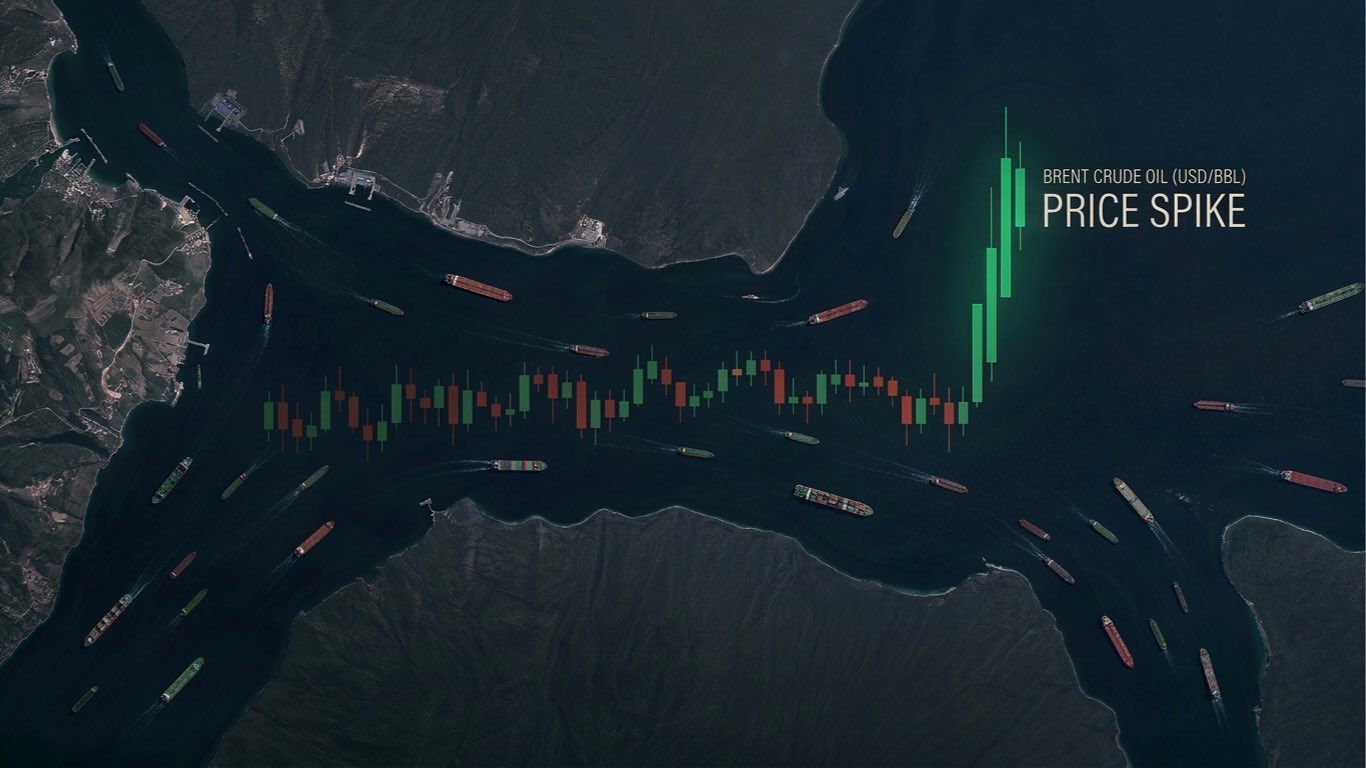
Oil had the most direct impact. Supply disruption equals price spike. De-escalation equals price drop. The relationship is direct and fast. Oil prices per barrel surged 55% in a single month before collapsing on ceasefire news, a move that rippled across every other asset class.
Equities moved inversely to oil throughout the conflict. Higher energy prices compress corporate margins, raise inflation expectations and undercut the case for rate cuts, all bearish for stocks. The reverse applied the moment the ceasefire was announced.
Forex was one of the most interesting markets throughout. The euro suffered disproportionately because Europe is a major energy importer, high oil prices hit the eurozone harder than the US, which produces much of its own energy. The dollar benefited from safe-haven flows throughout, then softened on the ceasefire news.
Crypto felt the macro pressure throughout. Bitcoin struggled to break above $67,000 as inflation expectations rose and risk appetite deteriorated.
Is the Ceasefire Permanent? What Comes After US-Iran Tensions and Peace Talks
The ceasefire is fragile. The two-week window is a negotiating pause, not a peace deal. Talks are scheduled in Islamabad on April 10, but the gap between US and Iranian positions on US-Iran relations remains wide, particularly on nuclear enrichment and the withdrawal of US combat forces from the region.
Israel has stated that Lebanon is not covered by the ceasefire, and continued strikes there risk pulling Iran back into active hostilities. New attacks were reported in the Gulf on the same day the truce took effect. JD Vance described the agreement as a "fragile truce."
If US-Iran peace talks succeed, the risk premium built into oil prices per barrel could continue to unwind and equities would likely extend their rally. If the ceasefire breaks down, markets would likely reverse sharply, oil could retrace toward its recent highs, equities would sell off, and safe-haven assets would come back into demand. Markets are not trading a known outcome. They are pricing probabilities across a wide range of scenarios.
Why Is the Strait of Hormuz Important to Financial Markets?
The Strait of Hormuz is a 33-kilometer-wide passage connecting the Persian Gulf to the Gulf of Oman. Before the conflict, it carried approximately 20 million barrels of oil per day and one-fifth of global LNG.
Here is what its closure meant in practice:
Before closure:
- Brent crude around $70/barrel
- Normal shipping routes, stable energy supply
- Inflation expectations contained
- Equities and risk assets supported
After closure:
- Brent surged 55% in one month, a record since 1988
- Global shipping disrupted
- Inflation expectations rose sharply
- Equities sold off, safe-haven demand surged
The reopening, even a temporary one, reverses that risk premium almost instantly, which is exactly what markets priced in on April 8.
Trade Every Market That Moves with Ouinex
When a geopolitical event like the US-Iran ceasefire hits, the opportunity is never confined to a single market. It shows up in oil, equities, forex and crypto all at the same time.
On Ouinex, you can trade spot crypto, perpetuals, Forex, indices and commodities from a single wallet, with full transparency on spreads and slippage before you execute.
Explore the Ouinex Academy and our Glossary to understand how global events impact financial markets.
👉 live.ouinex.com/login/signIn
FAQ
Did Iran open the Strait of Hormuz?
Iran agreed to allow shipping to resume as part of the two-week ceasefire announced on April 8, 2026. The first ships transited within hours, though uncertainty remains.
Is the US-Iran ceasefire still in place?
As of April 9, 2026, the ceasefire is fragile. Israel has continued strikes in Lebanon, Iran has accused the US of violations, and US-Iran talks are scheduled in Islamabad on April 10.
Why is the Strait of Hormuz important?
It carries approximately 20% of the world's daily oil supply and one-fifth of global LNG. Any disruption directly impacts oil prices per barrel and financial markets worldwide.
What happened to oil prices after the ceasefire?
Brent crude fell toward $95 per barrel, posting one of its biggest single-day declines since April 2020. During the US-Iran conflict it had surged above $109.
Trading digital assets, derivatives and other leveraged products involves significant risk and may result in the total loss of capital. This article is for informational purposes only and does not constitute financial or investment advice.