The crypto boom has given millions of ordinary investors access to markets once reserved for hedge funds and banks. However, many crypto exchanges conceal opaque practices that critics claim unfairly disadvantage retail traders.
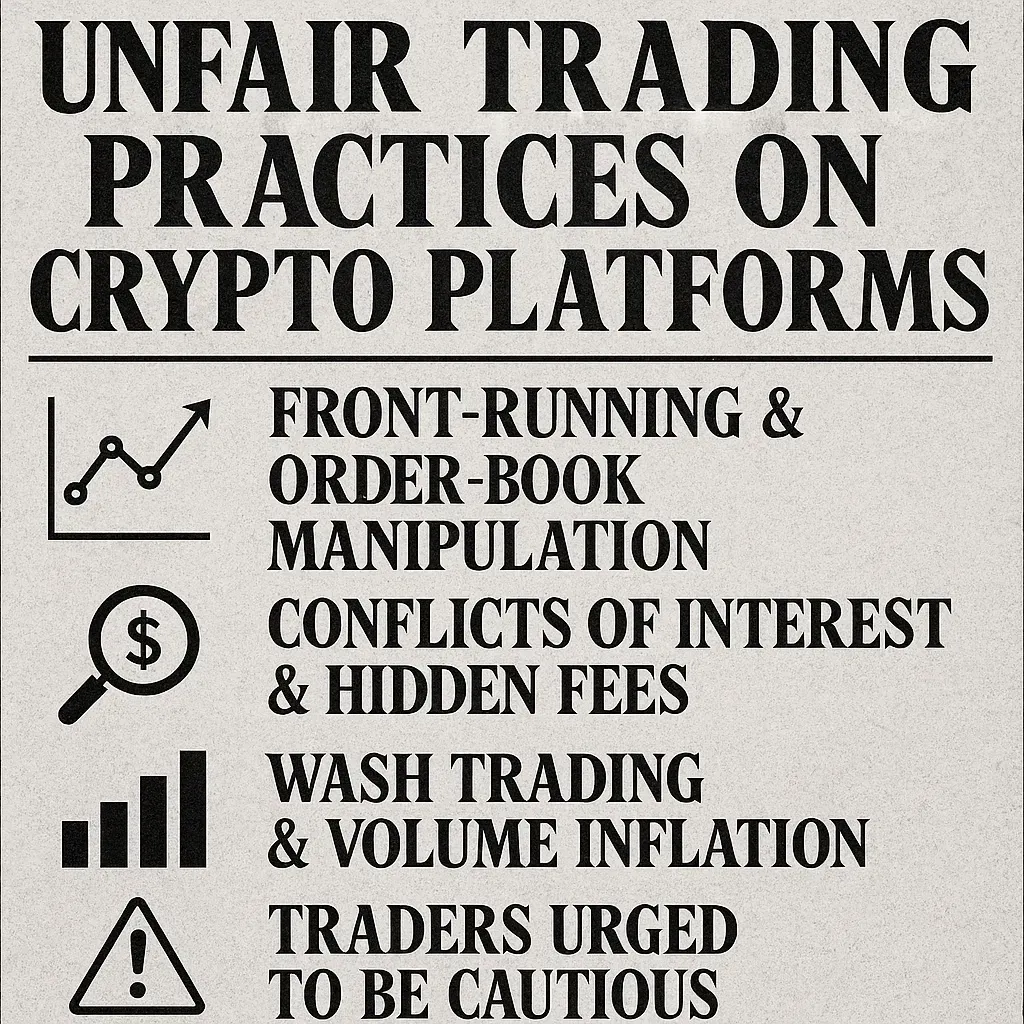
Front‑Running and Order‑Book Manipulation
One of the most controversial issues is front running, where an exchange or a market‑making partner uses privileged data about customer orders to trade ahead of them. On some platforms, large internal desks can see incoming buy orders milliseconds before they hit the market, allowing them to drive up prices and sell at a profit.
Order‑book manipulation is another red flag. Some platforms have been accused of running spoofing operations, where fake buy or sell orders are placed to create the illusion of momentum. Retail traders often follow these signals, buying high and selling low without realising they've fallen victim to manipulation.
Conflicts of Interest and Hidden Fees
Many centralised platforms operate as both brokers and market makers, creating potential conflicts of interest. In theory, they match buyers and sellers; in practice, some profit directly from spreads widened at the trader’s expense.
Hidden fees are equally notorious. Beyond the headline trading fee, platforms may charge inflated withdrawal costs or apply “liquidity surcharges” on volatile pairs. For smaller investors, these micro‑costs quietly drain returns.
Wash Trading and Volume Inflation
Investigations by analytics firms like Kaiko and Nansen have repeatedly highlighted wash trading, a practice where exchanges generate fake volume by buying and selling with their accounts. This creates the impression of deep liquidity and rising interest, enticing new investors into thinly traded tokens.
While top‑tier regulated exchanges are less prone to such tactics, hundreds of offshore platforms remain largely unpoliced, leaving traders vulnerable.
Regulatory Scrutiny Intensifies
Regulators in London, Brussels and Washington have taken notice. The UK’s Financial Conduct Authority recently warned that exchanges must ensure “fair and orderly trading environments”, while the EU’s Markets in Crypto Assets (MiCA) framework now mandates detailed disclosures of trading practices.
However, enforcement remains uneven. Many platforms operate across jurisdictions, exploiting regulatory gaps. For now, the burden often falls on traders themselves to do due diligence and on whistle-blowers and blockchain sleuths who expose misconduct.
How Traders Can Protect Themselves
Experts advise sticking to platforms with strong regulatory footprints, transparent fee structures and clear segregation between exchange operations and marketmaking activities. Using limit orders instead of market orders can also reduce exposure to sudden price spikes caused by manipulation.
“Crypto remains a frontier market,” said Clara Hughes, a partner at fintech law firm Dyer & Lowe. “The rewards are real, but so are the risks. Retail traders should anticipate potential disadvantages until global standards are enforced.
Stay on top of any cryptocurrency news by following us on X @ouinex