When diving into cryptocurrency markets, traders often face a fundamental choice: trade the spot market or trade derivatives like perpetual futures. While both avenues offer ways to profit from price movements, the underlying mechanics, particularly visible in the order books, are dramatically different.
Understanding these differences can give traders a crucial edge in reading market dynamics and anticipating moves more accurately.
Spot Trading vs Futures Trading: The Basics
In spot trading, you are buying and selling the actual cryptocurrency. When you buy Bitcoin (BTC) on a spot exchange, you own that Bitcoin outright. If you believe BTC will rise from $60,000 to $65,000, you must have the full $60,000 available to purchase 1 BTC and realise a $5,000 profit if your prediction proves correct.
In contrast, futures trading allows you to speculate on the price movements without owning the underlying asset. Crucially, futures contracts enable traders to go long or short and, importantly, to use leverage. This means that with significantly less capital, sometimes as little as 5-10% of the asset's value, you can control the same position size.
Naturally, futures have become the preferred playground for retail traders, thanks to the lower upfront costs and the ability to profit in both rising and falling markets.
Order Books: Spot vs Futures
The order book, a real-time list of buy and sell orders, reveals much about the behaviour and intent of market participants. However, the type of market (spot or futures) dramatically affects how the order book should be interpreted.
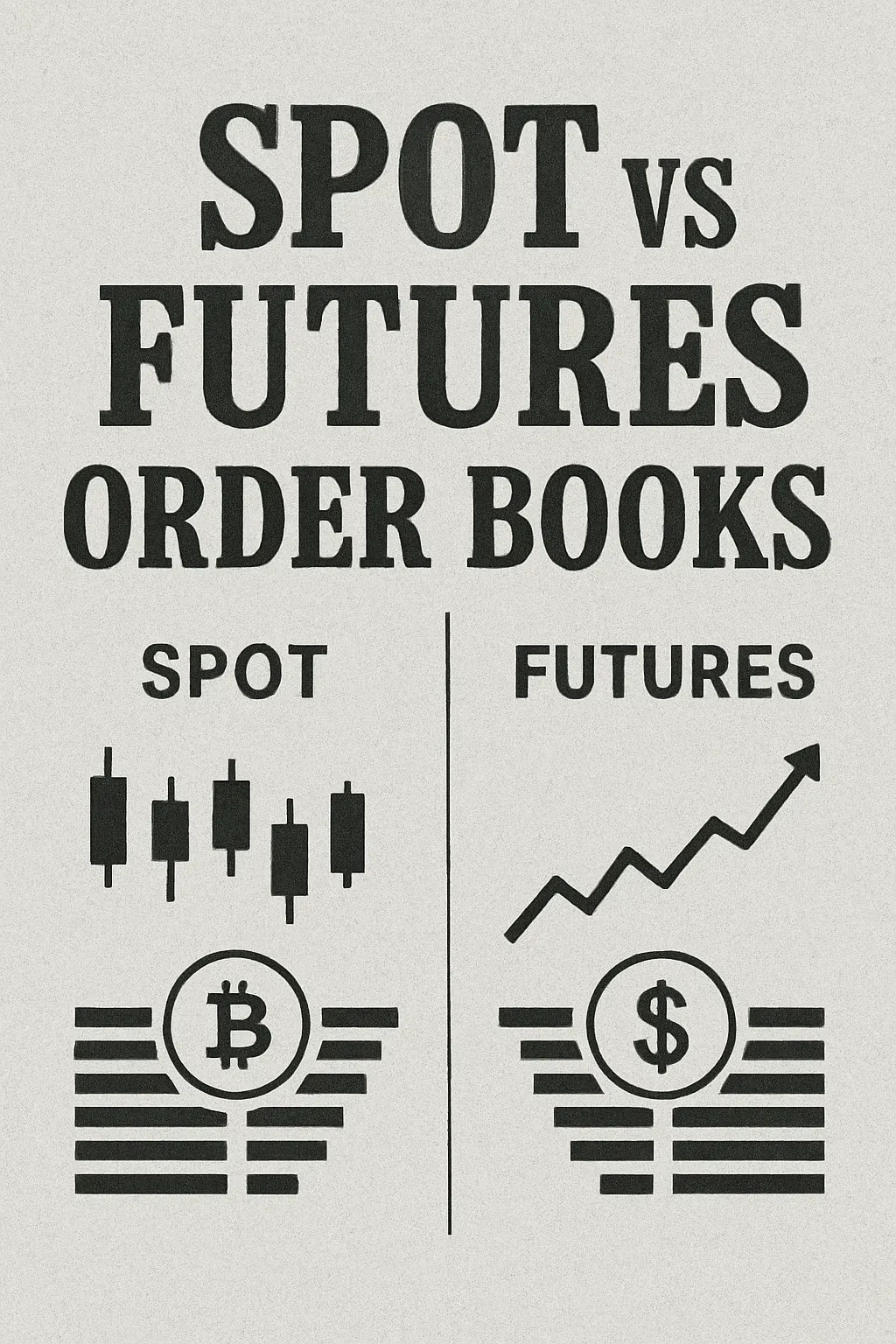
In futures markets, the order book is often flooded by market makers. These participants aren't necessarily taking a directional bet on the asset’s price. Instead, they place bids and offers to provide liquidity, profiting from the bid-ask spread. As a result, futures order books are typically thick with orders above and below the current price, masking true supply and demand levels.
This can mislead inexperienced traders. What might seem like strong support or resistance is often just artificial liquidity provided by automated systems rather than genuine market intent.
In the spot market, things look different. Here, large players and institutional traders those with enough capital to influence price leave visible footprints. The spot order book often shows large limit orders strategically placed at key psychological levels, revealing where big players are willing to accumulate or distribute assets.
Interestingly, when analysing filtered spot data (highlighting only large orders), you can observe that major price turning points correlate with the presence of significant spot liquidity. By contrast, the futures order book tends to remain congested with orders regardless of price action.
Why It Matters for Traders
Recognising the difference between real buying or selling interest and manufactured liquidity is crucial. Spot market order books can provide valuable clues about genuine market strength or weakness, while futures order books often require a more cautious interpretation.
For traders seeking to read market structure more effectively, learning to prioritise the spot order book, especially when looking for meaningful levels, could significantly improve trade entries and exits.
In a landscape dominated by volatility and noise, understanding these subtle but vital differences could be your next big trading advantage.
Stay on top of any cryptocurrency news by following us on X @ouinex