Best Platforms to Stake USDC in 2026
Traditional savings accounts are paying below inflation while USDC staking is paying 4-12% APY and that gap is the entire focus of this article.
USDC is the dollar-pegged stablecoin issued by Circle and backed by audited cash reserves, It holds its $1.00 value while generating yield. No price risk. Just interest on dollars held on-chain or with a regulated platform.
The question is not whether to stake USDC. It is where, and what you are agreeing to when you do.
This guide ranks five platforms by three criteria: yield, security, and liquidity.
What USDC staking actually means
The term 'staking' covers two different mechanisms. Know which one you are using.
DeFi lending means supplying USDC directly to a protocol like Aave. Borrowers pay interest; smart contracts execute the settlement. You retain custody of your keys throughout. The code is public, the rates are live on-chain, and no company sits between you and your yield.
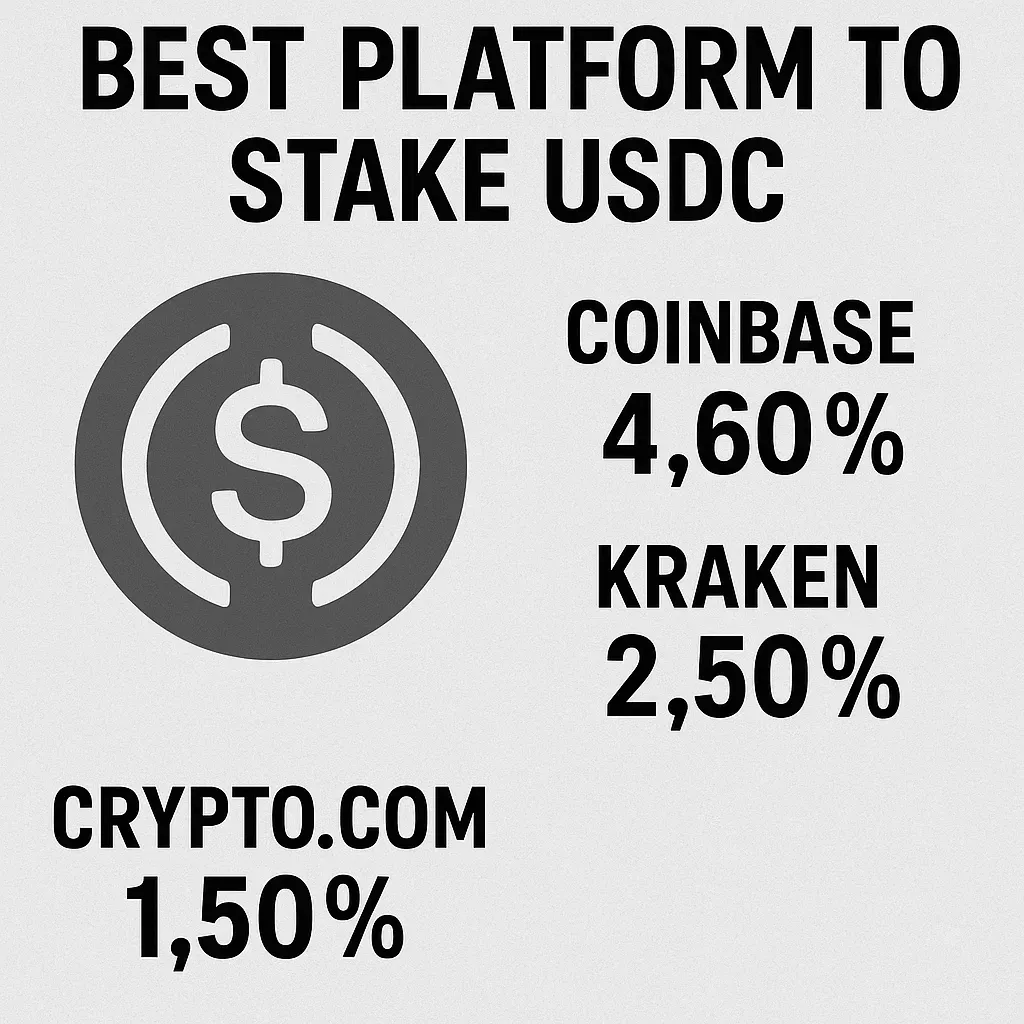
CeFi yield accounts work differently. You deposit with a reputable platform like Ouinex, Coinbase, Crypto.com which pools funds, manages the yield strategy, and pays you a fixed or variable rate. Simpler. But you are trusting a company, not a contract.
At a glance: five platforms, three criteria
Best Platforms to Stake USDC in 2026
Use this to orient. Then read the full breakdown for whichever platform matches your risk profile.
Platform | APY Range | Type | Lockup | Best For |
Ouinex Earn | 4–12% | CeFi DeFi-backed | None | Regulated yield Full liquidity |
Aave (Polygon/Base) | 4-7% | DeFi | None | Self-custody On-chain transparency |
Coinbase | 4-5% | CeFi | None | Beginners US-regulated security |
Yearn Finance v3 | 7-11% | DeFi (automated) | None | Yield maximizers Passive DeFi |
Crypto.com Earn | 4-8% | CeFi | Optional | Mobile-first Flexible or locked |
1. Ouinex Earn 4–12% APY, no lockup
APY: 4–12%
Type: CeFi (DeFi-backed pools)
Lockup: None
Best for: Regulated yield with full liquidity
Ouinex occupies an unusual position in this market: DeFi-level yields through a CeFi interface. Your USDC is deployed into audited DeFi liquidity pools, but access runs through Ouinex's. You get the yield without managing wallets, gas fees, or protocol risk directly.
The no-lockup structure matters. Most platforms offering yields above 7% require you to commit funds for 30 to 90 days. while your USDC On Ouinex earns in real time and withdraws without complications.
For users who want accountability alongside performance, plus audited pools, regulated interface, no anonymous deployers, this is the reference point in the CeFi/DeFi category.
2. Aave (Polygon / Base) — 4–7% APY, self-custody
APY: 4–7%
Type: DeFi (non-custodial)
Lockup: None
Best for: Self-custody, on-chain transparency
Aave has more TVL, more audits, and more history than any other lending protocol in DeFI USDC staking. You supply USDC. Borrowers pay you interest via smart contract. The entire transaction is on-chain, non-custodial, and transparent in real time on DefiLlama.
Deploying on Polygon or Base keeps gas fees below $0.10. Ledger and Trezor connect directly. For users who will not accept third-party custody under any terms, Aave is the standard.
The yield ceiling is lower than Ouinex or Yearn. That is the price of self-custody.
3. Coinbase: 4–5% APY
APY: 4–5%
Type: CeFi (centralised)
Lockup: None
Best for: Beginners, US investors, conservative holders
For us based citizens exclusively, Coinbase's USDC rewards programme has one advantage: it is regulated under US federal law. No smart contract risk. No counterparty opacity. Circle and Coinbase are founding partners as well, USDC was built for this.
The yield is the lowest in this comparison. That is not a flaw. It reflects the risk-adjusted reality: A REGULATED option charges the smallest premium.
4. Yearn Finance v3: 7–11% APY, automated vault
APY: 7–11% (dynamic)
Type: DeFi (automated multi-pool vault)
Lockup: None
Best for: Yield maximisers, DeFi power users
Yearn does not pick one lending pool. It distributes your USDC across multiple protocols simultaneously, rebalancing continuously to capture the highest available rate. The result is the second highest dynamic APY after Ouinex in this comparison and the most complex risk profile.
Yearn's vaults are audited. TVL is significant. But layered smart contract exposure means a vulnerability in any underlying protocol can affect your position. This is not a platform for users who do not understand what they are approving when they sign a transaction.
If you are a DeFi power user and yield optimization is the goal, Yearn is the instrument.
5. Crypto.com Earn: 4–8% APY, mobile-first
APY: 4–8%
Type: CeFi (centralised)
Lockup: Flexible or optional fixed terms
Best for: Mobile users, CRO holders, flexible/fixed hybrid
Crypto.com's differentiator is optionality. Flexible terms give you liquidity; fixed terms (1 or 3 months) unlock higher yield tiers. CRO holders receive an additional APY boost, if you already hold CRO for the Visa card programme, the yield economics here improve meaningfully.
The platform has one of the best mobile experiences in this category especially in interface quality.
CeFi or DeFi
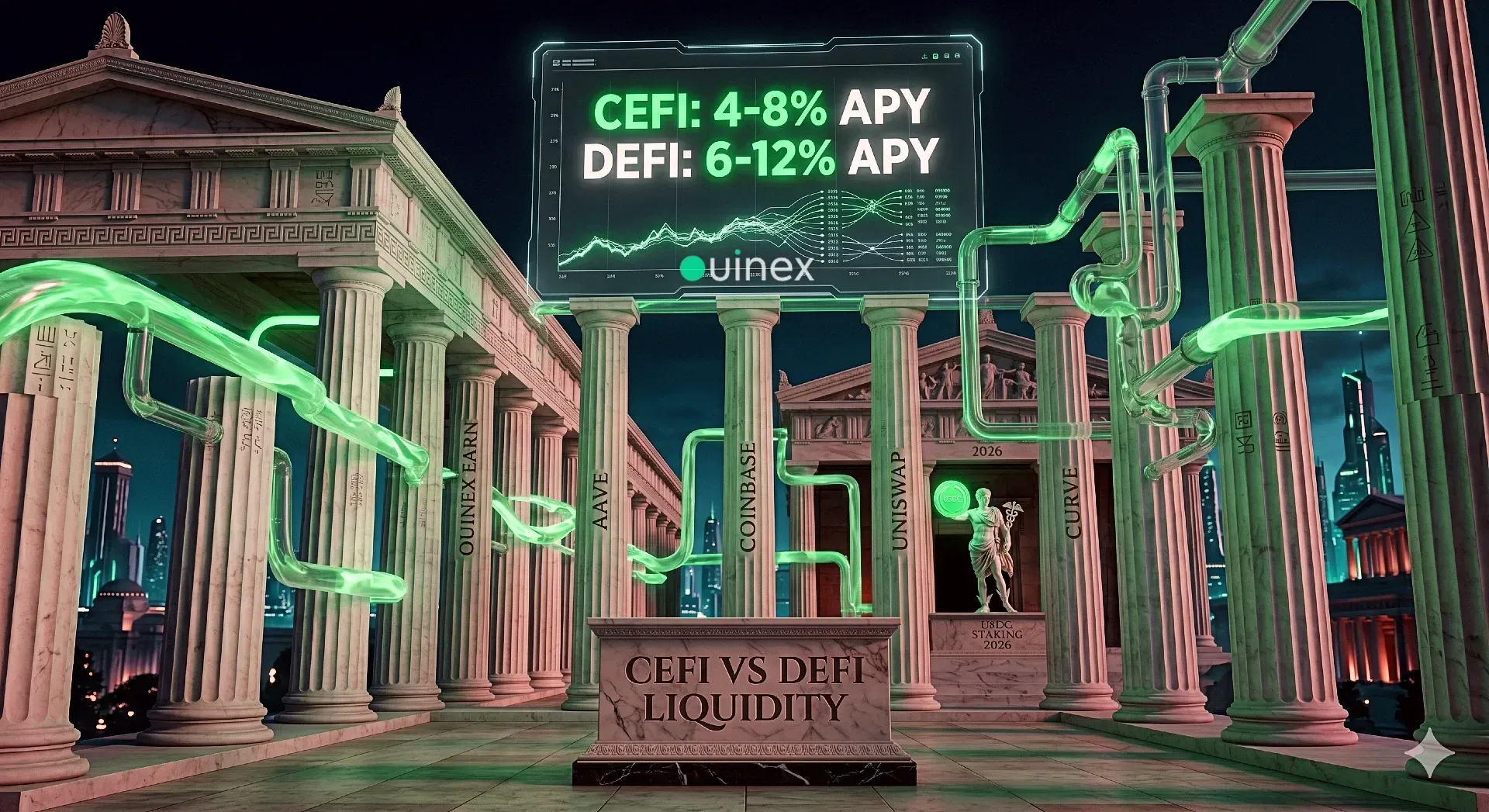
There are two structures. Everything follows from the choice between them.
Choose CeFi if:
- You want a single interface without wallet or gas management
- You require regulated, KYC-compliant infrastructure
- You prefer predictable yield over maximum yield
- You are entering DeFi for the first time and need a lower-friction starting point
Choose DeFi if:
- Non-custodial is a requirement, your keys, your assets, full stop
- You want on-chain transparency: rates, pool balances, and audit reports all publicly verifiable
- You are comfortable approving smart contract interactions from a hardware wallet
- You accept smart contract risk as the trade-off for removing counterparty risk
For most users entering this market, Ouinex Earn is the rational first position, regulated, audited, liquid. DeFi can be the second move once the mechanics are understood.
The risks of USDC staking
Smart contract risk
Every DeFi protocol on this list has been audited. Audits reduce risk. They do not eliminate it. Code can contain undiscovered vulnerabilities. TVL above $1B is a useful proxy for protocol maturity, not a guarantee of safety.
CeFi counterparty risk
Celsius and BlockFi were also paying yield in 2022. CeFi platforms carry platform-level insolvency risk regardless of their marketing. The mitigation is regulation, reserve transparency, and KYC compliance, which is why Ouinex's regulatory structure and Coinbase's US licensing are substantive differentiators, not marketing copy.
USDC depeg risk
USDC briefly fell to $0.87 in March 2023 when Silicon Valley Bank failed. It recovered within 72 hours. Circle has since restructured its reserve management. The risk is real and historically contained, but it is not zero.
Regulatory risk
Stablecoin yield products are under active regulatory scrutiny in the US and EU. Access may change by jurisdiction without advance notice. Verify local legality before depositing.
Frequently asked questions
What is the best platform to stake USDC in 2026?
Depends on what you are optimising for. Regulated yield with no lockup: Ouinex Earn, 6–10% APY. Self-custody on-chain: Aave on Polygon. Maximum yield with DeFi risk: Yearn Finance v3, up to 11%. Simplest entry with US regulatory cover: Coinbase, 4–5%.
Where can I stake USDC for the highest APY?
Yearn Finance v3 reaches 7–11% dynamically by routing across multiple lending pools simultaneously. Ouinex Earn reaches 12% with a regulated interface. The yield premium over Coinbase or Aave reflects layered smart contract exposure, and that trade-off is explicit, not incidental.
Is USDC staking safe?
No financial instrument is risk-free. CeFi staking carries counterparty risk. Celsius and BlockFi are the case studies. DeFi carries smart contract risk and audits reduce it, but not eliminate it. USDC depegged briefly in March 2023 and recovered. So choose regulated platforms with audited pools and size positions accordingly.
What are USDC staking interest rates in 2026?
4–5% on conservative CeFi platforms (Coinbase). 6–12% on regulated CeFi with DeFi-backed pools (Ouinex Earn). 4–7% on Aave. 7–11% dynamically on Yearn Finance v3. Rates shift with lending demand; these figures reflect current market conditions, not guaranteed fixed returns.
What is the difference between centralised and decentralised USDC staking?
- CeFi: you deposit with a company that manages yield on your behalf. You trust the platform.
- DeFi: you interact directly with smart contracts. The code manages settlement. You trust the protocol.
CeFi is simpler and carries counterparty risk. DeFi requires a Web3 wallet and carries smart contract risk.
Can I stake USDC without a lockup period?
Yes. Ouinex Earn and Aave both offer fully flexible USDC staking withdrawals at any time, no penalties. Crypto.com Earn offers both flexible and fixed terms. Fixed terms yield more; flexible terms preserve full liquidity.
How do I start staking USDC?
- For CeFi, create an account on Ouinex, complete KYC, deposit USDC, and select Ouinex Earn. Yield accrues from deposit.
- For DeFi, acquire a Web3 wallet (MetaMask or Ledger), fund it with USDC, navigate to Aave.app, and supply USDC to the lending pool.
See our full step-by-step guide on how to stake USDC for the complete walkthrough.
How does staking USDC compare to staking USDT or DAI?
USDC typically yields slightly less than USDT on equivalent platforms, in exchange for stronger reserve transparency and US regulatory standing. DAI (now USDS) is fully decentralised and carries additional mechanism risk. For most risk-aware users, USDC offers the best balance of yield, liquidity, and institutional credibility.