
Trading Guide: Narratives and Multi-Timeframe Analysis
What is a narrative in trading?
The narrative is the storyline or logical structure through which you, and most people, approach the market.
The narrative of a trading plan is the overarching theme that explains why and how you will trade this plan. It comes from your objectives, market analysis, strategies, and risk management rules, forming a coherent whole that guides your daily actions.
How do you build a trading plan based on your profile?
An effective trading plan must be built around your personal profile: risk tolerance, goals, experience, and available time. It must be specific, written down, and regularly reviewed to stay relevant and effective.
Timeframes (TF)
Always choose your timeframes based on your trading horizons.
Reminder: analysis scales / confirmation scales
- Case 1: W1/H4 - swing/medium term
- Case 2: H1/H1 - swing
- Case 3: H4/M15 - day trading
- Case 4: H1/5' - intraday
- Case 5: 15'/1' - scalping
If you are in case #2, you need to know the underlying trend on those timeframes.
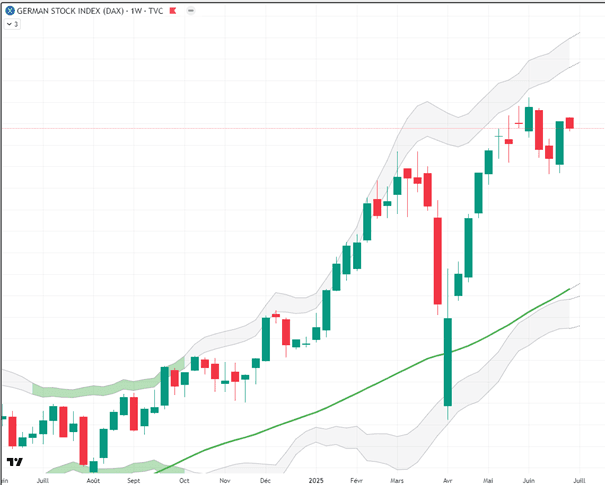
W1:
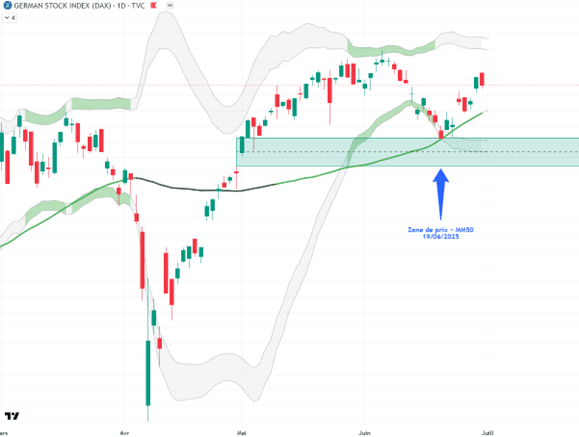
D1:
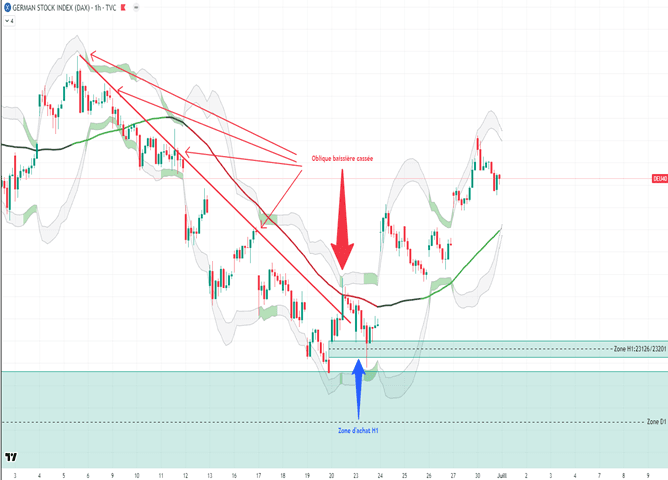
H1:
Example of TF analysis
If W1/D1 are bullish, but H1 gives a bearish signal, this means that in intraday mode, the asset's prices may fall, thus presenting a potential short trade opportunity. However, the move will probably be limited because there's a retracement underway in this larger bullish trend, likely to recover a key area on D1 and then resume the main trend.
Examples:
Weekly (W1): Underlying bullish trend
Daily (D1): Identifying a daily support area + 50 MA
H1 Analysis: Building the narrative
H1: Since we're in case #2, we know the underlying trend (W1 and D1) is bullish, with a support zone + D1 50 MA likely to serve as support.
This is where our story takes shape!
1. We'll wait for either a breakout of a previous high at the close, or a change of trend by breaking a trendline (here, the break of a bearish trendline). That was the case here!
2. We'll wait for a pullback into the hourly zone (here, 23126/23201) to buy, with a stop loss on H1 close below that same zone.
3. In this case, even if you entered at the very top of the zone (23201), the trade was at one point at a latent loss of 120 points (not much for a swing trade) and then already delivered more than 820 points in 5 days!
Summary
Know your underlying trend on your higher timeframes (analysis scales), wait for a trend change (breakout of highs/lows or trendlines), take position in the zone (confirmation scales), your stop is clearly defined at close on the same TF, offering a good risk/reward on this kind of plan.
Ludovic Bertola
01 July 2025
Note: This guide presents the fundamental concepts of trading based on narrative market analysis and the use of multiple timeframes to optimize entry and exit points.