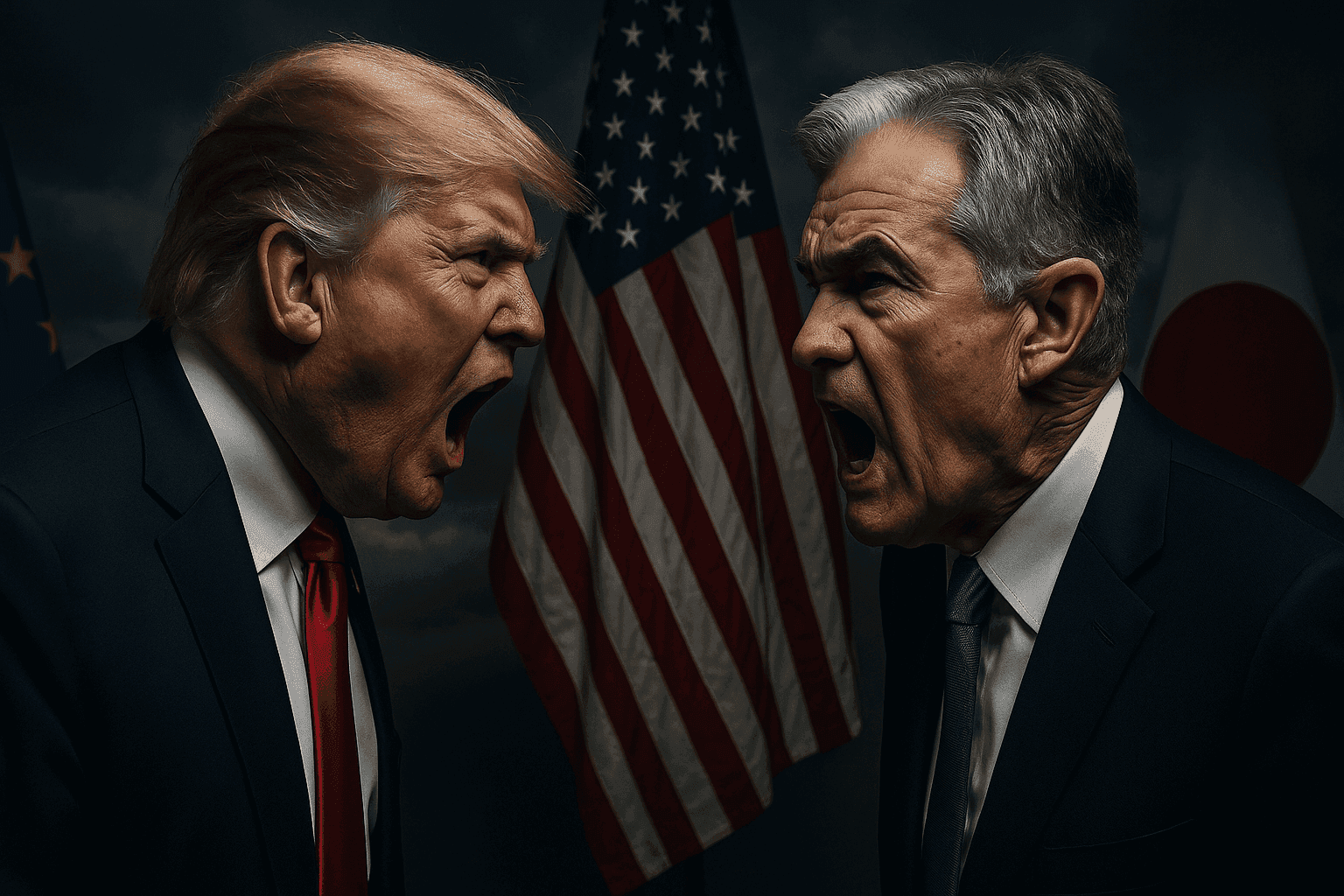
The summer of 2025 promises to be fraught with tension for global financial markets. A rumor out of Washington, straight out of a political thriller, was enough to ignite the financial world: Donald Trump, the frontrunner in the US presidential race, is said to be considering firing Jerome Powell, the current Chairman of the Federal Reserve. In an environment of extreme volatility, where every statement can wipe out billions of dollars in minutes, this possibility has sparked panic.
The Dollar Caught in the Storm
At the heart of this tempest, the dollar plummeted, trapped between speculation and panic. All over the world, from New York to Singapore, traders rushed to safe-haven assets, widening spreads and driving up the futures on long-term U.S. interest rates. Behind this chain reaction lies a major fear: that one of the fundamental pillars of global economic stability—the independence of the U.S. central bank—could collapse.
A Few Words Sowing Doubt
Donald Trump tried to cool things down by saying he currently had no intention "for now" of letting Jerome Powell go. However, the caveat he added did not go unnoticed: he would only rule out that possibility in the absence of "fraud" or "mismanagement". This "little phrase" spread like wildfire, opening the door to all sorts of interpretations. All the more so since Trump has been relentlessly criticizing the Fed's monetary policy for weeks, considering it too restrictive despite controlled inflation and a dynamic job market.
Growing Concern on Wall Street
In the hushed halls of Wall Street, anxiety is rising. Major financial players are viewing any attempt to undermine the Fed’s authority with great suspicion. For them, the credibility of the dollar and the stability of bond markets rely precisely on the central bank's ability to withstand political pressure, especially during times of global uncertainty.
Global Repercussions: Impact on Europe and Asia
This episode in American politics immediately spilled over into Europe. In London, the British pound weakened—not only due to Trump’s threats of restarting a trade war with the European Union but also because of a climate of widespread risk aversion affecting all “secondary” currencies. The European Central Bank and the Bank of England must now deal with the indirect impact of this transatlantic institutional earthquake. British monetary authorities have even publicly mentioned a possible rate cut if employment were to slow, clear evidence of the instant repercussions of U.S. turmoil on global monetary policies.
In Asia, caution prevailed. Markets reacted with some restraint, but general sentiment remains shaped by distrust. Asian investors know that any doubt about the Fed’s credibility would have major consequences for the dollar’s value, the cost of financing emerging economies, and global capital flows.
Bluff or Real Plan? The Stakes of Independence
At the heart of this saga, every strategist is asking: is this just a bluff by Donald Trump to pressure Jerome Powell on the eve of crucial rate decisions, or a real plan for political takeover of the Federal Reserve? U.S. monetary history shows such threats are not trivial and revive the specter of a precedent where the executive might dare cross the red line of institutional independence.
A New Era of Global Currency War?
Beyond the markets, this tension reveals the new face of the global currency war. Now, the issue is no longer just about rates or inflation. It’s a battle of influence among politics, economics, and institutions. If Donald Trump succeeds, the entire balance of reserve currencies and the dollar’s role as a universal safe asset will be at risk. The impact would be felt from Frankfurt to Beijing, from London to Tokyo—because the slightest loss of faith in the dollar would trigger a global risk reassessment, higher U.S. debt risk premiums, and a massive return of volatility.
The Game Is Far From Over
However, the game is far from over. Jerome Powell's supporters, both in the government and Congress, are multiplying messages of support, reminding everyone that any dismissal attempt could trigger an institutional, even judicial crisis. If Trump persists, the matter could reach the Supreme Court, opening an unprecedented constitutional debate about the separation of powers in the United States. As for Powell himself, his legitimacy is tested as much in the markets as at the top of the state: he must stay the course, reassure without yielding, and maintain the stability of an already stressed financial system.
For traders, investors, or mere observers, the coming saga is thrilling on many levels. It proves yet again that global finance is never so fragile as when it believes itself safe from political shocks. The war of nerves between Trump and Powell may just be another episode in a long string of future showdowns, where each camp stakes its credibility, its worldview, and above all the future of markets in the months ahead.
In this context, vigilance is required: every tweet, every statement, every hint from the top of government can now swing a session one way or another. More than ever, the independence of central banks becomes a global political battleground, and both traders and retail investors will have to assess its impact day by day. If Trump crosses the red line, the consequences won’t be limited to Wall Street: the entire global financial system could enter a new era of uncertainty and volatility.
The IVT Team
July 17, 2025