The Main Story
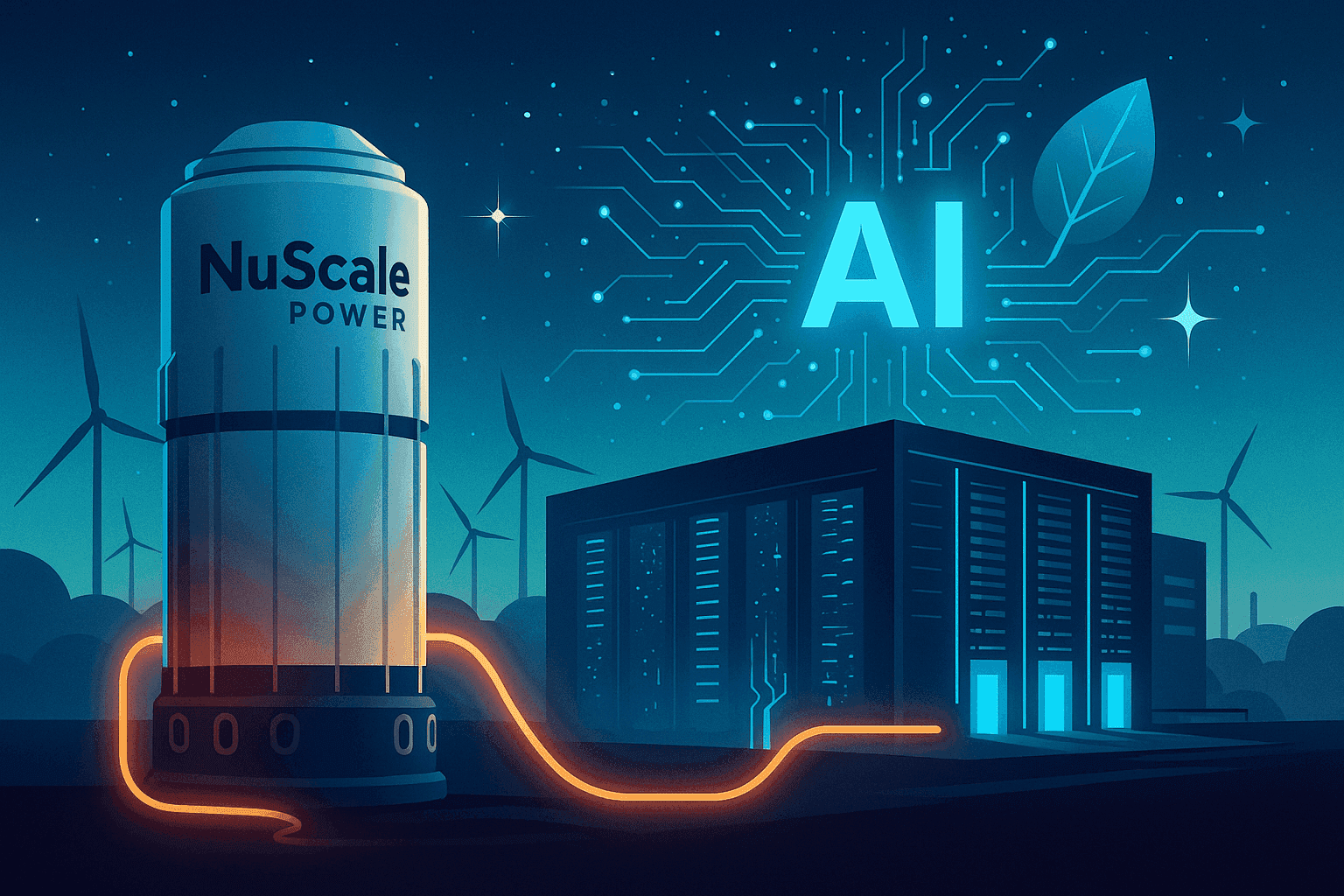
NuScale Power (NYSE: SMR) is currently the only American supplier of Small Modular Reactor (SMR) technology to hold an official Nuclear Regulatory Commission (NRC) certification, with its VOYGR-4 and VOYGR-6 modules approved in May 2025. With a market capitalization estimated at around $13 billion and reactors not yet operational, NuScale is often compared to Nvidia... but in the energy sector.
The Surge in AI Data Center Energy Demands
According to recent projections, global data center energy consumption could triple by 2030, reaching around 176 GW—the equivalent used by 100 million American households. Faced with this demand, tech giants—Microsoft, Google, AWS, Oracle—are actively exploring SMRs as a reliable, local, and carbon-neutral source.
SMR Technology: Passive Safety and Modularity
NuScale reactors operate without active pumps: using a self-regulating natural convection loop that can shut down and cool itself without intervention. Their emergency zone (EPZ) is reduced to the site itself—a first enabled by NRC certification—making it easier to install them near data centers.
Projects in Development and Strategic Partnerships
NuScale has signed two SMR projects with Standard Power in Ohio and Pennsylvania to deliver nearly 2 GW of clean power for data centers via 24 modules of 77 MWe each. Internationally, the company is involved in projects in Poland (with KGHM) and Romania (Doicești site) planned for 2026–2029.
Cost Analysis, Funding, and Criticism
The flagship Carbon Free Power Project (600 MWe) for Idaho was canceled in November 2023 after estimated costs doubled—from $3.6 billion to $9.3 billion—despite $1.355 billion from the DOE and a $30/MWh IRA subsidy. The leveled cost of production (LCOE) becomes profitable only with public subsidies; otherwise, it remains much higher than the traditional energy mix. Over $1.5 billion has recently been raised by players like NuScale, Oklo, X-Energy, or Newcleo, while Google, Microsoft, and Amazon are multiplying partnerships in the field. Some analysts, like Josh Wolfe (Lux Capital), believe the phenomenon is more about marketing than genuine industry disruption in the short term.
Regulatory Risks and Legal Hurdles
Startups and several U.S. states have filed legal actions against the NRC, arguing its uniform requirements for SMRs are too restrictive and stifle local innovation. The slow pace of licensing procedures remains a major barrier to the rapid deployment of these technologies, despite bipartisan support for advanced nuclear energy.
Advantages vs. Risks: Comparative Analysis
Key Advantages | Risks and Limitations |
|---|---|
Unique SMR design approved by the NRC (USA) | Very high construction costs & extended timelines |
Passive operation, enhanced safety | Economic viability depends on subsidies |
Local, carbon-neutral, modular solution | Digital sector still emerging: risk of client/market dependence |
Big Tech interest in powering energy-hungry AI | Regulatory barriers & local public opposition |
Key Issues to Watch
- The evolution of LCOE after subsidies
- The conversion of non-binding agreements into firm contracts
- The impact of legal challenges against the NRC
- The pace of the first commercial deployments in the US and abroad
In Summary
NuScale Power is a bold bet at the intersection of modular nuclear and the AI revolution. While its technology and partnerships position it as a potential future catalyst for clean energy, technical, economic, and regulatory challenges remain significant and could delay or undermine its rollout.
The IVT Team
July 26, 2025