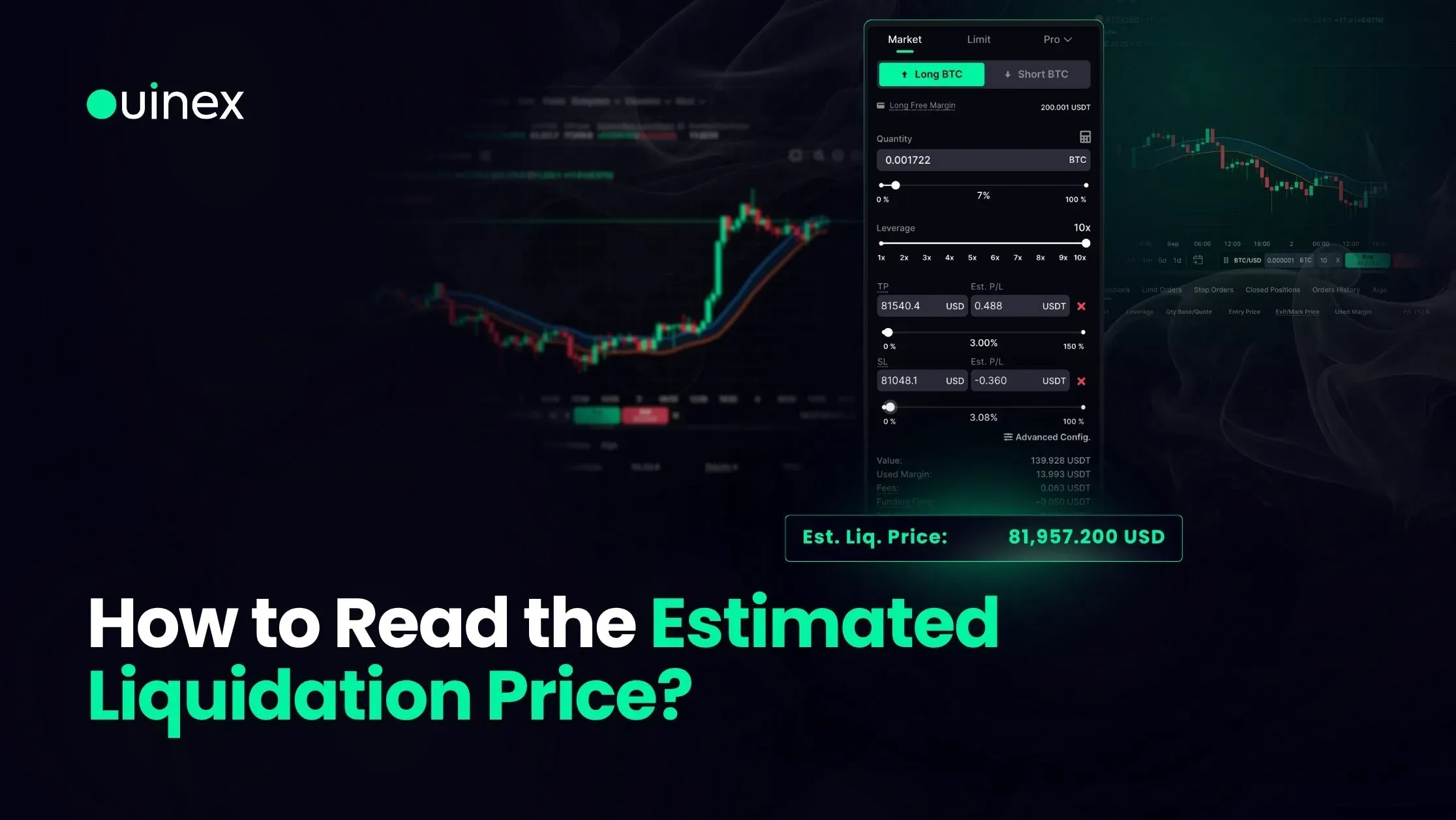
That placement is the feature. A liquidation price you can only see after entering a position tells you what you have done. A liquidation price you can see while adjusting the leverage slider tells you what you are about to do, at the one moment when changing your mind is free.
Watch the walkthrough: How to Read the Estimated Liquidation Price on Ouinex
What a liquidation price is
Liquidation is the point at which your position no longer has enough margin behind it to stay open, and the platform closes it automatically. It is not a penalty and it is not discretionary. It is the mechanical consequence of the account's margin falling to the level where the position can no longer be supported.
The liquidation price is the market price at which that happens. On a long position it sits below your entry; on a short, above it. How far away it sits is set by your leverage, your position size, and the margin available in the wallet.
The word estimated is doing real work in the label and should not be read as a formality. The figure moves with your unrealised P&L, with funding, and with anything else that changes the margin available to the position. It is an accurate picture of where you stand right now, not a fixed line that has been promised to you.
The detail that makes this number different
Ouinex calculates the estimate against your entire wallet, not the order in isolation, so it accounts for margin already committed to your other open positions.
This matters more than it sounds. If you are already holding two positions and you open a third, the third position's real liquidation price is not the one it would have had in an empty account, the margin supporting it is whatever is left after the first two have taken theirs. A per-order calculation would show you a comfortable number and a wallet-level calculation shows you the true one.
The practical consequence: as you open more positions, the liquidation prices of all of them tighten. Adding a position does not simply add risk, it concentrates it. This is the mechanism behind accounts that survive four trades and then lose all five at once, the fifth position moved the liquidation prices of the other four closer to the market, and one adverse move took everything.
If you trade several positions at a time, check the estimate on the new order and remember that the existing ones have also just changed.
Watching it move with leverage
The most useful thing to do with this number is to drag the leverage slider and watch it respond.
Higher leverage brings the liquidation price closer to the current market price. Lower leverage pushes it further away. That is a more concrete way to understand what leverage actually does than any explanation of margin ratios, because it converts an abstract multiplier into a price on the chart, a price you can compare against where the instrument has traded this week.
The question to ask is not "how much leverage do I want?" but "is this liquidation price inside the range this instrument moves in normally?" If the estimate sits closer to the market than the instrument's ordinary daily range, the position will very likely be liquidated by routine movement rather than by being wrong about direction. That is a sizing problem, and it is visible before you confirm.
A liquidation price is not a stop loss
They are easy to conflate and they are opposites in intent.
A stop loss is a level you choose, to exit a trade that is not working, at a loss you decided you could accept. A liquidation is a level the margin maths chooses, to close a position that can no longer be supported, typically at close to the maximum loss the position can produce.
Reaching your liquidation price means your risk management never engaged. The estimate is useful precisely because it lets you place a stop well in front of it, and if there is no sensible place to put a stop that is comfortably clear of the liquidation price, the position is too large. That is the actual signal this feature gives you.
Reading the figure sensibly
It is not a floor. In a fast market or across a gap, a position can be closed at a price beyond the estimate. The estimate tells you where the mechanism triggers, not where the fill lands.
It moves. Unrealised profit pushes it away; unrealised loss and funding charges pull it closer. A liquidation price that looked comfortable at entry can be much closer three days later without the position having changed at all.
It assumes nothing else changes. Open another position, withdraw funds, or let funding accumulate, and it moves again.
None of that makes the number less useful. It makes it a live reading rather than a guarantee, which is what any margin figure is.
FAQ
What is an estimated liquidation price? The market price at which a leveraged position would be closed automatically because the margin supporting it has fallen to the minimum required level. On Ouinex it is shown in the order summary before you confirm the trade, and it updates as you change quantity or leverage.
Why does my liquidation price change after I open the position? Because it is calculated from the margin currently available, which moves. Unrealised profit increases the margin behind the position and pushes the liquidation price further away; unrealised losses and funding charges pull it closer. Opening another position also moves it, since the two now share the same wallet margin.
Does Ouinex calculate liquidation price per order or per wallet? Per wallet. The estimate takes your entire wallet into account, including margin already committed to other open positions, so it reflects your real exposure rather than the position in isolation.
Can I be liquidated at a worse price than the estimate? Yes. The estimate is where the liquidation is triggered, not where the position is filled. In a fast market or across a gap between sessions, the closing price can be beyond it.
How do I move my liquidation price further away? Reduce leverage, reduce position size, or add margin to the wallet. Reducing leverage before confirming is the simplest, watch the Est. Liq. Price line respond as you adjust the slider.
The bottom line
The estimated liquidation price is the cheapest risk check on the platform because it costs nothing and happens before the trade. Use it as a sizing test rather than a statistic: if the estimate sits inside the instrument's normal weekly range, the position is too big regardless of how confident you are in the direction. Remember that it is calculated across your whole wallet, so every position you add moves the others. And treat it as a floor you never want to approach, not a backstop you can rely on, a stop loss placed well in front of it is what actually protects the account. The estimate is live now on every derivatives order form on Ouinex.