Artificial intelligence is driving markets in 2026. But buying "AI" as a whole doesn't mean anything, and doing it at the top, in FOMO mode, without knowing what you really own, is dangerous.
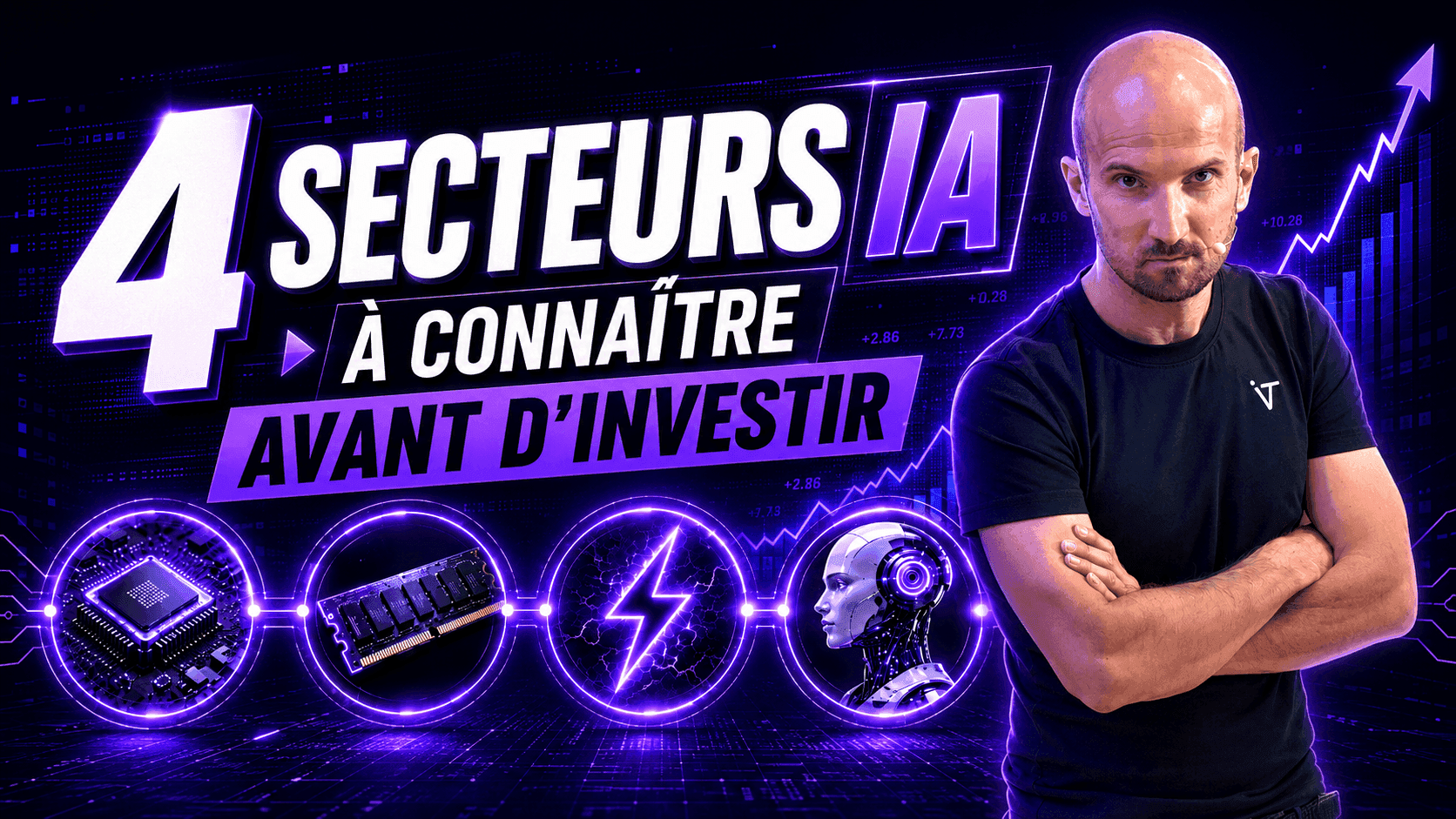
This article gives you a simple framework: 4 pillars, each with its ETF, 3 stocks per pillar, and the rule to guide each of your entries. There's also a complete video at the bottom if you want to dig deeper into the topic.
Two ways to approach each pillar, and they complement each other:
- The ETF, to capture an entire sector without the risk of picking the wrong stock.
- 2 or 3 leading stocks, to seek higher returns—with more risk.
For each pillar, you’ll find the why, the tool, the key stocks to watch, and a technical area to monitor for entry.
Pillar 1: Compute, the Brains of AI
No model trains or runs without raw computing power. This is the foundation absorbing most of the $750 billion capex from cloud giants this year. Global semiconductor sales are targeting a near-record $975 billion in 2026, half of it for AI.
ETF: SMH (VanEck Semiconductor). 0.35% fees, only 26 holdings, top 10 around 70%, capitalization-weighted. A concentrated fund, a clear bet on leaders. Up over 64% since January.
Stocks to watch:
- Nvidia: GPUs and the CUDA ecosystem, over 80% of the data center chip market.
- Broadcom: Custom chips and the network that connects thousands of chips together.
- TSMC: The foundry producing nearly all advanced AI chips, up around +100% in a year.
Nvidia is consolidating, about 17% off its May peak, and momentum has shifted to foundries. Look to buy on pullbacks, using the 20-week moving average as a trend marker for well-performing stocks.
Pillar 2: Memory and HBM, the Star of 2026
A powerful chip is useless if it's not fed with data fast enough. High-bandwidth memory has become the real bottleneck, with margins of 60–70%—unheard of in this segment. Micron has signed 16 firm contracts through 2030, securing $22 billion: revenues are getting predictable, which changes everything for valuation. As a side effect, there's a shortage affecting smartphones and PCs, with smartphone market expected to drop 13% this year.
ETF: ARTY (iShares Future AI & Tech). Not a pure memory fund, but the best access to the memory cycle. 0.47% fees, about 70 holdings, top 10 around 50%, each stock capped at 6%. Up over 52% since January.
Stocks to watch:
- Micron: Only US manufacturer of HBM and DRAM, at the heart of the shortage. Close to +700% in a year.
- SK Hynix: Global leader in HBM, main supplier to Nvidia.
- Seagate: Storage, boosted by the same bottleneck, around +550% in a year.
This is the hottest segment, and also the most volatile: on June 23, it lost 13% in a single session before rebounding within days. Never buy the green candle—wait for pullbacks, ideally to the 20-week moving average, or the 50-day moving average if the stock is active.
Pillar 3: Energy, the Real Brake on AI
The real brake for AI is not the chip—it's power. Grid connection queues exceed 2,100 GW, and 30–50% of planned data center capacity for 2026 may be pushed to 2028 for lack of available electricity. Hence "bring your own power": cloud giants are now producing their own energy and reviving nuclear, with 20-year contracts.
ETF: AIPO (Defiance AI & Power Infrastructure). 0.69% fees, about 80 holdings, cap-weighted, with half of the fund in energy production and network equipment. Up over 45% since January.
Stocks to watch:
- GE Vernova: Turbines, transformers, and grid. Record order book of $18.3 billion in Q1 (+71%), turbines 90% booked through 2030. Over +200% in a year.
- Constellation: Nuclear, signing long-term contracts with hyperscalers.
- Vertiv: Cooling, central to data center operations. Watch the $280 weekly zone.
This is a strong long-term trend, but these stocks have already seen big runs. Pullbacks toward the 20-week moving average remain the area to watch for building a position.
Pillar 4: Robotics, Tomorrow’s Bet
After AI on our screens comes AI in the real world. When AI can see, move, and manipulate, it enters factories and warehouses. Jensen Huang talks of a $40 trillion market. Bank of America sees humanoid deliveries going from 20,000 units in 2025 to 10 million in 2035.
This is the most speculative and long-term pillar: true pure-play leaders like Figure or Unitree are still private, and China is leading the race.
ETF: KOID (KraneShares), the first US humanoid ETF. 0.69% fees, 50 equal-weighted holdings, rebalanced quarterly, 2–2.7% per stock. Equal weighting avoids betting everything on a single name—logical for such a young theme. Up more than 29% since January.
Stocks to watch:
- Tesla: The Optimus robot, the only directly listed humanoid bet.
- Nvidia: The brain and software platform powering these robots.
- MP Materials: The rare earths for magnets and motors. A humanoid contains 2–3 times more than an electric car.
On this pillar, build positions slowly and for the long term, accepting volatility. The ETF is often wiser than stock picking in such a new theme.
Leadership Has Already Shifted Within the Theme
Nvidia is almost flat since January. Micron is nearing +700% in a year. GE Vernova is over +200%. In other words, "buying AI" is no longer enough. Outperformance has shifted to bottlenecks—memory and energy—not to the sector king. You need the right link, at the right time.
The 3 Risks to Keep in Mind
- Stretched valuations and already full order books. The market has already priced in growth. Now, results must be delivered, and even slight disappointments are punished. Broadcom plunged in early June on a guidance seen as just a bit too cautious.
- Record concentration. The Magnificent 7 make up about 33% of the S&P 500, the top 10 over 40%, and tech 37.5% of the US market—more than at the top of the dot-com bubble. You may think you’re diversified—you may not be.
- Memory rises fast and can fall fast. South Korea’s giant bet already raises fears of oversupply if AI capex slows.
The Golden Rule: How to Enter Without Getting Caught
Never go all-in at the current price. Never. Wait for pullbacks toward key levels. For many of these stocks, the 20-week moving average is a trend reference: as long as the price stays above it, the long-term trend is healthy, and pullbacks often offer better entries.
And split your entries. Build a position in several steps, keep some cash for volatility. Because there will be volatility. There will always be entry points.
Don’t repeat the Bitcoin bought at $20,000 out of FOMO, then sold at $3,000 in panic. The problem wasn't Bitcoin—it was owning an asset you didn’t understand.
Know what you own. Enter incrementally. Define your time horizon. The rest will follow.
The Full Video
https://www.youtube.com/watch?v=QXKjOzUi9dM
The video is 40 minutes long, but it's the most concrete, detailed, and concise format to explore each of the 4 pillars, with additional ETFs not covered here.
This is educational content, not personalized investment advice. Always do your own research before investing.